
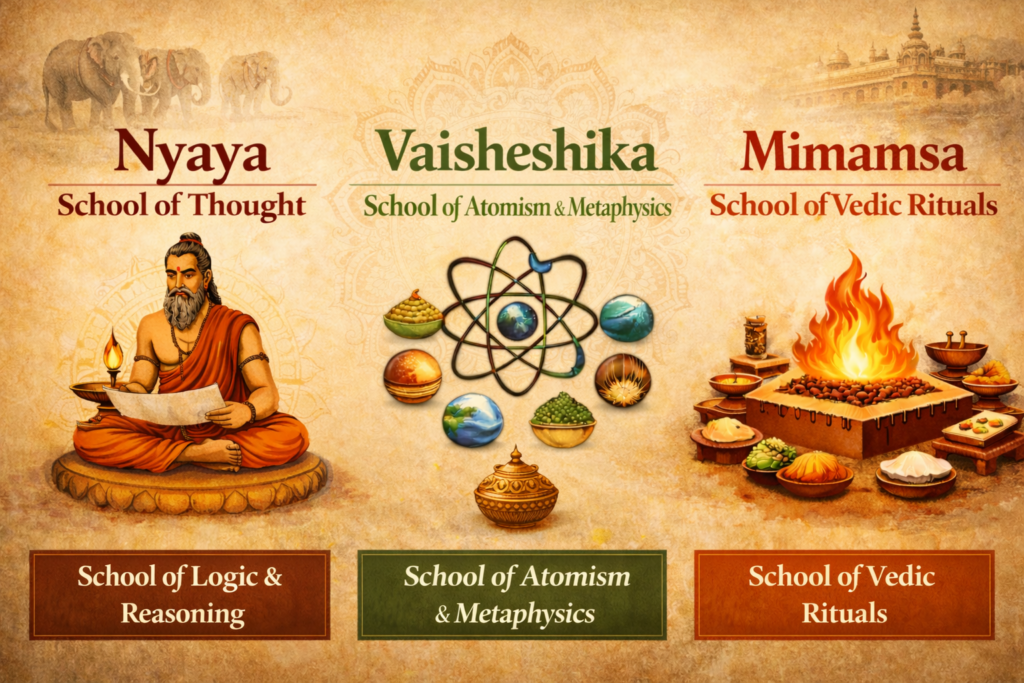
Nyaya, Vaisheshika and Mimansa are the most underexplored schools of Indian philosophy — and the ones that reveal the most surprisingly modern insights about how consciousness actually works.
| न्याय – Nyaya | वैशेषिक – Vaisheshika | मीमांसा – Mimamsa |
| Right Reasoning | Atoms & Categories | Deep Investigation |
| The careful scientist at a desk saying “prove it step by step.” Precision. Logic. The most detailed analysis of how consciousness actually functions. | The scientist who asks — what is the universe actually made of? And arrives at the conclusion: consciousness is as fundamental as atoms. | The practitioner who says — consciousness is self-luminous, and its highest expression is not withdrawal from the world, but selfless action within it. |
| Part One Nyaya — The School That Proved God Through Consciousness |
How Awareness Actually Works — Step by Step
| Step 1 | Step -2 | Step -3 | Step- 4 | Step- 5 |
| 🍎 | 👁 | 🔀 | ✦ | 🪞 |
| Object | Sense Organ | Mind — Manas | Soul Cognizes | Anuvyavasaya |
| The apple exists — real, physical, independent | Eyes receive reflected light from the apple | Inner organ organizes and categorizes sense data | Soul becomes aware: “there is a red apple” | Knowing that you know — consciousness of consciousness |
The Four Sources of Valid Knowledge
Nyaya’s most important contribution is its theory of Pramanas — valid sources of knowledge. It asks a question no other school asked as precisely: how do we know our awareness is giving us accurate information about reality?
| Pramana 1 | Pramana 2 |
| Pratyaksha | Anumana |
| DIRECT PERCEPTION | INFERENCE |
| Awareness through direct sensory experience. Nyaya divides this into Nirvikalpa — raw, unprocessed awareness before the mind labels it — and Savikalpa — processed, conceptual awareness where you recognize what you perceive. This maps precisely onto the distinction between pure awareness and full self-reflective consciousness. | You see smoke on a distant hill. You cannot see the fire. But you infer — “where there is smoke, there is fire.” Consciousness operating through logic — connecting what is directly perceived to what is not directly perceived. A theory of inference as sophisticated as Aristotle’s. |
| Pramana 3 | Pramana 4 |
| Upamana | Shabda |
| COMPARISON | TESTIMONY |
| Awareness through analogy and similarity. Someone tells you “a gavaya looks like a cow.” Later you see the animal and recognize it. Your consciousness of the new used stored knowledge of the familiar. Recognition as a distinct valid mode of knowing. | Awareness through the words of a reliable, trustworthy source. You have never been to Antarctica — but you know it exists because reliable sources have told you. Nyaya carefully analyzed what makes a source trustworthy and developed precise criteria for evaluating this as a valid source of knowledge. |
Nyaya’s Precise Map — Awareness vs Consciousness
| Awareness — Nirvikalpa | Consciousness — Anuvyavasaya |
| Raw, pre-conceptual perception The soul simply receiving information through the senses and mind. Pure noticing — without labeling, without self-reference. You experience something before you know what it is. The sensation before the concept. | The cognition of cognition Not just knowing the apple — but knowing that you know the apple. The mind reflecting back on its own activity. Self-referential consciousness — awareness that is aware of itself. One of the most sophisticated analyses in all of philosophy, East or West. |
| Part Two Vaisheshika — The Atomic Theory That Found Consciousness Fundamental |
Vaisheshika — founded by the sage Kanada (“atom eater”) — was the most scientific and materialist-leaning of all Indian philosophical schools. It proposed that the universe is made of eternal, indivisible atoms — centuries before Democritus in Greece. And yet it arrived at deeply spiritual conclusions about consciousness.
Among its nine fundamental substances — alongside earth, water, fire, air, and space — Vaisheshika lists Atman (soul) and Manas (mind) as equally fundamental. Consciousness is not a byproduct of matter. It is a basic feature of reality.
The Crystal Analogy — Vaisheshika’s Most Beautiful Insight
Think of a pure, transparent crystal. It has no color of its own. But when you place a red flower next to it — the crystal appears red. Place blue cloth — it appears blue. The crystal’s transparency is its true nature. The color is borrowed — arising from contact. In Vaisheshika: the soul is like the crystal — pure, transparent. Consciousness is like the color — arising when the soul comes into contact with the mind. Awareness is the specific color at any given moment — what arises when mind meets specific sense objects.
The Six Categories — Where Consciousness Fits in Reality
| Dravya SUBSTANCE | Consciousness has a home — the soul. Soul and mind are as fundamental as atoms. Without substance, there is no consciousness. Reality is not made of one thing — it is made of nine distinct fundamental substances. |
| Guna QUALITY | Consciousness and awareness are real qualities — not illusions. Cognition, pleasure, pain, desire — these are genuine properties of the soul. Not more real than atoms, not less real. Just a different category. |
| Samavaya INHERENCE | Consciousness inheres in the soul — it belongs to it inseparably when the soul-mind connection is active. This inseparable belonging relationship is what makes consciousness real and not merely apparent. 2,500 years ago — the same insight that modern neuroscience is rediscovering: consciousness is not a thing sitting in the brain — it is what happens in dynamic relationships between systems. |
| Part Three Mimamsa — Consciousness Is Self-Luminous and Lives in Action |
The Most Surprising Answer
Mimamsa is the most unusual and surprising of the three. While Advaita says “realize you are Brahman” and Jainism says “remove karma through discipline” — Mimamsa says: the highest expression of consciousness is right, selfless, dutiful action in the world. Not withdrawal. Not meditation in a cave. Action.
Svayamprakasha — The Self-Luminous Nature of Consciousness
Kumarila Bhatta — the greatest Mimamsa thinker — asked: when you see a lamp, the lamp illuminates other objects. But what illuminates the lamp itself? Another lamp? And what illuminates that lamp? This is an infinite regress. Consciousness solves this problem by being self-illuminating. It lights itself up. It does not need another consciousness to be aware of it. This is Svayamprakasha — the self-luminous nature of consciousness.
Consciousness is the light. Awareness is what that light illuminates. The light does not need another light to be seen. But everything else needs the light to be seen at all.
Two Kinds of Awareness — Mimamsa’s Most Practical Insight
| Svasamvedana | Vishayasamvedana |
| SELF – AWARENESS | OBJECT – AWARENESS |
| The awareness you have of your own inner states — your thoughts, feelings, intentions, desires. Consciousness turned inward. Knowing your own knowing. Most people have almost none of this. | The awareness you have of the external world — objects, people, duties, relationships. Consciousness turned outward. Most people have too much of this — and it fills all available space. |
The spiritually developed person — for Mimamsa — has both operating simultaneously and harmoniously. The source of most human suffering is having plenty of object-awareness (obsessed with the outer world) but almost no self-awareness. The Mimamsa spiritual project is developing Svasamvedana so that your actions in the world become truly conscious, truly free, and truly aligned with Dharma.
The Three Schools Side by Side
| Question | Nyaya | Vaisheshika | Mimamsa |
|---|---|---|---|
| What is consciousness? | A produced quality arising from soul-mind-sense contact | A relational quality arising in the soul-mind relationship | A self-luminous knowing — the light that illuminates all experience |
| What is awareness? | Raw, pre-conceptual perception — Nirvikalpa | Quality arising from mind-sense contact | Directed, object-focused knowing — always paired with self-awareness |
| Is the soul conscious? | No — soul is unconscious alone | No — consciousness is a contact quality | Yes — the soul has inherent self-luminous consciousness |
| What is liberation? | Cessation of suffering through right knowledge | Soul existing beyond produced qualities | Selfless action in full alignment with eternal Dharma |
| Key gift | Most precise theory of how awareness works | Most scientific — consciousness as fundamental as atoms | Most practical — consciousness expressed through selfless action |
Three Professors — One Fire
The Nyaya Professor
“Let me first establish that fire is real through valid perception. Then let me logically prove its properties through inference. Fire is hot — this is a quality. Fire burns — this is an action. Now I can tell you precisely what fire is and how we know it.” — Understanding consciousness through precision.
The Vaisheshika Professor
“Fire is Tej — one of the nine fundamental substances of reality. It has specific qualities — color, heat, luminosity. Here is the complete scientific map of fire.” — Locating consciousness within the structure of reality itself.
The Mimamsa Professor
“Fire’s self-luminous nature is the best analogy for consciousness itself — it lights itself and everything around it. Now — knowing fire’s nature — use it correctly, in the right place, at the right time, for the right purpose. Right knowledge must become right action.”
What These Three Schools Complete
Advaita told you — you are the ocean. Jainism told you — you are a diamond. Bhakti told you — you are a spark of divine love. Now these three schools add something equally important and more immediately useful:
Nyaya: “Understand clearly how your awareness actually works — step by step — so you stop being deceived by false knowledge.” Vaisheshika: “You are a real, individual soul — as fundamental to this universe as atoms and space.” Mimamsa: “Your consciousness is most fully itself when you act rightly, selflessly, and with complete awareness — right here, right now, in the life you already have.”
You are the ocean. You are the diamond. You are the spark. You are the sky. And you are also — right now — a conscious, aware, reasoning, acting being — with the extraordinary gift of awareness to navigate it all. 🙏

Hina is the founder of BrowsingIndia, a platform dedicated to making Indian philosophy, epics, and consciousness-related ideas accessible to curious readers. A computer engineer by profession, her lifelong passion for Indian scriptures led her to pursue a Master’s in Hindu Studies, and she is currently a PhD research student in the same field. Her writing is grounded in close reading of primary texts and respected scholarly sources.