
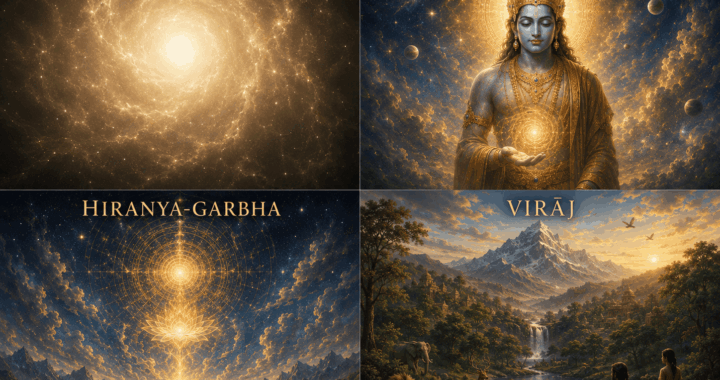
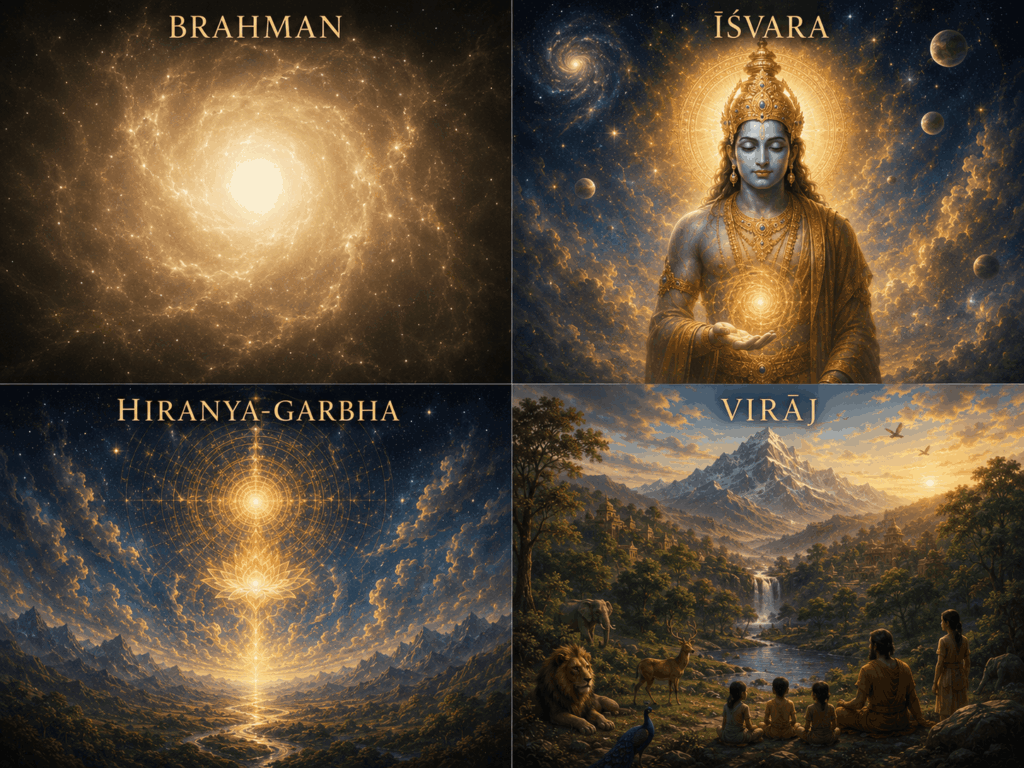
Brahman, Ishvara, Hiranya-Garbha, Viraj — four simultaneous faces of one reality. Every tradition that looked deeply enough found this same structure. And behind all four — something no word can touch.
Bahva (ऋषि बाह्व) was asked three times to explain the nature of Brahman. Three times he said nothing. Finally his student protested. And the teacher spoke only this: “I am teaching — but you do not follow. The self is silence.”
Brahma Sutra Commentary · Referenced by Shankaracharya
The Question the Mind Cannot Answer
There is a particular kind of question that stops thinking rather than starting it. Not because it is unanswerable — but because the answer exists in a dimension that thinking cannot enter.
“What are the four states of consciousness in Hinduism?” is one way to ask it. “What is Brahman?” is another. Both point at the same wall.
You can approach it from a hundred angles. You can read every Upanishad, master every philosophical system, memorise every Sanskrit term. And at the end of all that reading — if you are honest — you will find yourself standing at the same threshold Bahva stood at. The tongue turns back. The mind fails. And what remains is not confusion. It is something closer to awe.
But here is what Indian philosophy does that is extraordinary. It does not stop at the silence. It maps everything that leads up to the silence with extraordinary precision — including the four states of consciousness that Hinduism describes as the complete structure of reality. And then — having drawn the map — it says: now put the map down. The territory is not the map.
This blog is the map. The most important part will be knowing when to put it down.
Table of Contents
What Radhakrishnan Concludes
The Upanishads give us four simultaneous faces of one reality — not a ladder from low to high, but four ways of seeing the same diamond from four different angles. Miss any one of the four states and the picture is incomplete.
The Mandukya Upanishad says Brahman is catus-pat — four-footed. The Taittiriya Upanishad pictures it as a nest from which three birds have emerged. Radhakrishnan, reading these texts alongside Plotinus, Plato, and the Tao Te Ching, distils the same fourfold structure that every deep tradition independently arrives at.
These four states of consciousness in Hinduism are not four different beings. They are not four levels of a hierarchy with the physical world at the bottom and God at the top. They are four simultaneous faces of one reality — always co-present, always interpenetrating, separable only in appearance.
The Four States of Consciousness in Hinduism — Radhakrishnan · Principal Upanishads
Face One
Brahman
The Absolute · Nirguna · Beyond All
Pure, formless, beyond all qualities and descriptions. The ground of all existence. Neither being nor non-being. Neither light nor darkness. Not this, not this. Known only in silence. The ocean before any wave has risen.
Face Two
Īśvara
The Personal God · Creative Freedom
Brahman’s free creative expression. Not compelled to create — choosing to create, from the overflow of its own delight. The Absolute moved into creative will. The artist who does not need to paint — and paints anyway, for the joy of it.
Face Three
Hiranya-garbha
The World-Soul · The Golden Womb
The cosmic blueprint. The first ripple on the infinite ocean. The seed containing every form that will ever unfold in the universe. The spirit moving everywhere through creation — present in every atom, every cell, every mind, as its innermost organising principle.
Face Four
Virāj
The Manifest World · Matter · You
The physical universe. Stars, planets, bodies, thoughts, relationships, suffering, joy. Not the lowest rung of a ladder — but Brahman at its most contracted, most apparently dense. No less Brahman for being contracted. The wave is not less ocean for being a wave.
The Svetasvatara Upanishad makes the fourth of these states unmistakable. It says Brahman is beast, bird and insect, the tottering old man, boy and girl. Not symbolically. Literally. The physical world — in all its ordinary, unglamorous, sometimes painful reality — is a face of the Absolute. Matter is not an obstacle to the spiritual life. Matter is the spiritual life in its most contracted form.
Sat, Chit, Ananda — The Nature Behind All Four States
Having mapped the four states of consciousness in Hinduism, Radhakrishnan asks the deeper question: what is the essential nature of Brahman itself — behind all four faces? The Upanishads give three words. And then immediately clarify: these are not three qualities. They are three ways of saying the same one thing.
Sat
Pure Being
Not existence as a quality. Existence itself. That which simply is — without cause, without condition, without beginning or end. Absolute being in which there is no nothingness.
Chit
Pure Consciousness
Not a mind that knows things. Knowing itself. The light that illuminates without needing to be illuminated. Absolute consciousness in which there is no non-consciousness.
Ānanda
Pure Bliss
Not pleasure or happiness as we know them. The natural condition of consciousness when it rests in itself without encountering a second. Absolute bliss in which there is no suffering or negation.
That last phrase is the most important. Radhakrishnan writes with precise philosophical care: “All suffering is due to a second, an obstacle.” The moment you experience yourself as a separate being in a world of other separate beings — suffering becomes structurally inevitable. Because now there are things that can threaten you, oppose you, leave you, end.
Liberation — moksha — is not the acquisition of bliss from somewhere outside. It is the removal of the false experience of a second. The bliss was always already there. It was simply obscured by the belief in separation. This is why the Upanishads do not say “you will become Brahman.” They say: you are Brahman — and the only question is whether you know it.
Imagine a mirror that has been dusty for so long that it has forgotten it is a mirror. It thinks it is a grey, dim, opaque thing. The spiritual path is not adding brightness to the mirror. It is removing the dust. The mirror’s nature — to reflect pure light — was never lost. It was only temporarily obscured. Sat-Chit-Ananda is not a destination. It is what you already are, under the dust.
Every Tradition Found the Same Four States
This is perhaps the most quietly radical thing Radhakrishnan does. He does not treat the four states of consciousness in Hinduism as one tradition’s private philosophical property. He shows, systematically, that every deep tradition — when it goes far enough — arrives at the same fourfold structure, the same ineffable Absolute, the same recognition that the individual is rooted in something universal.
This is not coincidence. This is what always happens when consciousness turns to look at itself without flinching — in any century, in any language, without any prior commitment to arriving at a particular answer.
The Same Truth · Different Windows
Upanishads · India
Brahman is non-dual, all-inclusive, the ground of all being. It is Sat, Chit, Ananda. The self is silence. Neti, neti — not this, not this.
Plotinus · Greece
The One — simple, unconditioned, beyond all predication. Below it: the Nous (Divine Mind), the World-Soul, and the Many. The same four levels. The same ineffable summit.
Tao Te Ching · China
“One may think of it as the mother of all things. Its true name we do not know — Tao is the by-name we give it.” Something formless yet complete, without sound, without substance, all-pervading.
Meister Eckhart · Christianity
“God and Godhead are as different as heaven from earth.” The Godhead — beyond God, beyond being, beyond all names — is the same silence the Upanishads point toward. “None will have missed me; God passes away.”
Rumi · Sufism
“I died a mineral and became a plant, I died a plant and rose an animal, I died an animal and I was man.” The same evolutionary arc of consciousness — the same return to the source from which nothing is ever truly separate.
Paul · Christianit
“O Lord, My God, the Helper of them that seek Thee — I behold Thee in the entrance of Paradise, and I know not what I see, for I see naught visible.” The same threshold. The same failure of language. The same awe.
The Convergence Is the Evidence
When a Greek philosopher, an Indian sage, a Chinese poet, a Christian mystic, and a Sufi master — with no knowledge of each other — describe the same four-layered reality in different words — that convergence is not cultural borrowing. It is independent verification. Consciousness, wherever it looks at itself long enough, finds the same thing.
The Teacher Who Said Nothing
The Most Important Story in These Pages
Bahva was asked by his student Bashkali to expound the nature of Brahman. The teacher was silent. The student asked again. Still silence. A third time — and the teacher finally spoke:
“I am teaching — but you do not follow. The self is silence.”
Referenced in Shankaracharya’s commentary on the Brahma Sutra
This story is not an evasion. It is the most precise teaching possible.
Every word you use to describe Brahman turns Brahman into a thing. And Brahman is not a thing. It is that from which all things arise. The moment you say “Brahman is X” — you have already made Brahman into an object of thought. And Brahman is not an object of thought. It is the ground of the thinker.
Radhakrishnan quotes the Upanishad directly: Brahman is “that from which our speech turns back along with the mind, being unable to comprehend its fullness.” This is not mystical evasion. It is epistemological precision. The eye cannot see itself. The hand cannot grasp itself. And the mind cannot think the ground of thinking.
“The knowledge of it is deep silence and the suppression of all the senses.”
Hermes Trismegistus · quoted by Radhakrishnan
What the silence points toward is not emptiness. It is the fullness that precedes all description — Sat, Chit, Ananda — being, consciousness, bliss — too complete, too whole, too present to be captured in any single frame of language.
This is why the Upanishads use both the way of negation (neti, neti) and the way of affirmation (Satyam, Jnanam, Anantam). Neither is complete alone. Negation without affirmation leaves you with nothing. Affirmation without negation leaves you with an idol — a concept you have mistaken for the real. The two together — relentlessly stripping away what Brahman is not, while pointing toward what it is — create the conditions in which the mind, exhausted and emptied, might finally fall silent. And in that silence — recognition.
At last.. The Four States of Consciousness — What They Mean for You
Let us bring the four states of consciousness in Hinduism down to the most personal level possible. Because philosophy that does not touch your actual life is just furniture in a room nobody lives in.
You are Viraj — the fourth state. The manifest world. A specific body, a specific mind, a specific history. This is real. This is not illusion in the dismissive sense. The physical world — including everything difficult and painful and confusing about your life — is Brahman at its most contracted. No less real for being contracted. No less sacred for being material.
And simultaneously — right now, in this very moment — you are also Hiranya-Garbha. There is a principle within you that organises, that seeks coherence, that reaches toward meaning. The part of you that has ever felt drawn toward truth, beauty, love — that is the World-Soul expressing itself through your particular nervous system.
And simultaneously — you are also the Ishvara level. There is a creative freedom within you. A capacity to choose, to respond rather than react, to bring something new into the world. That creative freedom is not separate from the divine creativity that produced the universe. It is a local expression of it.
And simultaneously — at the deepest level of your being — you are Brahman. The pure, silent, witnessing awareness reading these words right now. Not the thoughts about the words. Not the feelings that arise. The awareness itself — the simple, undeniable, always-present fact that you know you are here. That awareness has never been born. It will never die. It is the first of the four states — looking out through your eyes.
The Practical Conclusion
You are not a physical being trying to become spiritual. You are all four faces simultaneously — right now, without any practice, without any achievement. The only question is which face you are currently identified with. And identification can shift — not by adding something, but by seeing more clearly what was always already true.
A Question to Sit With
Bahva’s teacher said the self is silence. Not that the self is silent — but that silence itself is the self. If you stopped all inner commentary right now — all the narrating, evaluating, planning — what would remain?
Is that remainder nothing? Or is it the only thing that has never not been here?
More such a deep topics simplified from the Upanishads > Vedanta Simplified
References & Sources
This blog draws primarily from Radhakrishnan’s introduction to The Principal Upanishads and the Mandukya, Taittiriya, and Svetasvatara Upanishads. All positions on the four states of consciousness in Hinduism are grounded in these primary sources.
S. Radhakrishnan · George Allen & Unwin, 1953
Trans. S. Radhakrishnan · The Principal Upanishads
Trans. S. Radhakrishnan
Svetasvatara Upanishad · IV.3–4
Trans. S. Radhakrishnan
Shankaracharya · Referenced in Radhakrishnan · p.67
Note:- All philosophical interpretations are the author’s own synthesis informed by these sources. For deeper reading on the four states of consciousness in Hinduism, the Mandukya Upanishad with Shankaracharya’s commentary is the primary classical text. Radhakrishnan’s The Principal Upanishads provides the most accessible scholarly introduction in English.

Hina is the founder of BrowsingIndia, a platform dedicated to making Indian philosophy, epics, and consciousness-related ideas accessible to curious readers. A computer engineer by profession, her lifelong passion for Indian scriptures led her to pursue a Master’s in Hindu Studies, and she is currently a PhD research student in the same field. Her writing is grounded in close reading of primary texts and respected scholarly sources.