
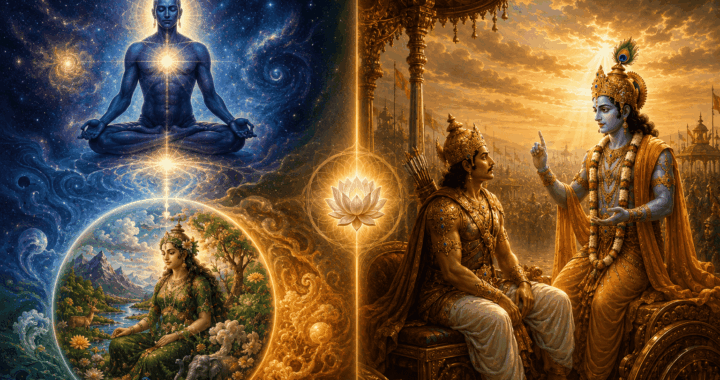
Classical School
Sankhya Philosophy
Kapila · 6th century BCE · Dualistic
Chapter Two · Gita
Sankhya Yoga
Krishna · Kurukshetra · Synthetic
Sankhya philosophy and Bhagavad Gita Chapter Two are called by the same name — Sankhya. They share vocabulary, they share foundational ideas, and yet they arrive at completely different conclusions. Understanding the relationship between Sankhya philosophy and the Bhagavad Gita — where they meet and precisely where they part — is one of the most illuminating things you can do as a student of Indian thought.
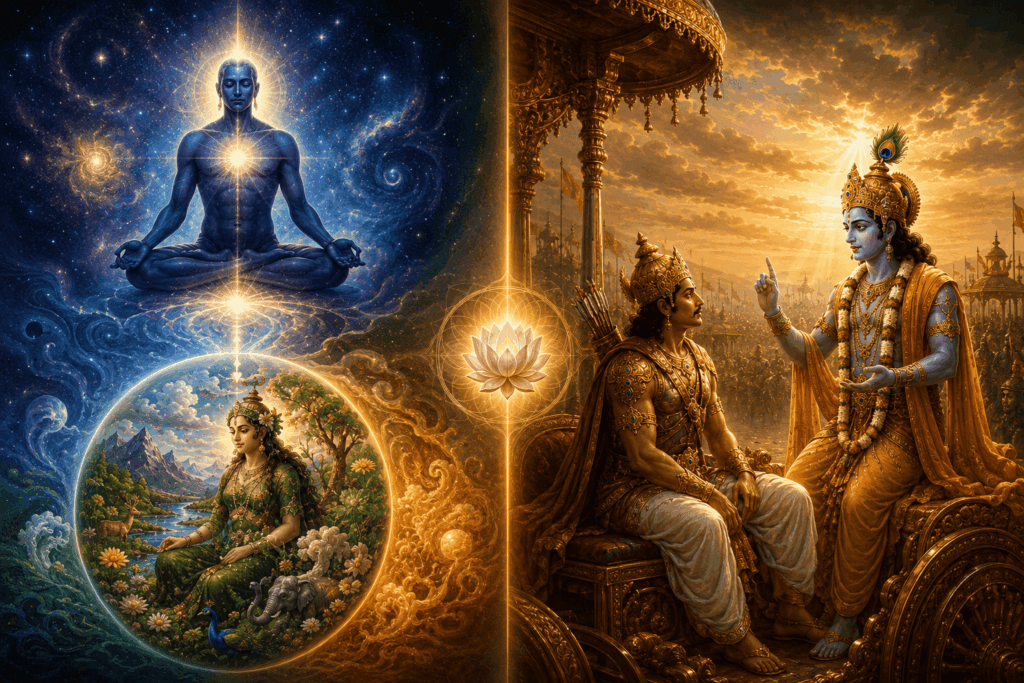
Most introductions to the Gita either treat Sankhya philosophy and Bhagavad Gita’s Sankhya Yoga as identical — which obscures the Gita’s genius — or ignore the relationship entirely, leaving readers confused about why Chapter Two carries the Sankhya name at all. Let us untangle this properly, from the ground up.
Part One · The Classical School
What Is Sankhya Philosophy — Before the Bhagavad Gita?
Sankhya philosophy is one of the six classical darshanas — schools of Indian thought. Its founder is traditionally the sage Kapila, and it is among the oldest systematic philosophical frameworks in the world. Its method is precise, analytical and unsparing — hence the name itself. Samkhya in ancient Sanskrit means simply number or enumeration — the philosophy that counts and names the categories of reality clearly.
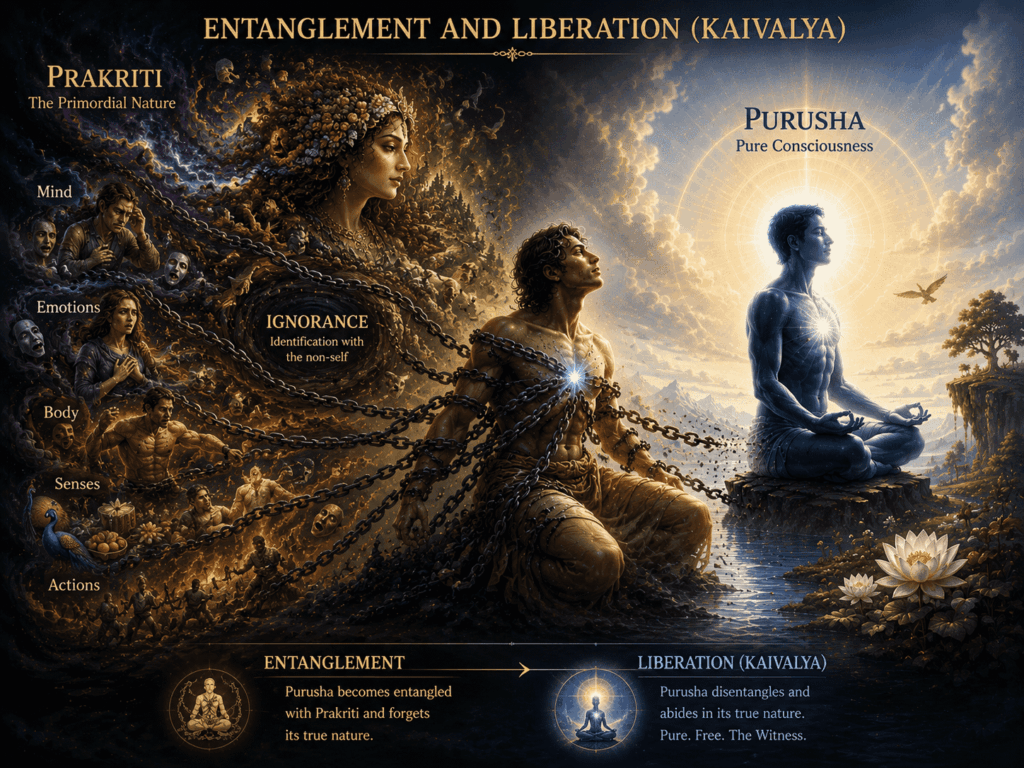
At its heart, classical Sankhya proposes that all of reality is built from exactly two eternal, independent, and fundamentally different principles.
The Two Principles of Classical Sankhya
Purusha
Pure Consciousness
Unchanging, passive, the eternal witness. It does not act. It does not move. It simply is — illuminating everything around it the way a lamp lights a room without itself moving. Purusha is the seer. Never the seen.
Prakriti
Nature · Matter · The Manifest World
Dynamic, ever-changing, made of the three Gunas — Tamas, Rajas and Sattva — in constantly shifting combinations. Everything that can be perceived, including the mind, intellect, ego and senses, is Prakriti.
The Central Problem Samkhya Identifies
Purusha somehow becomes entangled with Prakriti and forgets its own nature — beginning to believe it is the mind, the body, the emotions, the doer. Liberation — Kaivalya — is the moment Purusha completely disentangles and recognizes itself as it always was. Pure. Free. The untouched witness.
One more crucial detail — classical Sankhya philosophy is dualistic. It accepts two ultimate, eternal, permanently distinct realities. Even at liberation, the individual self does not merge with anything greater. It simply recognizes its own complete separateness from Prakriti. There is no God in Sankhya philosophy. No divine creator, no sustainer, no cosmic love story. Purusha and Prakriti are sufficient to explain everything — and that is where the explanation ends. This is the first and most important place where Sankhya philosophy and Bhagavad Gita begin to diverge.
Part Two · Where They Meet
What Is Sankhya Philosophy — Before the Bhagavad Gita?
The word Sankhya — what it meant before Kapila’s school claimed it
In ancient Sanskrit, sankhya simply meant discriminative knowledge — the capacity to see clearly, to distinguish, to analyze reality carefully. Before it became the name of Kapila’s Sankhya philosophy, it referred to any systematic inquiry into the nature of things. When Krishna names Chapter Two Sankhya Yoga in the Bhagavad Gita, he means the yoga of clear seeing — the path of those who approach liberation through knowledge and discrimination rather than through action or devotion alone.
The Bhagavad Gita’s Sankhya Yoga draws heavily from Sankhya philosophy’s vocabulary and framework. The distinction between the eternal Self and the temporary body-mind. The three Gunas and how they shape every experience. The idea of the witness that stands apart from the drama of the world. All of this language and architecture comes directly from Sankhya philosophy.
But Krishna uses this framework to address something Kapila never addressed — a man on a battlefield who cannot move.
Krishna’s Sankhya argument to Arjuna — Chapter Two
Arjuna, you grieve for those who do not deserve grief. The Atman cannot be killed. Weapons cannot cut it. Fire cannot burn it. Water cannot wet it. Wind cannot dry it. What you are about to fight — the bodies of Bhishma, Drona, your cousins — these are Prakriti. They are the changing, temporary layer. The Purusha — the real Self within each of them — was never born and will never die. Stop grieving for the costume. The one wearing it was never in danger.
This is pure Sankhya logic. The discrimination between the eternal and the temporary. The witness and the witnessed. The Self and the not-Self. And at this level, the Gita and classical Sankhya are genuinely speaking the same language.
But then Krishna does not stop there. He adds something classical Sankhya never offered — and in doing so, he transforms the entire framework.
Part Three · Where They Part
Three Ways Sankhya Philosophy and Bhagavad Gita Diverge
1. The question of God — does a divine presence exist beyond the two principles?
Classical Sankhya says
No God. No divine creator or sustainer. Purusha and Prakriti are sufficient to explain all of reality. One of the very few schools of Indian philosophy that is explicitly non-theistic.
The Gita adds
Krishna himself — the Purushottama, the Supreme Purusha — something beyond both individual Purushas and Prakriti. A divine presence that is not merely the witness but the very ground from which everything arises.
2. The final relationship between Self and reality — separation or unity?
Classical Sankhya says
Permanent duality. Purusha and Prakriti are eternally distinct. At liberation, the individual self does not merge with anything — it simply recognizes its own complete separateness. Two forever.
The Gita adds
Non-duality. The individual self is not merely separate from Prakriti — it is ultimately one with Brahman, the infinite consciousness. The duality between individual Purusha and Supreme Purusha eventually dissolves into the one.
3. What to do with the body and the world — withdraw or engage?
Classical Sankhya says
Knowledge and discrimination — recognize the witness and become free. The direction is inward and away from the world of Prakriti. The body acts, but the wise one is not the body.
The Gita adds
Recognize you are the witness — and then pick up your bow. Karma Yoga follows directly from Sankhya Yoga in Chapter Three. The wisdom is not a reason to withdraw. It is the foundation for engaging without bondage.
Part Four · The Synthesis
What Sankhya Philosophy Gave the Bhagavad Gita — and What the Gita Added
Sankhya Philosophy and the Bhagavad Gita — The Complete Exchange
Purusha–Prakriti distinction — the eternal Self vs the changing world
→
Used to free Arjuna from grief about what cannot actually be destroyed
The three Gunas — Tamas, Rajas, Sattva — shaping all experience
→
Expanded into a complete psychology of action, devotion and liberation
The witness that stands apart — unchanging, unaffected, always free
→
Becomes the foundation for acting fully in the world without ego-bondage
Liberation as recognition of the Self’s true nature
→
Deepened into union with Brahman — not just separation from Prakriti
Classical Sankhya gave the Gita its map.
The Gita transformed that map into a complete journey — with a destination Sankhya never named.
This is what makes the relationship between Sankhya philosophy and Bhagavad Gita one of the most fascinating stories in all of Indian thought. The Gita did not create its ideas from nothing. It stood on the shoulders of Sankhya philosophy — among the most sophisticated frameworks of its time — and wove it together with Yoga and Vedanta into something that transcended each one individually. Understanding where each ingredient came from makes the synthesis more remarkable, not less.
In the END…
Sankhya Philosophy and Bhagavad Gita — in two lines
“Recognize you are the witness — and be free.“
SANKHYA PHILOSOPHY · KAPILA
“Recognize you are the witness — and then pick up your bow.“
SANKHYA YOGA · THE BHAGAVAD GITA
The Gita does not ask Arjuna to leave the battlefield and go to a forest. It does not ask him to renounce the world. It asks something far harder and far more radical — to understand the nature of the Self so completely that action in the world becomes possible again. But from a completely different place. Not from the contracted, frightened, grief-stricken ego. From the open, free, unshakeable witness that was always already there.
Sankhya philosophy gives you the recognition. The Bhagavad Gita gives you the courage to return — transformed — to the very life you were about to abandon.
Sankhya philosophy shows you the witness.
The Bhagavad Gita hands the witness a bow
and sends it back into the world.
A question to sit with
Is there a place in your life where you have used spiritual understanding as a reason to withdraw — when what was actually being asked of you was to engage, but from a deeper and freer place within yourself?
Explore more deeper thoughts on Gita with our Bhagavad Gita explained simply series
References & Further Reading
The verses cited, the classical texts behind both traditions, and the teachers who explain the relationship between Sankhya philosophy and the Bhagavad Gita most clearly.
Sankhya Philosophy
Primary text: Sankhya Karika of Ishvarakrishna · c. 4th century CE · 72 verses · the complete map of Purusha and Prakriti
Sankhya Yoga
Primary text: Bhagavad Gita Chapter Two · verses 19–25 · and Chapter Three · verse 19 · where the transformation happens
Larson, G.J. (1979)
Classical Sāṃkhya: An Interpretation of Its History and Meaning
Radhakrishnan, S. and Moore, C.A. (eds.) (1957)
A Source Book in Indian Philosophy
Swami Sarvapriyananda
Search: “Sankhya and Vedanta” or “Bhagavad Gita Chapter Two”
Vedanta Society of New York. Covers the Sankhya philosophy and Bhagavad Gita relationship directly in his Chapter Two lectures. The clearest spoken account of how Krishna uses and transforms Sankhya — accessible to any listener.

Hina is the founder of BrowsingIndia, a platform dedicated to making Indian philosophy, epics, and consciousness-related ideas accessible to curious readers. A computer engineer by profession, her lifelong passion for Indian scriptures led her to pursue a Master’s in Hindu Studies, and she is currently a PhD research student in the same field. Her writing is grounded in close reading of primary texts and respected scholarly sources.