

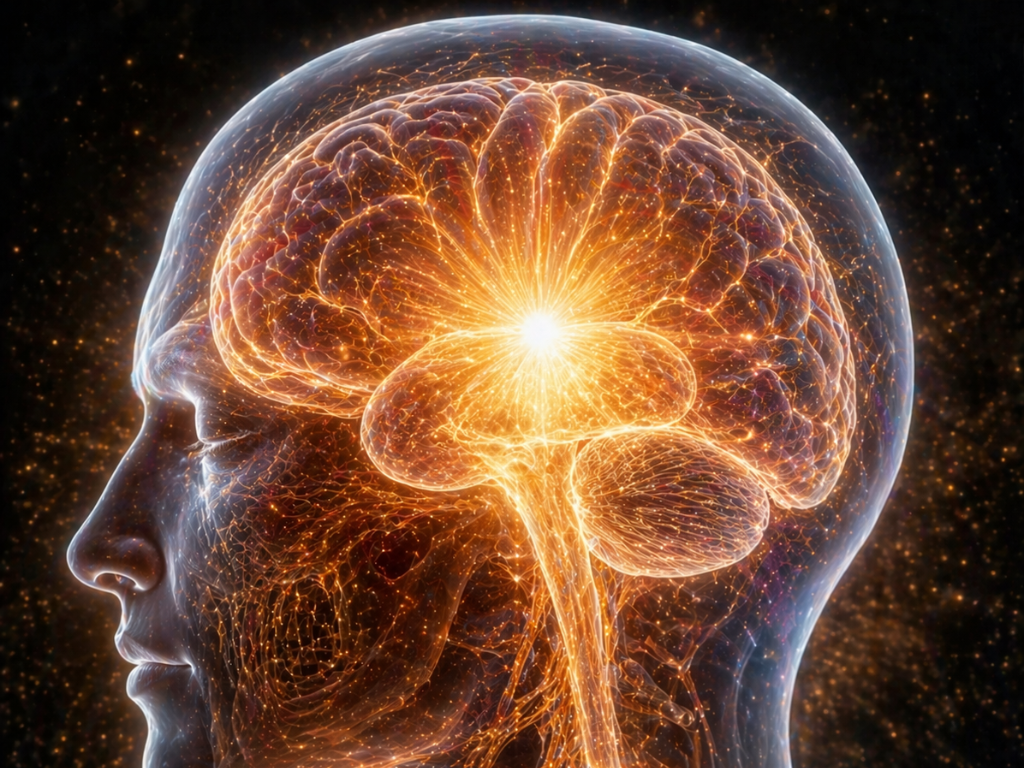
“If my true nature is vast, free, boundless, and eternal — why does my daily life feel so small, so limited, so painful, so confined? Why do I get stuck in traffic, worry about money, feel lonely, get sick, grow old — if none of this is my true nature?”
This frustration is not weakness. It is the beginning of genuine wisdom. Only someone who has glimpsed their true nature gets frustrated by the limitation. You are asking this question because something in you already knows the answer.
FIRST
The Most Important Thing to Understand
Before anything else — one realization that changes the entire framing of this question:
THE REFRAME
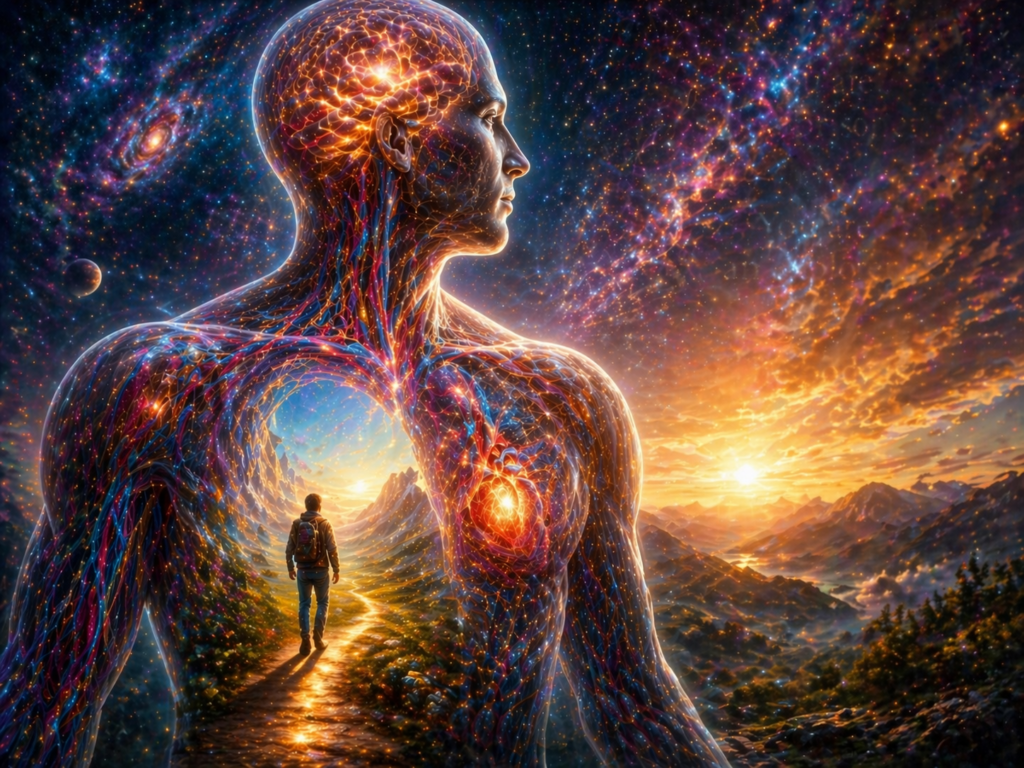
You are not a free consciousness that got trapped in a body. You are consciousness that chose embodiment — for reasons so profound that the ordinary mind cannot fully grasp them.
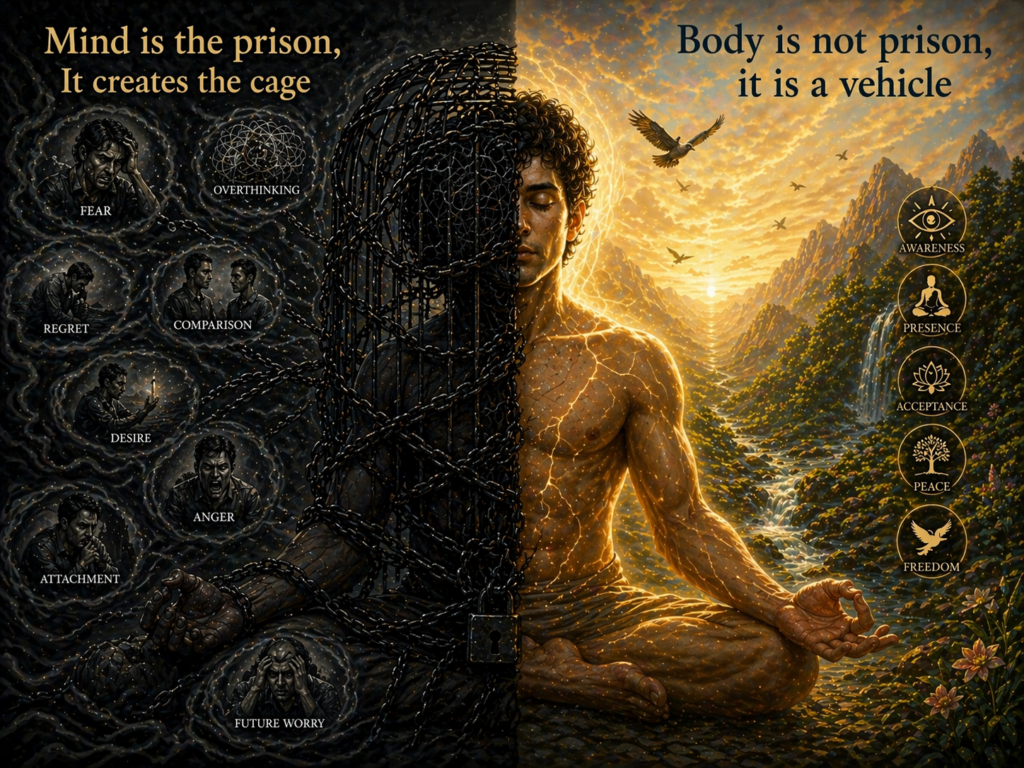
The question assumes — “I am a prisoner. How do I escape?” But every great tradition says — “You are not a prisoner. You are an explorer. The body is not a cage. It is a vehicle. And the journey has a purpose.”
PART ONE
Why Does Consciousness Experience Time and Space at All?
Advaita Vedanta — The Game of Forgetting
The concept of Lila — divine play
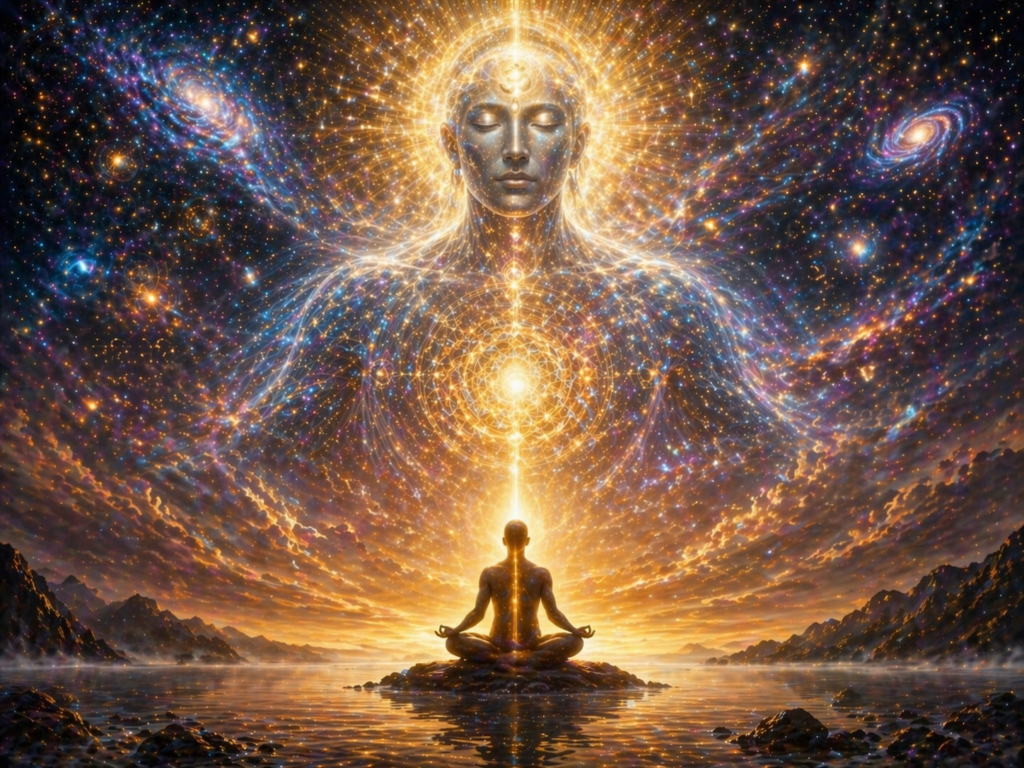
The infinite consciousness — Brahman — is complete, perfect, and lacking nothing. But completeness has one limitation — it cannot experience anything new. It cannot be surprised. It cannot love — because love requires an other.
So consciousness — in an act of pure creative play — contracts itself. It deliberately limits its infinite awareness. It enters time and space. It forgets its own infinite nature. Not because it was forced to. But because the game of forgetting and remembering is the most extraordinary experience that infinite consciousness can have.
If you knew the ending of every movie before it started — movies would be pointless. The joy requires not knowing what comes next. Consciousness entering human experience is the universe watching its own movie — from the inside. This is Lila — divine play — why consciousness experiences time and space. Not as punishment. As adventure.
Kashmir Shaivism — Shiva’s Five Acts
The most complete explanation — Panchakriya
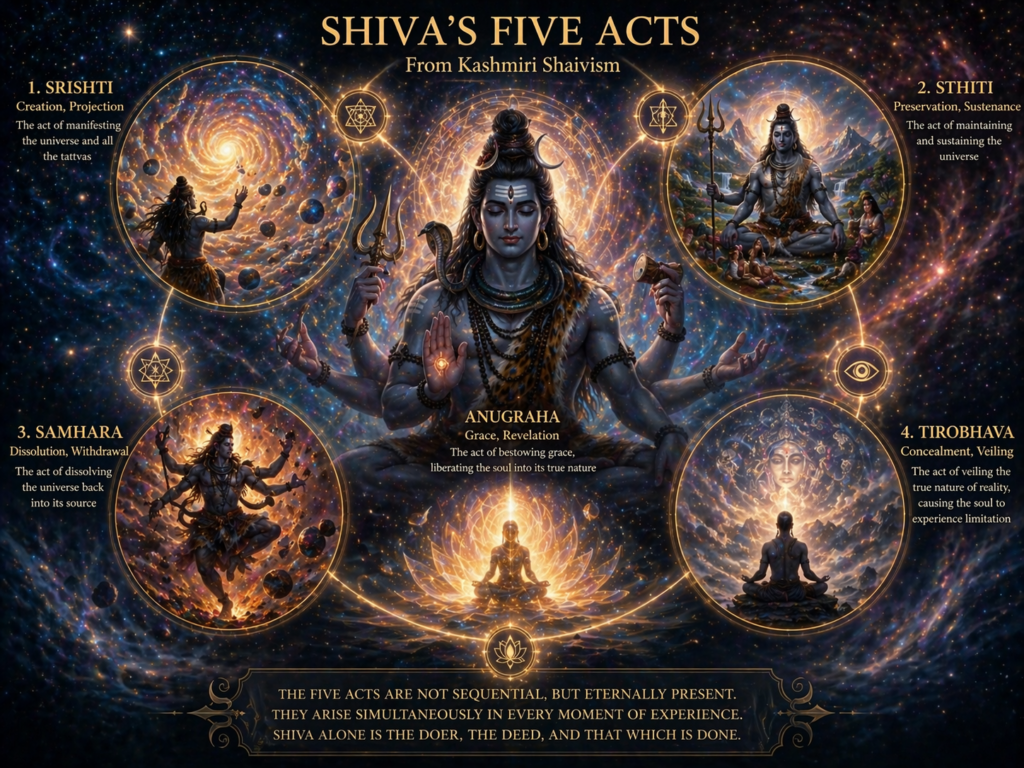
According to this tradition — the infinite consciousness performs five acts continuously, as a complete cycle:
| Act 1 · Srishti | Act 2 · Sthiti |
| Creation | Preservation |
| Consciousness projects the universe — time, space, matter, bodies, minds — out of itself. Like a dreamer creating a dream world. | Consciousness sustains the creation — keeps the dream running — maintains the experience of time and space as stable and consistent. |
| Act 3 · Samhara | Act 4 · Tirodhana |
| Dissolution | Concealment |
| Consciousness periodically dissolves the creation back into itself — death, endings, sleep, the spaces between breaths. | The crucial act. Consciousness deliberately hides its own nature from itself. Creates the veil of Maya. Without concealment — there is no game. Without forgetting — there is no journey. |
| Act 5 · Anugraha |
| Grace — The Return |
| Consciousness dissolves the concealment. The veil lifts. Recognition dawns. The individual awareness realizes it was always the infinite consciousness. This is liberation — Moksha. The entire human experience is all five acts — simultaneously — on itself. |
Jainism — Each Soul Has Its Own Journey
Karma as the weight that binds consciousness
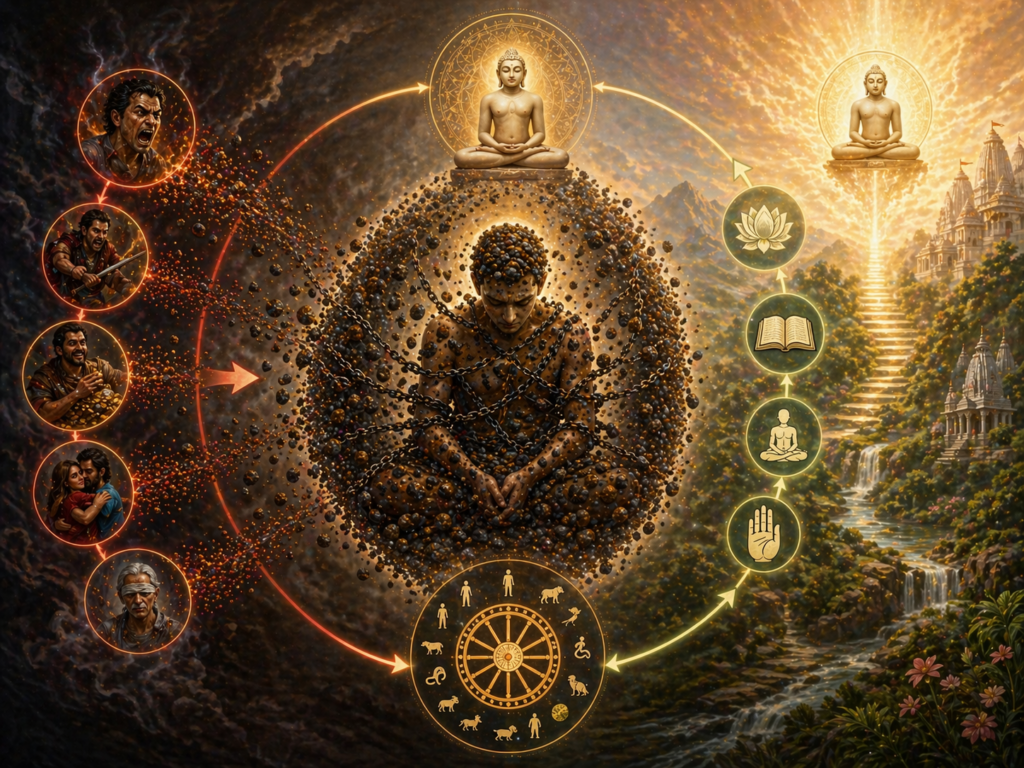
Jainism gives a different but equally profound answer. For Jainism — the soul experiences time and space because of karma — the accumulated weight of past actions, desires, and ignorance across countless lifetimes. Every moment of anger, violence, greed adds karmic weight that pulls consciousness into denser and denser experience of time and space.
Liberation in Jainism is not sudden enlightenment. It is the gradual, patient removal of karmic weight — through right faith, right knowledge, right conduct — until the soul is light enough to rise beyond time and space entirely. The soul experiences physicality because it has earned it — through its own choices. And it transcends physicality by making different choices.
Buddhism — The Wheel Turns Until You Wake Up
Samsara — the wheel of conditioned existence
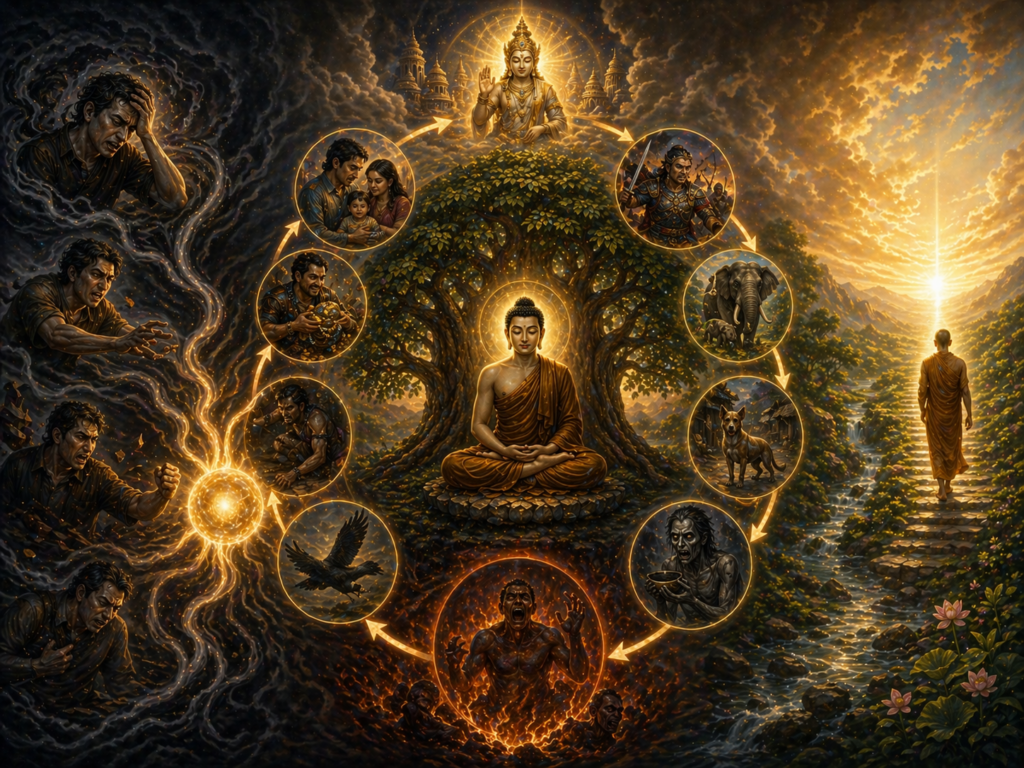
The Buddha’s insight was devastatingly simple: we experience time and space — birth after birth — because of craving and ignorance. Not knowing our true nature makes us reach for experiences, grasp at pleasures, push away pain. This craving creates karma — which creates rebirth — which creates more time and space — which creates more craving.
Liberation is not going somewhere beyond time and space. It is the cessation of the craving that keeps recreating the experience of time and space moment by moment. When craving stops — the wheel stops. Not because you escaped — but because you stopped feeding the engine that was running it.
PART TWO
Why Can’t We Go Beyond Physicality Right Now?
This is the most honest and direct part of the question. And it deserves an equally honest answer.
1. The Body Is Not the Prison. The Mind Is.
The obstacle to experiencing your true nature is not the physical body — it is the identification with the body. You can be completely in a body with all its limitations and simultaneously rest in the recognition of boundless, timeless consciousness. This is what every liberated master demonstrated. Ramana Maharshi had a body. The Buddha felt hunger and fatigue. But they were not identified with the body. The problem is not physicality — it is mistaking physicality for your identity.
2. The Veil Is Made of Thought
Every tradition agrees — the veil between you and your true nature is not made of matter. It is made of one thought repeating in thousands of forms: “I am this.” I am this body. I am this fear. I am this story. Every time that thought arises and is believed — the veil thickens. The habit of identifying with the physical is extraordinarily deeply grooved — reinforced by every moment of your life, and according to most traditions, by countless previous lifetimes. You cannot simply decide to stop believing a thought you have believed for millions of moments.
3. The Dream Has Its Own Momentum
Imagine you are in a vivid dream and you know it is a dream — that flash of lucidity. Can you immediately dissolve the entire dream? Sometimes yes. But often — no. The dream has its own momentum. Its own logic. Even after recognizing it as a dream, the walls are still there, the people are still there. The same is true of waking life. Even after deeply recognizing your true nature, the body is still there the next morning. Recognition dissolves identification — but it doesn’t immediately dissolve the dream. You become free within it — and every tradition says that is actually better.
4. You Are Here for a Reason
Every tradition says that the human birth is extraordinarily precious. Not because it is comfortable — but because the human form is the precise vehicle through which consciousness can recognize itself. Trees are conscious — but cannot reflect on their own consciousness. Animals are aware — but cannot inquire into the nature of awareness. Only the human being stands at the intersection of matter and spirit — physical enough to experience the full weight of embodiment — and aware enough to see through it. The Katha Upanishad says: “The human birth is rare.” Rare as in extraordinarily precious — a cosmic opportunity.
PART THREE
Then What Do We Actually Do?
First — The Trap of Spiritual Bypassing
Spiritual bypassing is using spiritual ideas to avoid dealing with real life — “time is an illusion so my responsibilities don’t matter” or “I am consciousness so my relationships are just Maya.” Every great tradition warns against this explicitly. Ramana Maharshi had a body and took care of it. The Buddha ate, slept, and engaged with his community. Transcendence is not escape. It is full, conscious, loving engagement with life — from a place of non-identification. The goal is not to leave the dream. It is to be fully in the dream — awake.
| 1. Recognize What You Already Are |
| The first step is not doing anything new — it is recognizing what is already true. Right now — before any meditation, before any practice — you are already awareness. You are already the timeless witness. You don’t need to become this. The simplest practice: ask “Who is aware right now?” Don’t answer with a concept. Just look — directly — at the consciousness that is reading these words. You will find that awareness has no edges. No beginning. No location. This recognition — even for one second — is more valuable than years of conceptual understanding. This is Ramana Maharshi’s Self-Inquiry — the most direct path. |
| 2. Practice Non-Identification in Daily Life |
| When a difficult emotion arises — instead of “I am angry” — try “awareness is noticing anger.” When a thought arises — instead of “I think therefore I am” — try “a thought is appearing in consciousness.” When the body feels pain — try “awareness is noticing a sensation.” This tiny linguistic and attentional shift — practiced consistently — begins to loosen the identification with physicality — not by rejecting the body but by gently relocating your sense of identity from the content of experience to the awareness of experience. |
| 3. Use the Physical World as the Teacher |
| Instead of trying to transcend the physical — use the physical as a doorway into the transcendent. Every sensory experience — properly met — can be a recognition of consciousness. The warmth of sunlight fully felt, without labeling, without commentary — is pure awareness meeting pure sensation. The taste of food fully tasted — can be a moment of pure presence beyond time. Kashmir Shaivism calls this Pratyabhijna — recognition — the sudden recognition of your true nature through the very experiences of the physical world. The physical world is not the obstacle to consciousness. It is consciousness appearing as the physical — waiting to be recognized. |
| 4. Live Your Dharma Fully |
| This is the Bhagavad Gita’s answer — the most practical of all. You are here. In this body. In this specific life with its specific relationships, responsibilities, gifts, and challenges. This is not an accident — this is your specific assignment. The path beyond physicality is not found by abandoning your life. It is found by living your life with complete awareness, complete presence, and complete non-attachment to results. As Krishna said to Arjuna: “Do your duty. Act fully. But do not be attached to the fruits of action.” Full engagement. Zero identification. That is the path. |
PART FOUR
The most honest answer
You Already Do This Every Night
You asked — “Why can’t we just go beyond physicality? This is not our true version.”
Consider This
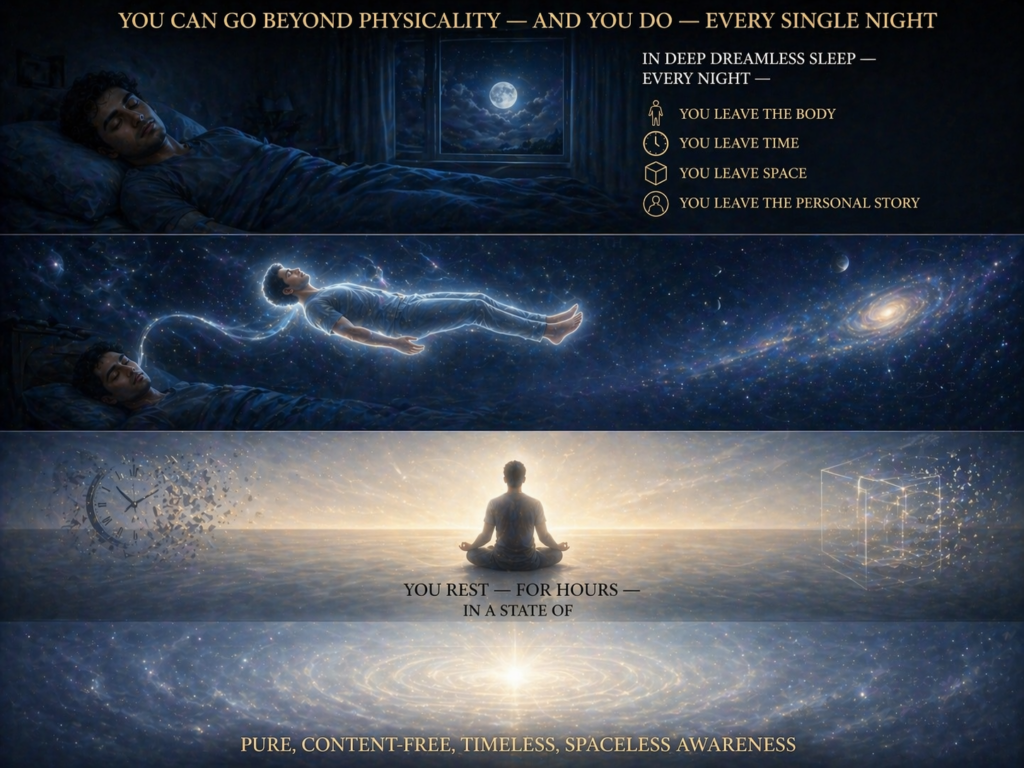
You can go beyond physicality — and you do — every single night. In deep dreamless sleep — every night — you leave the body, leave time, leave space, leave the personal story completely. And you rest — for hours — in a state of pure, content-free, timeless, spaceless awareness.
You do this every night. Without effort. Without practice. Without philosophy. The problem is — you don’t know you are doing it. You come back from that vast, peaceful, timeless space — and immediately pick up the story of the personal self again — as if nothing happened.
Enlightenment — in simple terms — is doing consciously and continuously what you already do unconsciously every night in deep sleep. Resting in the awareness that is beyond time and space — while simultaneously being present in time and space — with open eyes — fully engaged — without forgetting what you are.
In the END… Why Don’t We Just Stay There?
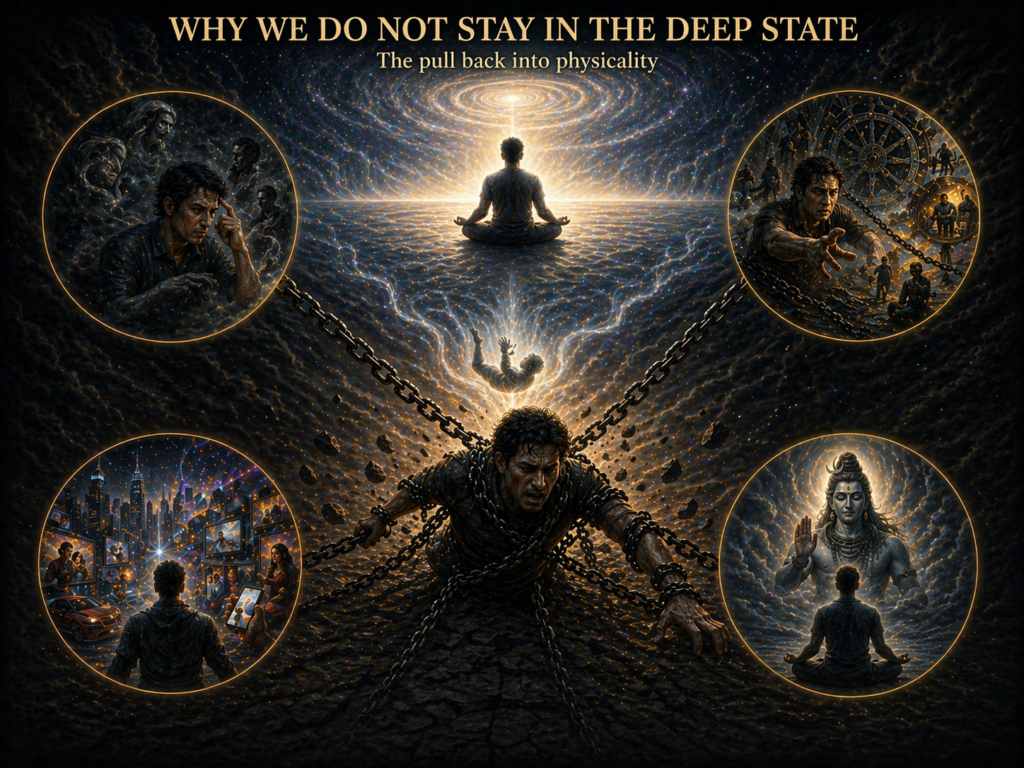
Because the habits of mind are extraordinarily strong. Because karma keeps pulling consciousness back into identification with the physical. Because the dream of physicality has tremendous momentum. And because — as Kashmir Shaivism says — the concealment is itself a divine act. You cannot force a flower to bloom faster than its nature allows. But you can make sure it has sunlight, water, and good soil.
The sunlight is self-inquiry — asking “who am I?” The water is practice — meditation, non-identification, present moment awareness. The soil is right living — ethical, loving, conscious engagement with life. Given these conditions — the recognition dawns. Not as an achievement. As a natural unfolding.
The timeless, spaceless, boundless awareness that you are looking for — is already looking. Right now. Through these eyes. Reading these words.
The one who wants to go beyond physicality — IS the beyond. Already. Always. Without exception.
Turn around. Look at the one who is looking. And find — in that turning — that there was never anyone trapped.
There was only consciousness — vast, free, eternal — playing the most extraordinary game ever conceived: pretending to be a person, looking for itself, and finding — with a smile of recognition — that it was never lost. 🙏
Welcome home. You were never away.
“The thing you are looking for is the thing that is looking.”— St. Francis of Assisi
“You are what you are seeking.”— Ramana Maharshi
“The wave does not need to go anywhere to become the ocean. It already is the ocean.”— Advaita Vedanta

Hina is the founder of BrowsingIndia, a platform dedicated to making Indian philosophy, epics, and consciousness-related ideas accessible to curious readers. A computer engineer by profession, her lifelong passion for Indian scriptures led her to pursue a Master’s in Hindu Studies, and she is currently a PhD research student in the same field. Her writing is grounded in close reading of primary texts and respected scholarly sources.