
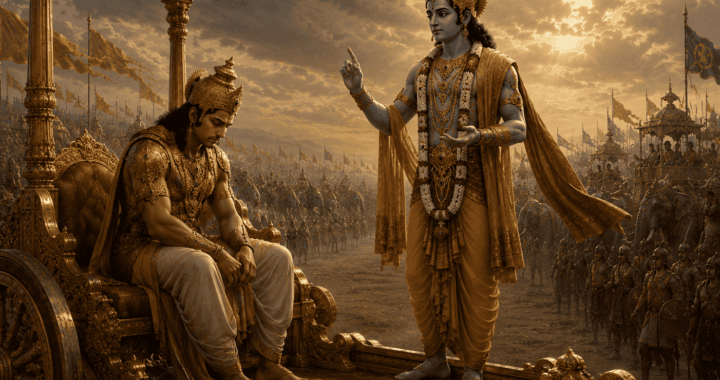
hagavad Gita Chapter One — what the war scene really describes, and what Shankaracharya’s diagnosis reveals about Arjuna’s grief that every other reader missed.
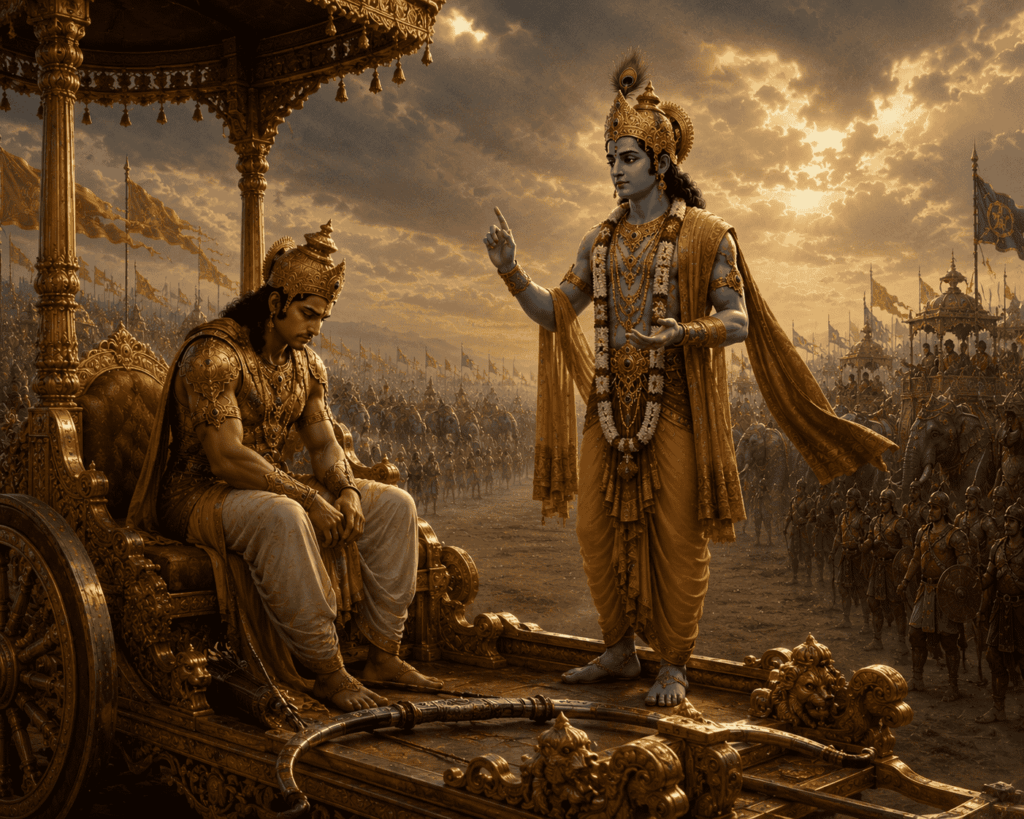
Most teachers rush past Bhagavad Gita Chapter One as if it were a prologue — a necessary setup before the real philosophy arrives in Chapter Two. Shankaracharya did the opposite. He read it as the most important chapter in the entire text. Because if you do not understand what broke Arjuna — you cannot understand what healed him.
Bhagavad Gita Chapter One has a name: Arjuna Vishada Yoga — the yoga of Arjuna’s grief. That word yoga is the first signal that something unusual is happening. The Gita is calling grief a discipline. A path. A doorway. Before a single philosophical argument has been made, the text is already telling you — breakdown is not the opposite of awakening. It is often the beginning of it.
Part One · The Scene
What Bhagavad Gita Chapter One Actually Describes
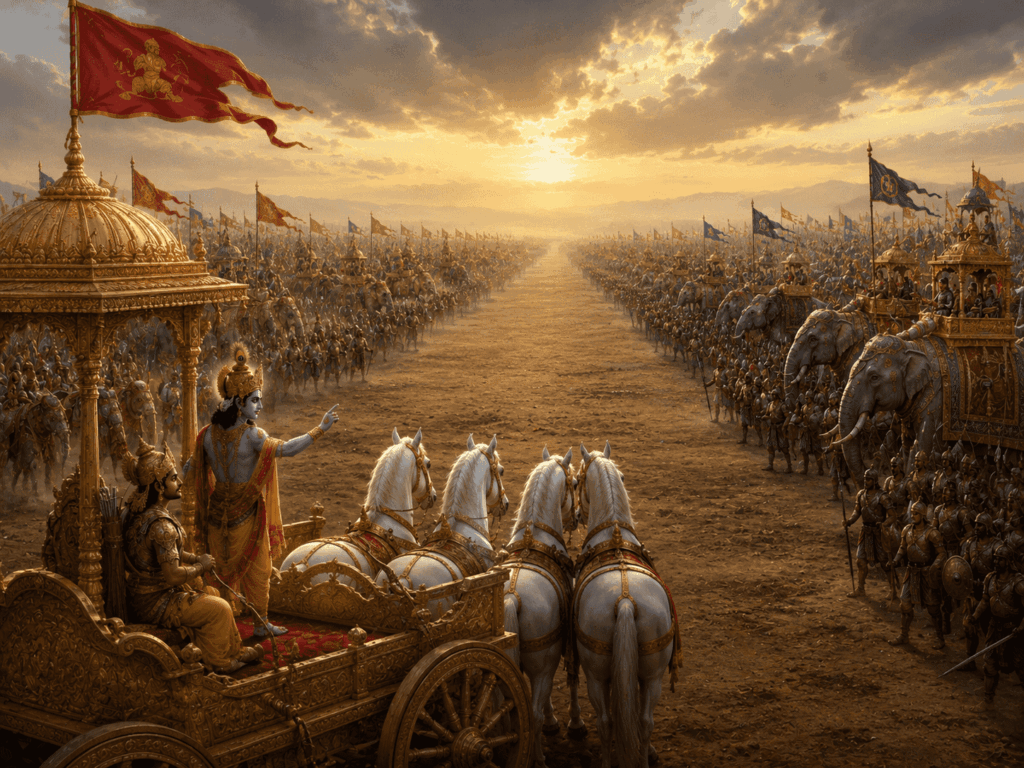
Kurukshetra. Northern India. Two enormous armies face each other across a vast plain. The Pandavas on one side, the Kauravas on the other. Eighteen akshauhinis of soldiers — an almost incomprehensible number. Elephants, chariots, horses, foot soldiers stretching to every horizon. The greatest warriors of an entire age gathered in one place for one final reckoning.
Then the conch shells sound.
The Signal
Before a Single Arrow — The Conches
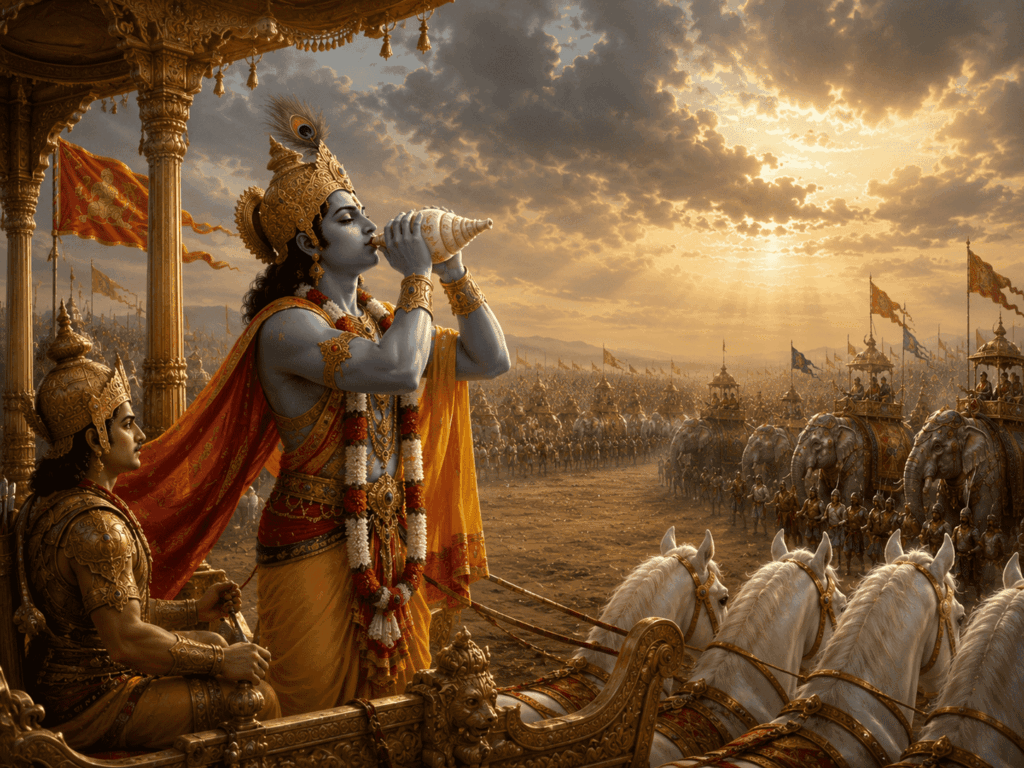
Before the first arrow is fired, every great warrior blows his conch shell. Each conch has a name. This is not ceremony for its own sake. Each warrior is announcing — I am here. I am present. I am ready.
Krishna
Panchajanya
Arjuna
Devadatta
Bhima
Paundra
Yudhishthira
Anantavijaya
Nakula
Sughosa
Sahadeva
Manipushpaka
And then Arjuna asks Krishna — his charioteer, his closest friend — to drive their chariot to the center of the field. Between the two armies. So he can see clearly who he is about to fight.
This is the first act of genuine seeking in the entire text. Arjuna does not yet know it. But the simple desire to see before acting — to look clearly before choosing — is what makes everything that follows possible. The seeker is already present, even before the seeking has been named.
The Seeing
What Arjuna Looks at — and What It Does to Him
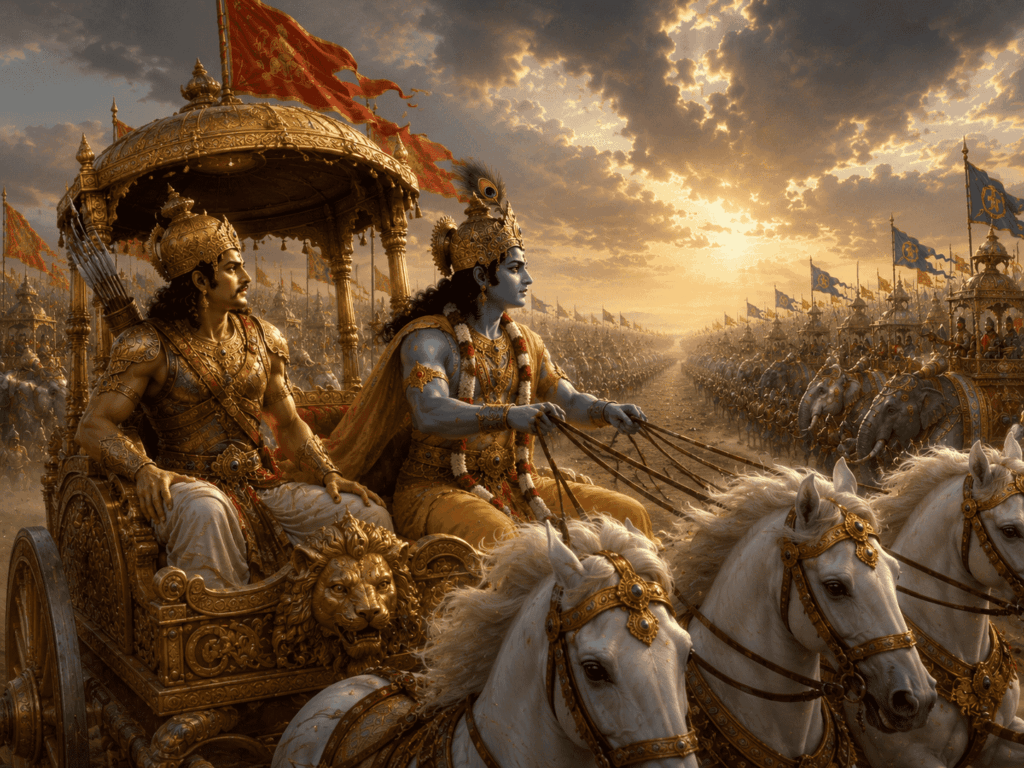
Krishna drives the chariot forward. And Arjuna looks.
He sees his grandfather Bhishma — the man who taught him what love looks like. He sees his teacher Drona — the man who placed a bow in his hands and spent years making him extraordinary. He sees cousins, uncles, friends. He sees an entire generation of people who made him who he is — arrayed against him, and him against them.
And something in him breaks.
What the Sanskrit Describes — Arjuna’s Physical Collapse
His limbs go heavy and weak
His mouth goes completely dry
His bow slips from his fingers
His skin burns and trembles
His mind reels — he cannot think
He cannot stand — he sits down
A great warrior. Trained his entire life for exactly this moment. Sitting down in his chariot in the middle of the battlefield. Unable to move.
The Arguments · Chapter One’s Real Depth
Arjuna Is Not Weak — He Is Thinking
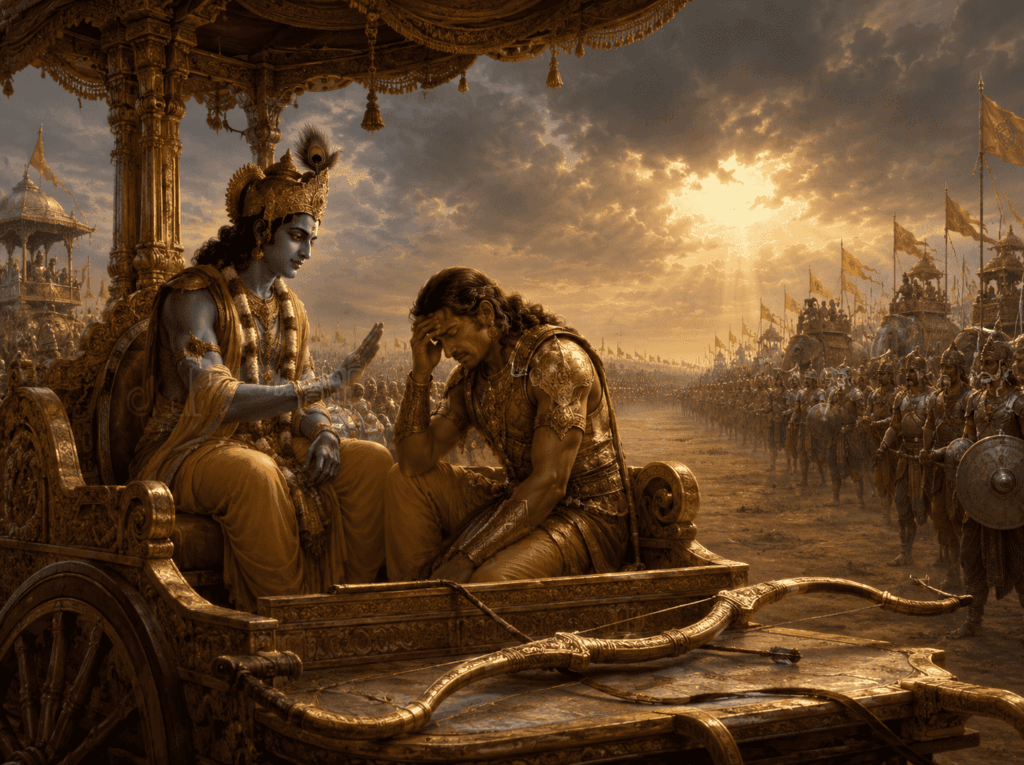
This is the point almost every surface reading of the Gita gets wrong. Arjuna is not afraid of dying. He is afraid of something far more honest — he is afraid of what victory will cost. What is a kingdom without the grandfather who taught you to love it? What is triumph over your own teacher? These are not weak questions. They are the questions of a man who has thought deeply — possibly for the first time — about what he is actually doing.
And so he speaks. Three distinct arguments. Each one philosophically serious.
Killing family is a sin beyond any duty
These are my people. My blood. Whatever dharma demands — surely it cannot demand the destruction of those who made me.
The destruction of lineages destroys civilization itself
If entire family lines are wiped out, the traditions collapse. The rituals that hold society together break down. The cost of this war is not personal — it is civilizational.
I would rather die than win this way
Let the sons of Dhritarashtra kill me — unarmed and unresisting. I will not do this. No kingdom is worth this price.
Krishna’s Response
Two Words — Then Silence
Krishna listens to everything. He does not interrupt. He does not rush to comfort. He watches Arjuna’s arguments unfold — brilliant, emotionally real, philosophically serious — and then, at the very end of the chapter, speaks for the first time.
Krishna’s first words — the end of bhagavad gita Chapter One
Kutas tva kaśmalam idam viṣame samupasthitam
From where has this weakness come to you
— at this critical moment?
Not — you are wrong. Not — your feelings are invalid. Not — stop grieving. Simply — from where has this come? It is the question of a master teacher. Not dismissing the crisis. Not solving it immediately. Pointing directly at its source — and inviting Arjuna to look at what is actually happening inside him, rather than simply being swept away by it.
Bhagavad Gita Chapter One ends there. Arjuna in his chariot. Bow on the floor. Between two armies. Arguments made. A single question hanging in the air.
The greatest philosophical dialogue in all of Indian literature begins in silence and dropped weapons.
The Commentary
What Shankaracharya’s Reading of Bhagavad Gita Chapter One Reveals
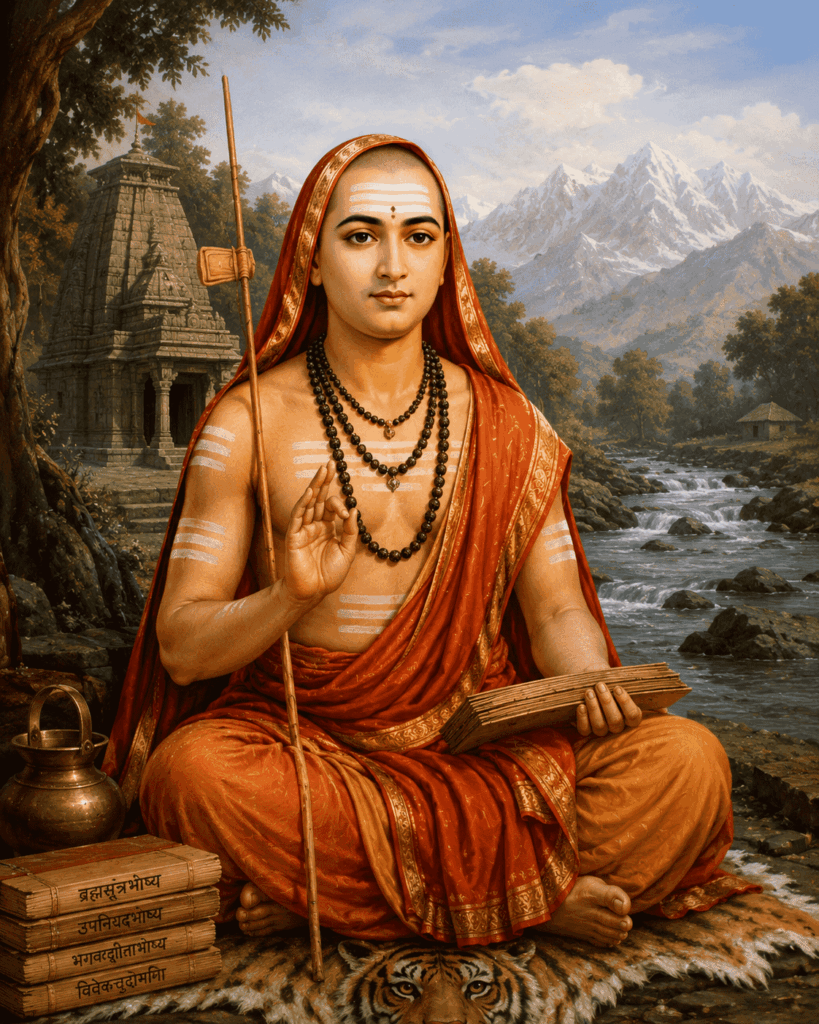
Adi Shankaracharya · Bhagavad Gita Bhashya
When Shankaracharya arrives at Chapter One in his commentary, he does not rush past it. He stops. He diagnoses. With surgical precision, he identifies exactly what is wrong with Arjuna — and his diagnosis is not “Arjuna is weak” or “Arjuna is confused about his duty.” His diagnosis is far more radical: Arjuna is suffering from Avidya — fundamental ignorance about the nature of the Self. Everything else is a symptom. The disease is one thing only.
The Disease
Two Precise Mistakes — The Root of All Human Suffering
Shankara identifies two specific errors Arjuna is making simultaneously. And he says — these are not Arjuna’s mistakes. These are the two foundational mistakes of the human condition.
Adhyasa
Superimposition
Arjuna is superimposing the qualities of the body and relationships onto the Atman — the pure Self. He sees Bhishma and sees my grandfather. He sees Drona and sees my teacher. But these are appearances within consciousness — not ultimate realities. The grief is real. The premise generating the grief is false.
Ahamkara
Ego-identification
Arjuna says I cannot. I will not. I will be destroyed. Shankara asks — which I is speaking? The contracted ego-I that can lose things, that can be destroyed, that has everything to fear. Not the real I — the Atman — which cannot lose anything. Has nothing to fear. Was never born and will never die.
The Refutation
What Shankara Says About Each of Arjuna’s Three Arguments
Arjuna says
Killing family is a sin — there is no dharma that can justify this.
Shankara sees
This argument presupposes a self that accumulates sin and bears consequences. But the Atman neither kills nor is killed. The sin Arjuna fears belongs to the ego-self. And the ego-self is not the real Self.
Arjuna says
Destroying lineages destroys civilization — the long-term cost is catastrophic.
Shankara sees
Arjuna is mixing levels of reality. Social dharma operates at the level of Maya — real and important there. But it cannot override the deeper dharma of acting from the fullness of what you truly are, not from the contracted fear of what you might lose.
Arjuna says
I would rather die unarmed than win at this price. This is my final position.
Shankara sees
This sounds like the highest nobility — but look carefully. Arjuna is not proposing genuine renunciation. He is proposing the renunciation of action as a way of avoiding the pain of action. True renunciation is not the giving up of action. It is the giving up of the ego’s claim on the outcome. One is escape. The other is liberation.
The Radical Claim
The Suffering Is Not the Problem — It Is the Qualification
The Sanskrit term Shankara introduces
Mumukshutva
The burning desire for liberation — not curiosity, not interest, but urgent and unavoidable longing to know the truth of what one is
Shankaracharya says Arjuna’s breakdown on the battlefield is not a failure of nerve. It is the arising of Mumukshutva. The grief, the confusion, the dropped bow — these are the signs that Arjuna has become ready. His questions are no longer comfortable philosophical questions asked from a safe distance. They are burning. They are immediate. They cannot be postponed. And it is only when questions burn like this that the answers Krishna gives can actually land.
The Deepest Seeing
What the Empty Hands Actually Mean
What most readers see
A strong man temporarily weakened. A warrior who has lost his nerve and must be talked back into doing his duty.
What Shankara sees
A man in whom the last defense of the ego has finally collapsed — creating, for the first time, the opening through which truth can enter.
The ego had constructed an entire identity — warrior, son, student, friend, prince — and built a life around protecting it. And now, in one terrible moment of clarity, Arjuna sees that the ego’s project leads here. To this field. To this impossibility. To this dropped bow.
The ego has nowhere left to go. And in that nowhere — in that complete impasse — the first genuine opening toward the truth becomes possible. You cannot receive what you think you already have. Arjuna’s empty hands are the most important image in the entire Gita.
Because only empty hands can receive.
In the END…
The disease must be seen clearly
before the medicine makes sense.
Chapter One is not the prologue to the Gita.
It is the reason the Gita is necessary.
A question to sit with
Is there a place in your own life where the bow has slipped — where your arguments have run out and you find yourself simply sitting in the middle of what you cannot resolve? What if that is not your failure — but your qualification?

Hina is the founder of BrowsingIndia, a platform dedicated to making Indian philosophy, epics, and consciousness-related ideas accessible to curious readers. A computer engineer by profession, her lifelong passion for Indian scriptures led her to pursue a Master’s in Hindu Studies, and she is currently a PhD research student in the same field. Her writing is grounded in close reading of primary texts and respected scholarly sources.