
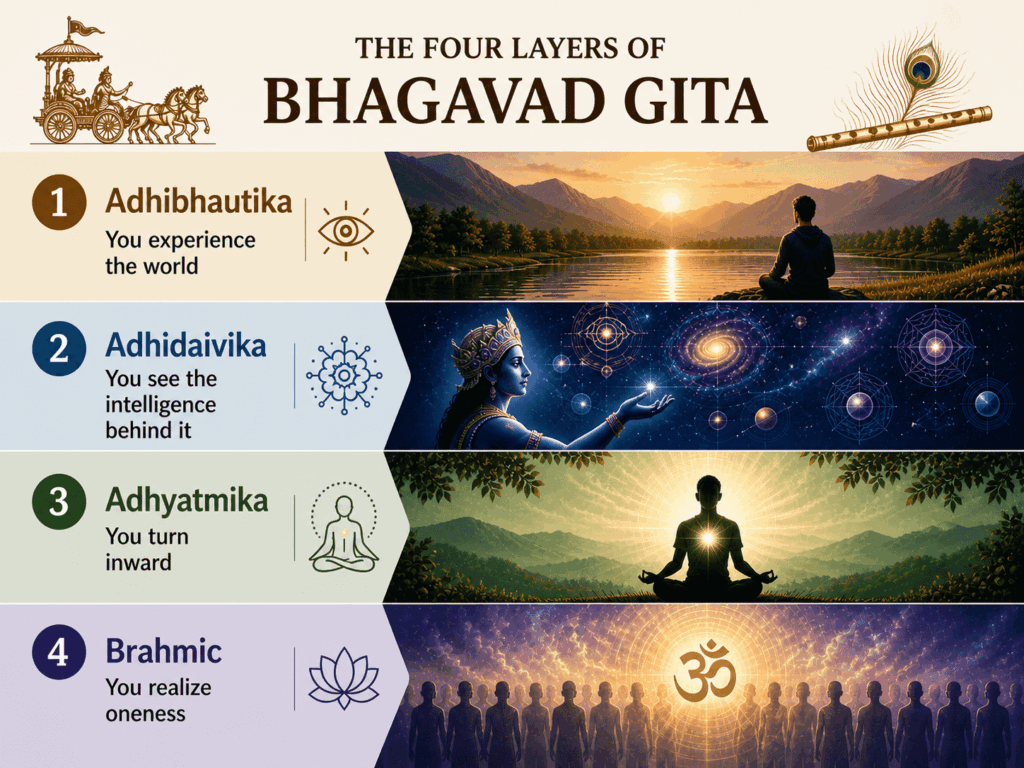
The Bhagavad Gita is eighteen chapters long. It has been read for five thousand years. And in those five thousand years, no two people have read exactly the same book — because the Gita is not one book. It is four. Stacked on top of each other. Waiting for the reader who is ready for each layer.
Most sacred texts offer one meaning — the one intended by the author, recoverable through scholarship and careful reading. The Gita is different. Its ancient commentators understood that great truth cannot be captured in a single register. That the same words must mean something different to a grieving soldier, a practicing philosopher, a sincere meditator, and a fully awakened sage — and be correct for all of them.
This is not ambiguity. This is architecture. Let us walk through each floor.
Adhibhautika · The Earth Layer
1. The Literal Layer of Bhagavad Gita
A real battlefield. A real man in crisis. A real teacher who does not let him run.
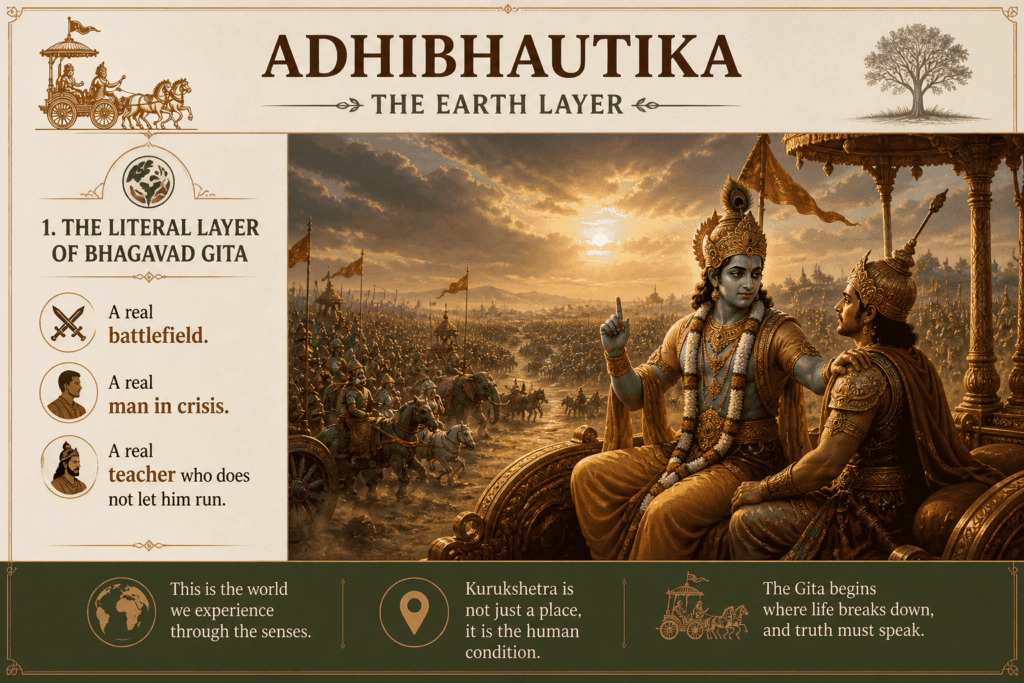
At this level, the Gita is exactly what it appears to be. Kurukshetra is a physical battlefield in northern India. Arjuna is a warrior — a Kshatriya — who has trained his whole life for this moment, and now, standing between the two armies, finds himself completely unable to act. He sees his cousins, his teachers, his grandfather across the field. He drops his bow. He cannot do it.
Krishna, his charioteer and closest friend, refuses to let him collapse. The teaching that follows is about dharma — your duty, your role, the specific responsibility that belongs to you and no one else. Do not abandon what you are called to do simply because it is painful. The fruit of action is not yours to determine. The action itself is.
Arjuna
A warrior who has lost his nerve. Every person who has stood at the edge of what is required and found themselves unable to move.
Krishna
A teacher who speaks with extraordinary clarity. The voice that refuses to let the student hide in sentiment and self-pity.
What this layer gives you
Courage. The teaching that life requires action — and that paralysis dressed as compassion is still paralysis. Most people who encounter the Gita first meet it here. And it is genuinely transformative even at this depth.
Adhidaivika · The Fire Layer
2. The Psychological Layer of Bhagavad Gita
Kurukshetra is not outside. It has always been inside.
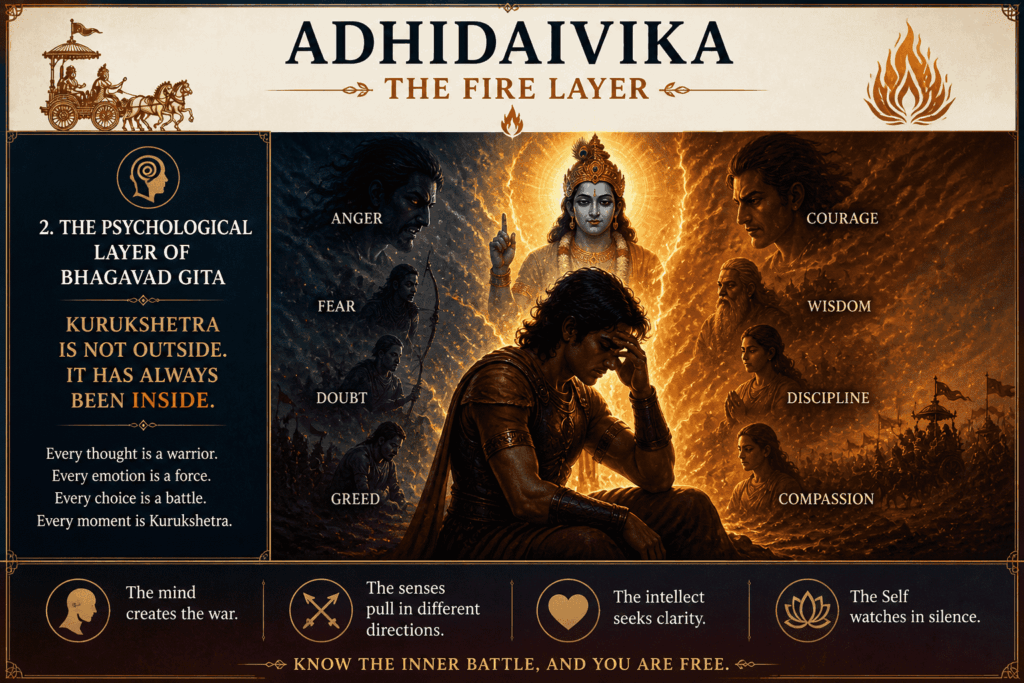
Push a little deeper and the battlefield dissolves — and reappears inside the human mind. Arjuna is no longer just a warrior. He is every person who has ever stood between what is comfortable and what is true. Between old identity and new clarity. Between running away and showing up fully.
And the armies? They are not enemies. They are the inner forces that every human being must eventually face and cannot avoid forever.
Duryodhana
The ego that refuses to surrender even when it knows it is wrong. The part of you that would rather destroy everything than admit it lost.
Karna
Misplaced loyalty — holding onto old identities and old allegiances that no longer serve the truth.
Shakuni
The ego that refuses to surrender even when it knows it is wrong. The part of you that would rather destroy everything than admit it lost.
Krishna
The higher self — the part of every human being that always knows — speaking to the confused, grief-stricken part that has temporarily forgotten.
What this layer gives you
A map of your own inner war. The realization that the conflict you feel between your clarity and your fear, between what you know is right and what feels safe — that conflict has always had a name. And the Gita has already mapped its resolution.
Adhyatmika · The Sky Layer
3. The Consciousness Layer of Bhagavad Gita
The question is no longer what should I do. It becomes — what am I?
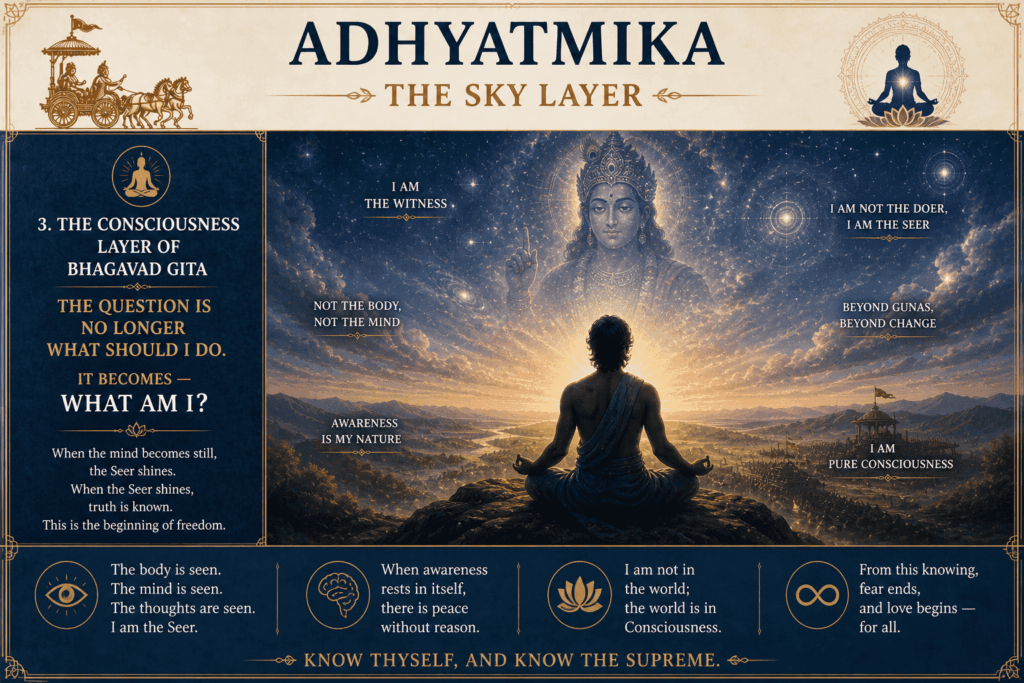
At this layer, the battlefield and the inner war both fall away. The question becomes metaphysical. Arjuna’s crisis becomes the occasion for one of the most complete maps of consciousness ever given — not in a quiet ashram over years of study, but in the urgency of a single afternoon, to a man in genuine crisis.
Krishna’s teaching here addresses the deepest questions directly. What is the Self? What is the relationship between the individual awareness and the infinite? What happens at death? What is real and what is appearance?
Karma Yoga
The ego that refuses to surrender even when it knows it is wrong. The part of you that would rather destroy everything than admit it lost.
Jnana Yoga
Misplaced loyalty — holding onto old identities and old allegiances that no longer serve the truth.
Bhakti Yoga
Consciousness through love — the dissolution of the individual self into the beloved, until the boundary between lover and loved simply melts.
The Three Gunas
Tamas, Rajas, Sattva — the three qualities through which consciousness experiences itself in every moment, in every being, in every action.
What this layer gives you
A complete philosophy of consciousness — arguably the most comprehensive ever assembled in a single text. The recognition that you are not a person having spiritual experiences. You are awareness itself, temporarily appearing as a person.
The Brahmic Layer · Beyond Description
4. The Cosmic Layer of Bhagavad Gita
There is no teacher. There is no student. There is only consciousness — dreaming both sides of the conversation.
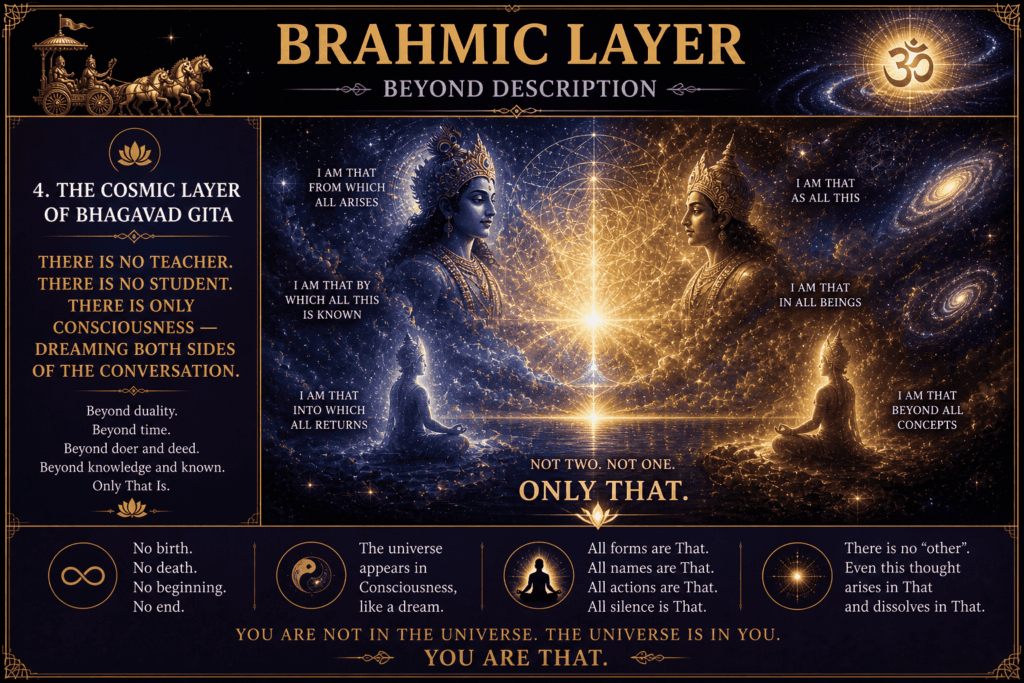
This is the layer that cannot quite be explained — only pointed at. At this depth, even the consciousness map dissolves. There is no longer a seeker and a teaching. There is no longer Arjuna receiving wisdom from Krishna. There is only the one infinite consciousness — wearing every costume simultaneously, playing every role, speaking every word, hearing every word.
This is what Chapter Eleven reveals — the Vishwarupa, the cosmic form. When Krishna shows Arjuna the totality of existence within himself, Arjuna does not see something outside him. He sees that he too is inside this totality. The warrior and the teacher and the armies and the grief and the teaching and the silence after the teaching — all of it is the one consciousness, experiencing itself from every angle at once.
The most extraordinary line in the entire Gita
A complete philosophy of consciousness — arguably the most comprehensive ever assembled in a single text. The recognition that you are not a person having spiritual experiences. You are awareness itself, temporarily appearing as a person.
At this layer, the question of who is teaching whom becomes impossible — and irrelevant. Consciousness is talking to itself, through the beautiful fiction of teacher and student, so that the recognition can unfold within the very drama it has created.
The Same Gita — Seen From Four Depths
Layer I
Literal
A warrior receives his duty from his teacher
Act. Your role is your responsibility. The fruit is not yours.
Layer II
Psychological
The higher self speaks to the confused ego-self
The inner war has always had a map. The Gita is that map.
Layer III
Consciousness
Awareness recognizes its own nature through teaching
You are not a person having spiritual experiences. You are awareness itself.
Layer IV
Cosmic
Consciousness dreams both sides of the conversation
There is no teacher. There is no student. There is only the one.
Why the Gita Has Never Stopped Being Alive
A young person
finds courage to act despite fear
A grieving person
finds perspective on loss and the deathless Self
A philosopher
finds the most complete map of reality ever assembled
A mystic
finds a mirror for pure awareness looking at itself
The same eighteen chapters. The same Sanskrit verses. Four completely different books. All of them true. All of them the Gita.
This is what the ancient tradition understood that modern reading has largely forgotten — that great texts are not puzzles to be solved once and set aside. They are living structures that meet you at whatever layer of yourself you bring to them. And as you deepen, the book deepens with you.
You do not finish the Gita. You grow into it. And one day — if you go deep enough — you may discover that the book was always reading you.
In the End..
You do not finish the Bhagavad Gita.
You grow into it.
And one day, if you go deep enough,
you discover — the book was always reading you.
A question to sit with
Which layer of the Gita feels most alive for you right now — and what does that tell you about where you are in your own journey?

Hina is the founder of BrowsingIndia, a platform dedicated to making Indian philosophy, epics, and consciousness-related ideas accessible to curious readers. A computer engineer by profession, her lifelong passion for Indian scriptures led her to pursue a Master’s in Hindu Studies, and she is currently a PhD research student in the same field. Her writing is grounded in close reading of primary texts and respected scholarly sources.