
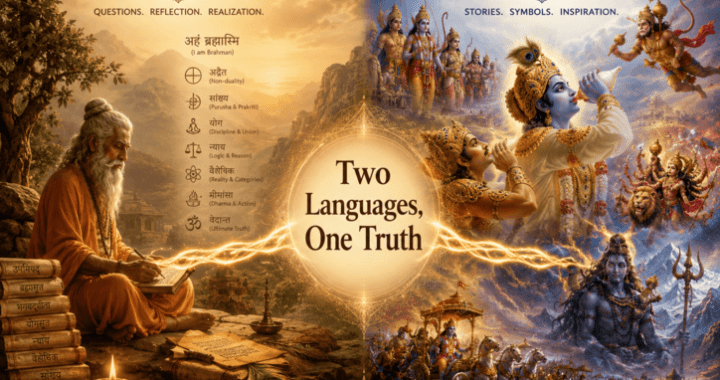
Philosophy speaks to the mind. Mythology speaks to the soul. But Indian mythology and philosophy have always been pointing at the same reality — with the same finger.
The Central Realization
Indian mythology and philosophy are not two separate things. Indian mythology is Indian philosophy — translated into story, symbol, character, and drama — so that the deepest truths about consciousness could be felt and lived — not just understood intellectually.
The rishis — the ancient seers of India — understood something that modern neuroscience is only now confirming: the human mind does not primarily operate through logical propositions. It operates through story, image, emotion, and relationship. You can understand that consciousness is infinite — and still live as a small, frightened, ego-driven person. Understanding is not enough. The truth must enter the heart.
That is what the Puranas do. The greatest gift of Indian mythology and philosophy together is this: one gives you the map, the other makes the map feel like home. The Upanishads tell you what fire is. The Puranic stories burn you with it.
Part One
Indian Mythology and Philosophy — The Direct Connections#
Brahman and Narayana — One Truth, Two Languages#
The connections
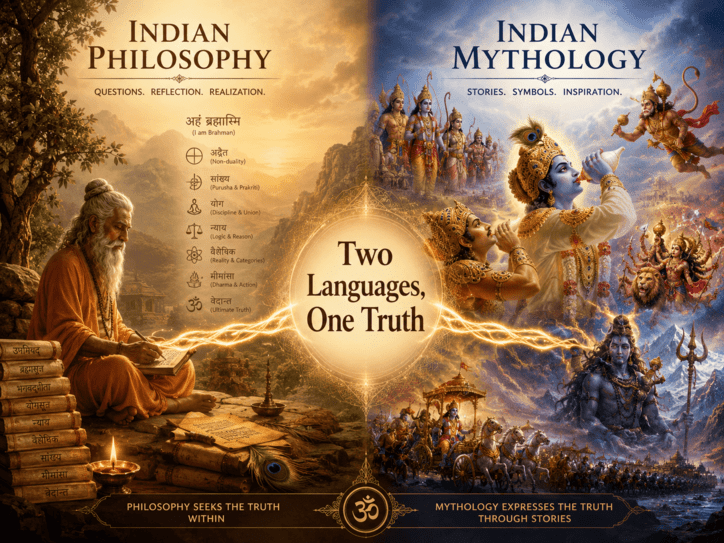
The relationship between Indian mythology and philosophy becomes most visible when you place them side by side. What the Upanishads describe in abstract terms — the Puranas describe through living, breathing, emotionally charged images. Neither is the lesser version of the other. They are two doorways into the same room.
📜 Indian Philosophy Says
🌊 Indian Mythology Says
Brahman
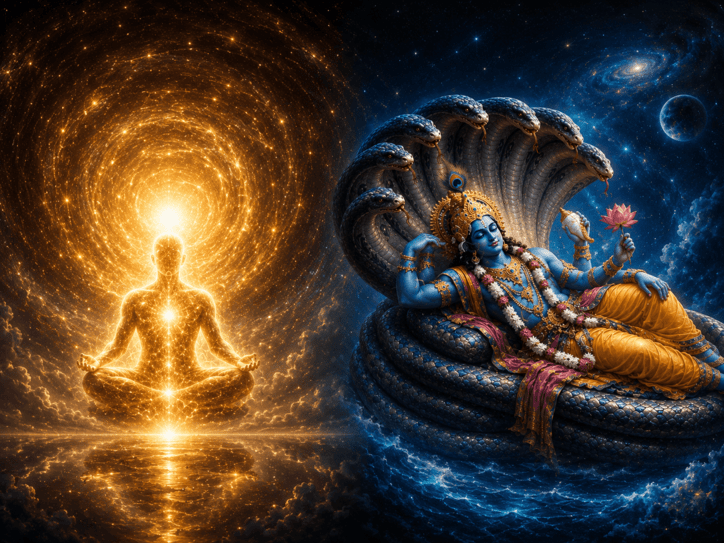
The infinite, undivided, self-luminous consciousness — the ground of all existence — without beginning, without end, without limitation. Everything arises within Brahman, is sustained by Brahman, and dissolves back into Brahman.
Narayana on Ananta Shesha
In the beginning — before creation — there was only the vast, dark, infinite ocean. Narayana rests on the cosmic serpent in a state of deep, undisturbed, infinite awareness. Nothing exists. No time. No space. Only the infinite consciousness — resting in itself — complete, peaceful, whole.
Lila — Divine Play
Through Lila — consciousness contracts itself, projects the universe out of itself, and creates the appearance of multiplicity and time within the undivided whole..
Brahma Opens His Eyes
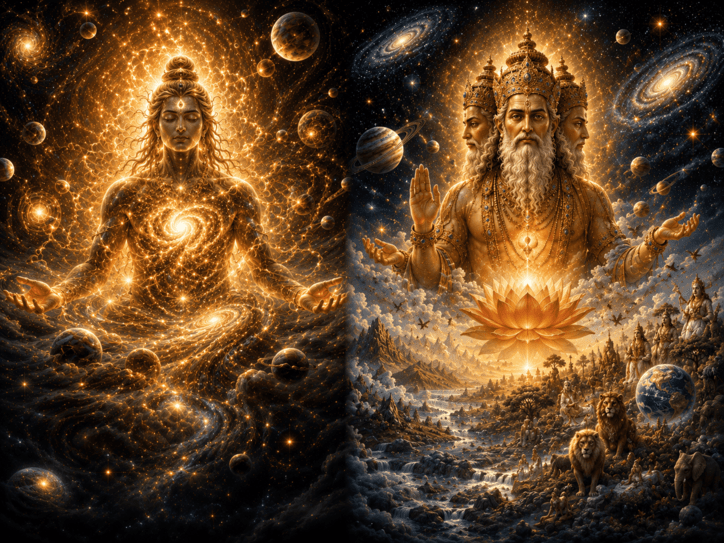
From the navel of Narayana — a lotus grows. On that lotus sits Brahma. Brahma opens his eyes — and begins to create the universe — the stars, the worlds, the beings, time itself.
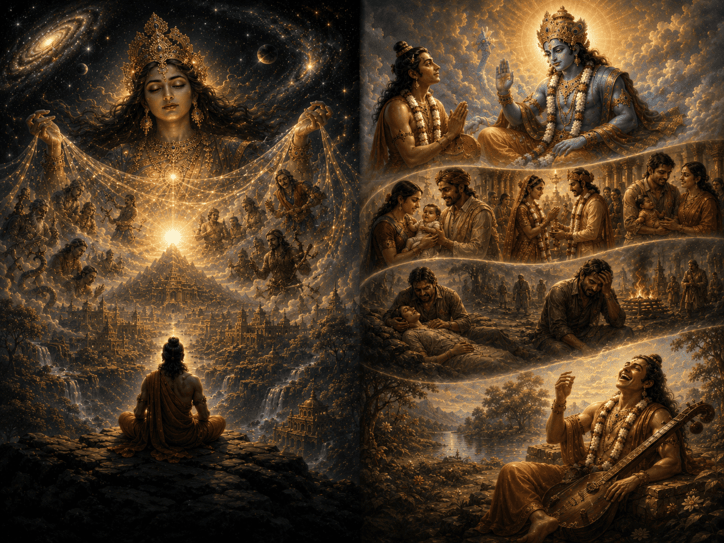
Maya — The Veil
Maya is the power of consciousness to appear as other than itself — concealing the truth while simultaneously creating the conditions for its rediscovery.
Narada’s Dream
Narada is shown Maya by Vishnu — completely immersed in a human life — experiencing birth, marriage, loss, grief — complete identification with a human story — then suddenly the veil lifts. He wakes. He laughs.
You cannot feel the Upanishadic statement “Brahman is the ground of all existence” in your body. But you can feel the image of the infinite being resting in vast, dark, peaceful waters — before anything exists — in a state of perfect stillness. Same truth. Different doorway into the same reality.
Brahma, Vishnu, Shiva — Three Faces of One Consciousness#
The deepest insight of Indian mythology and philosophy working together is this: the gods are not beings sitting in a distant heaven. They are the fundamental movements of consciousness itself — personified so that you can have a relationship with them, not just an intellectual understanding.
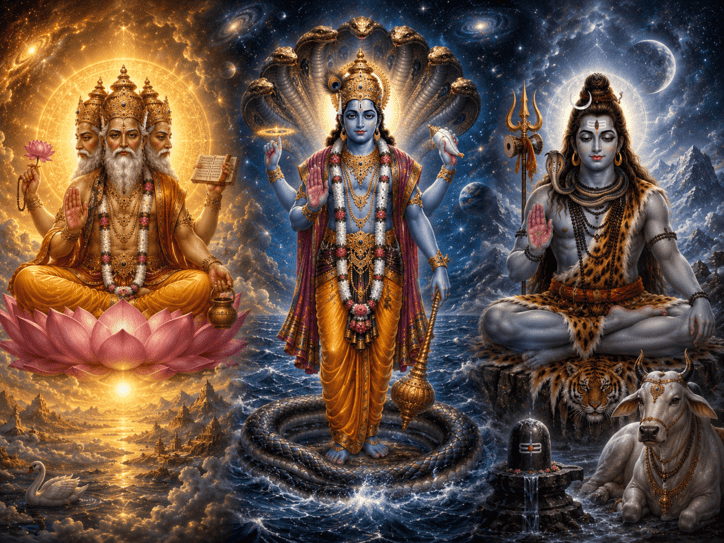
🌸 The Trinity — Brahma, Vishnu, Shiva
Indian Mythology and Philosophy in Perfect Unity
What Indian Philosophy Says
Kashmir Shaivism describes consciousness performing five acts: creation, preservation, dissolution, concealment, and grace. Three fundamental movements of the one consciousness. All are expressions of Brahman — not separate deities.
What Indian Mythology Gives You
When you feel the creative impulse arising within you — that is Brahma. When you feel the loving urge to protect and sustain — that is Vishnu. When you feel the necessary letting go — that is Shiva. The mythology puts a face on philosophical principles — so you can have a relationship with them — not just an intellectual understanding of them.
The Dashavatara — Evolution of Consciousness as Myth#
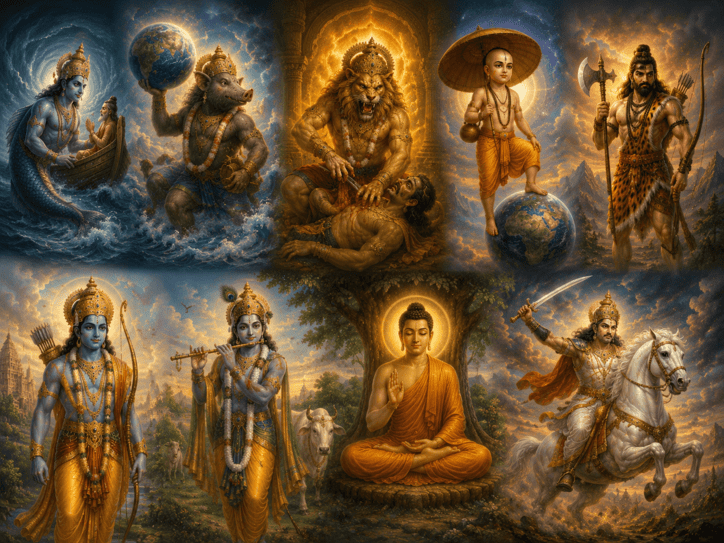
Perhaps the most extraordinary achievement of Indian mythology and philosophy together is the Dashavatara. Vishnu’s ten avatars are not random stories. They are a precise map of the evolution of consciousness through increasingly complex forms — described thousands of years before Darwin.
🐟
Matsya
Fish — aquatic consciousness
🐢
Kurma
Tortoise — amphibious consciousness
🐗
Varaha
Boar — land animal consciousness
🦁
Narasimha
Man-Lion — consciousness at the threshold
🧍
Vamana
Dwarf — early human consciousnes
↓ The arc of evolution ↓
⚔️
Parashurama
Warrior Sage — righteous human consciousness
👑
Rama
Ideal human — dharmic consciousness fully expresse
🪈
Krishna
Complete human — every dimension of consciousness aliv
☸️
Buddha
Awakened — consciousness recognizing itselfd
✦
Kalki
Future — consciousness transforming the age
Part Two
Puranic Stories — Indian Mythology and Philosophy as Living Drama
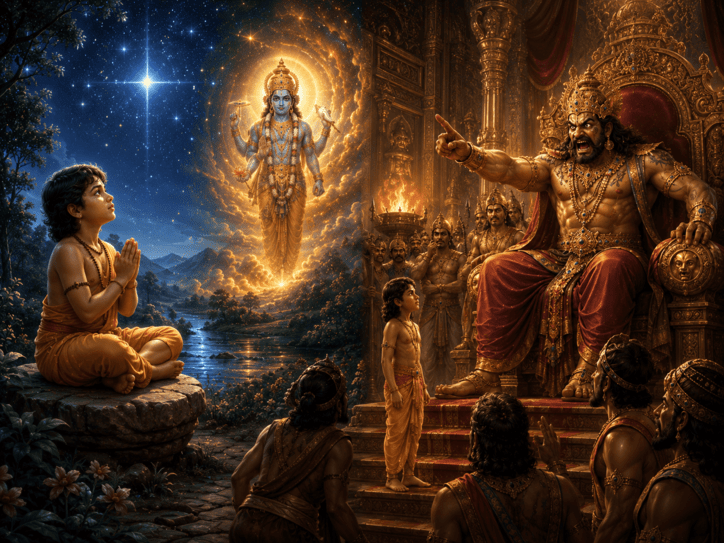
Prahlada — Consciousness That Cannot Be Extinguished
Bhagavata Purana · Indian Philosophy of Bhakti and the Indestructible Self
The Story
Prahlada — a five-year-old child — is the son of Hiranyakashipu, the most powerful Asura who ever lived. His father tortures him repeatedly — throws him from cliffs, sends serpents, orders elephants to crush him — because the child refuses to stop worshipping Vishnu. Every attempt fails. The boy survives — not through power — but through the complete recognition of consciousness as his true nature. Ultimately, Vishnu appears as Narasimha — the man-lion — and slays Hiranyakashipu.
The Indian Philosophy Within
Prahlada = consciousness that has recognized itself — even in a child’s body. Hiranyakashipu = the ego at the peak of its power — the one who believes he is the source, the center, the supreme. The torture that cannot destroy Prahlada = the Upanishadic truth: the Self cannot be cut, burned, wetted, or dried. Narasimha appearing = consciousness itself rising to protect what has recognized it. This is Indian mythology and philosophy showing that the Self is indestructible — not as an abstract idea — but as lived, breathed, incarnate reality.
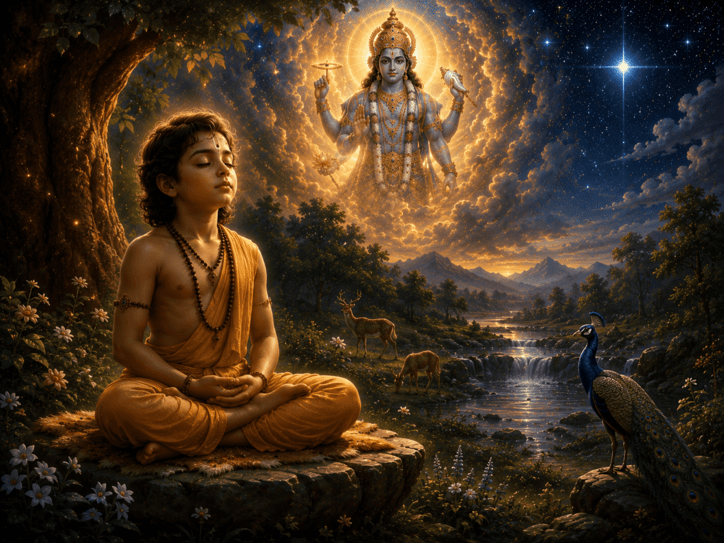
Dhruva — The Child Who Became the Pole Star
Bhagavata Purana · Indian Philosophy of Tapas and the Unwavering Self
The Story
Dhruva — a prince of five — is insulted by his stepmother and denied his rightful place on his father’s lap. He goes to the forest, performs extraordinary tapas — austerities — under the guidance of the sage Narada. He meditates so intensely that the universe begins to shake. Vishnu appears before him. But by the time Vishnu arrives — Dhruva has found something greater than the kingdom he originally sought. He is granted the position of Dhruva Nakshatra — the Pole Star — eternally fixed in the sky.
The Indian Philosophy Within
Dhruva’s original desire = the ego’s longing for recognition, for a place in the world, for love from the right people. The forest and the tapas = the inward journey — turning from outer seeking to inner inquiry. What Dhruva finds before Vishnu arrives = the Kutastha — the unchanging witness — the fixed point of pure consciousness beneath all movement. The Pole Star = Indian mythology and philosophy giving a visible, permanent, cosmological image of the one thing in existence that never moves — the witness consciousness at the center of all experience.
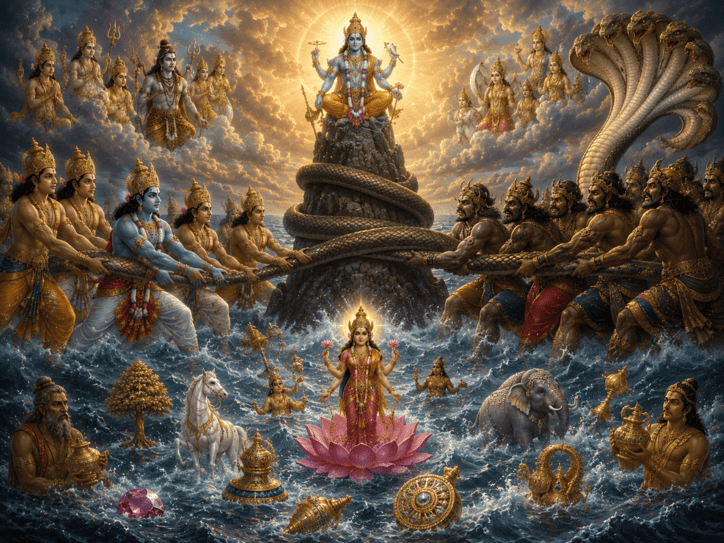
Samudra Manthan — The Churning of the Cosmic Ocean
Bhagavata Purana · Indian Philosophy of Spiritual Practice and Transformation
The Story
The Devas and Asuras — bitter enemies — temporarily cooperate to churn the cosmic ocean using the serpent Vasuki as a rope and Mount Mandara as the churning rod. First emerges Halahala — a deadly poison so powerful it threatens to destroy all creation. Shiva drinks it, holding it in his throat — becoming Neelakantha. Then divine gifts emerge one by one — Lakshmi, the divine physician, the wish-granting tree — and finally Amrita, the nectar of immortality.
The Indian Philosophy Within
The cosmic ocean = the vast ocean of consciousness containing both poison and nectar. The churning = genuine spiritual practice — the friction of working with both the divine and demonic within oneself. The poison emerging first = the universal truth: in any genuine inner journey, the darkness always rises before the light. Shiva drinking the poison = the Sakshi — the witness consciousness — holding what arises with awareness until it transforms. This is Indian mythology and philosophy at its most precise: a complete map of the spiritual path encoded in a single story.
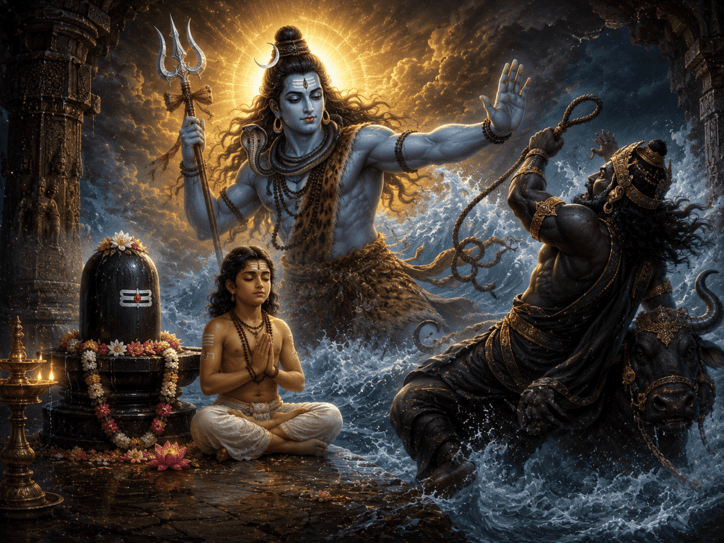
Markandeya — The Boy Who Conquered Death
Shiva Purana · Indian Philosophy of the Immortal Self
The Story
Markandeya is destined to die at sixteen. When Yama — the god of death — comes to claim him, the boy clings to the Shiva lingam in his devotion. Shiva himself emerges and kicks Yama away — declaring that Markandeya will live forever. The boy who was to die at sixteen becomes the eternal sage — the immortal witness to the dissolution and rebirth of entire universes.
The Indian Philosophy Within
Yama arriving = death as the ultimate test — the moment when the ego’s entire structure is stripped away. Markandeya’s devotion to Shiva = the soul clinging not to the body or the world — but to the one unchanging reality beneath all change. Shiva conquering Yama = the Atman — pure consciousness — that which was never born and therefore cannot die — asserting its nature. This story is Indian mythology and philosophy encoding the central Upanishadic truth — the Self is deathless — not as a doctrine but as a living, dramatic, unforgettable encounter.
Part Three
The Deeper Pattern — Why Indian Mythology and Philosophy Work on Three Levels
Why Every Puranic Story Works on Three Levels#
The genius of Indian mythology and philosophy together is this: every major Puranic story operates simultaneously on three levels. A child understands it as an adventure. A philosopher understands it as a metaphysical map. A practitioner uses it as a guide for living. This triple architecture is not accidental — it is the deliberate design of the rishis.
🌌The Cosmic Level
Describing the nature of consciousness, the structure of reality, the workings of the universe at the largest scale. Brahman, Lila, the spectrum of beings. Prahlada’s story is Brahman protecting itself.
🧠The Psychological Level
Describing the inner journey of every individual. Dhruva searching for love — then finding the unchanging Self. Markandeya clinging to the immortal beneath the mortal. These are maps of your own inner life — happening right now.
🌿The Practical Level
Showing how to live — what choices to make — what orientation to take toward life. The Samudra Manthan tells you exactly what to expect from genuine spiritual practice: the poison always comes before the nectar.
The gods are not outside — they are within. When you invoke Saraswati — you are activating the principle of luminous knowing within your own consciousness. When you remember Prahlada — you are remembering that the Self within you cannot be destroyed by any external force. This is the deepest gift of Indian mythology and philosophy together — a map of inner territory projected onto the cosmic screen so you can see it clearly enough to navigate it.
Indian Mythology and Philosophy — The Full Correspondence#
Here is the complete map — showing how Indian mythology and philosophy encode the same truths in two different languages. This table is the heart of the entire blog.
Indian Philosophy Concept
Puranic / Mythological Expression
What It Points To
Brahman — infinite consciousness
Narayana on Ananta Shesha
The timeless ground of all existence
Lila — divine play
Brahma opening his eyes; creation begins
Consciousness freely choosing to experience limitation
Maya — the veil
Narada’s dream — shown by Vishnu
The power of consciousness to appear as other than itself
Evolution of consciousness
Dashavatara — ten avatars of Vishnu
Consciousness expressing through increasingly complex forms
Atman — the indestructible Self
Prahlada surviving every attempt to destroy him
The Self cannot be cut, burned, wetted, or dried
Kutastha — the unchanging witness
Dhruva becoming the eternal Pole Star
The one fixed point of consciousness beneath all movement
Sakshi — witness consciousness in practice
Samudra Manthan — Shiva drinking the poison
Awareness holding what arises until it transforms
Atman is deathless — Katha Upanishad
Markandeya — the boy who conquered Yama
Pure consciousness was never born and cannot die
Two Wings of the Same Bird
Indian mythology and philosophy are not two separate traditions that happened to develop alongside each other. They are the same wisdom — delivered through two different channels — because the rishis knew that truth must reach both the mind and the heart to truly transform.
Philosophy is the map. Mythology is the journey. Philosophy is the finger pointing at the moon. Mythology is the moonlight falling on your face. And only when both are present — when Prahlada’s unshakeable recognition and the Upanishad’s precise declaration meet inside you — does the truth become not just known — but lived.
The stories of the Puranas are not history. They are not fairy tales. They are Indian mythology and philosophy doing what the rishis designed them to do — reaching across thousands of years — to wake something in you that was already awake. 🙏
“The Puranas are the fifth Veda. They make the eternal accessible to every human heart — regardless of learning.”
— Inspired by the Tradition
“Mythology is psychology misread as biography and cosmology.”
— Joseph Campbell
“In India, the boundary between philosophy and story was never drawn — because the truth was always understood to be both.”
— Inspired by the Tradition
More deep dive into the Indian Philosophy > Indian Philosophy explained simply
References & Citations#
The stories and philosophical claims in this blog draw from the following primary Puranic sources and scholarly works. Readers are encouraged to explore these directly.
Primary Puranic Sources#
Bhagavata Purana (Srimad Bhagavatam)
Composed c. 800–1000 CE. Primary source for the stories of Prahlada (Skandha 7), Dhruva (Skandha 4), and the Samudra Manthan (Skandha 8). The most philosophically rich of all the Puranas — widely considered the highest expression of Bhakti philosophy in narrative form.
Translated by A.C. Bhaktivedanta Swami Prabhupada (Bhaktivedanta Book Trust, 1972–1977). Also: C.L. Goswami & M.A. Shastri (Gita Press, Gorakhpur)
Composed c. 750–1350 CE. Primary source for the story of Markandeya and the conquest of Yama (Rudra Samhita). Also contains detailed accounts of Shiva’s role in the Samudra Manthan as Neelakantha — one of the most philosophically precise depictions of the witness consciousness in all of Indian mythology and philosophy.
Translated by a Board of Scholars, ed. J.L. Shastri (Motilal Banarsidass, 1969)
Composed c. 400 CE. One of the earliest and most systematic Puranas. Contains the Prahlada narrative (Book I, Chapters 16–20) and the cosmological accounts of the Dashavatara used in this blog. Also the source for the Dhruva story (Book I, Chapters 11–13).
Translated by M.N Dutt
Part of the Krishna Yajurveda. The philosophical claim that “the Self cannot be cut, burned, wetted, or dried” — used in the Prahlada section — is drawn directly from Katha Upanishad 2.19. The Markandeya story is the Puranic dramatization of this precise Upanishadic statement.
In: S. Radhakrishnan, The Principal Upanishads (HarperCollins India, 1994), pp. 598–647
Indian Philosophy — Primary Texts Referenced#
Brahmasutras of Badarayana with Shankaracharya’s Commentary
The foundational text of Advaita Vedanta. Shankaracharya’s Bhashya is the source for the philosophical claims about Brahman, Maya, and Lila used throughout this blog — and the framework within which the Puranic stories are interpreted as philosophical allegory.
Translated by Swami Gambhirananda (Advaita Ashrama, Calcutta, 1965)

Hina is the founder of BrowsingIndia, a platform dedicated to making Indian philosophy, epics, and consciousness-related ideas accessible to curious readers. A computer engineer by profession, her lifelong passion for Indian scriptures led her to pursue a Master’s in Hindu Studies, and she is currently a PhD research student in the same field. Her writing is grounded in close reading of primary texts and respected scholarly sources.