
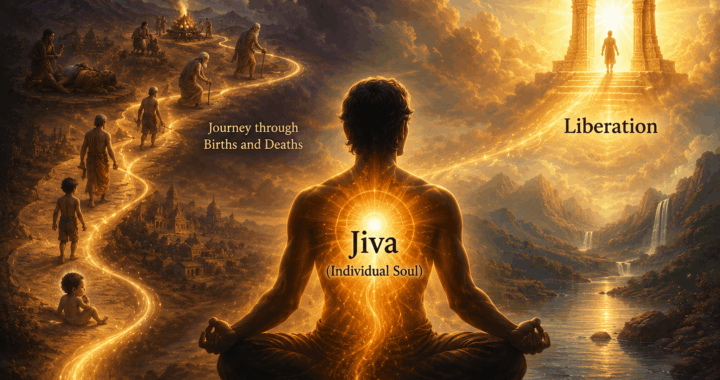
The individual soul — what it is, why it exists, and what happens when it finally recognises its true identity.
📖radhakrishnan on What Is Jiva in Hinduism · The Principal Upanishads · Section XIV
Jiva is literally that which breathes. It referred originally to the biological aspect of man’s nature which goes on throughout life, in waking, dream and sleep. It is called purusa — that which dwells in the citadel of the heart. It is the bhoktir, the enjoyer, the kartir, the doer. It reaps the fruits of deeds and survives the death of the physical body.
The human individual is a complex of five elements — prana, manas, vijnana and ananda. The Highest Spirit which is the ground of all being does not contribute to his self-sense. The ego belongs to the relative world, drawn round a centre which is Atman — the Universal Consciousness which is our true being.
Table of Contents
Question One
What Is Jiva in Hinduism?
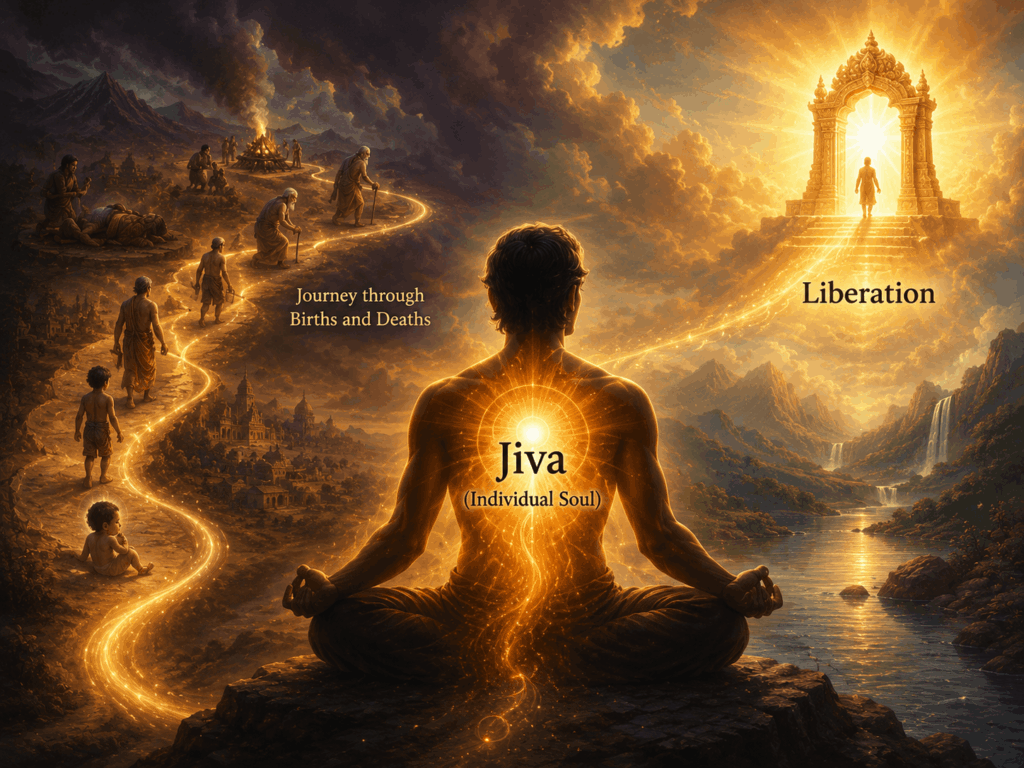
To understand what is jiva in Hinduism, start with the most direct answer possible. The Jiva is you — as you ordinarily experience yourself. Not the ultimate you. Not the cosmic you. The everyday, walking-around, thinking-and-feeling, remembering-yesterday-and-planning-tomorrow you. The one with a name, a history, a personality, preferences, fears, and desires.
Radhakrishnan describes the Jiva in Hinduism as a complex — not a single simple thing but a layered structure of multiple principles working together, from the outermost physical body all the way inward to the bliss layer nearest Atman.
Annamaya
The Physical Body
The gross material form — what science studies as biology and chemistry. Born, grows, decays, dies.
Pranamaya
The Life-Force
The vital breath that runs the body below conscious control. Heartbeat, digestion, the automatic sustaining of life.
Manomaya
The Thinking Mind
Perception, emotion, memory, imagination. The constant inner conversation. The mind that dreams.
Vijnanamaya
The Higher Intellect
Buddhi — the discriminating intelligence that can tell real from unreal, eternal from temporary, self from not-self.
Anandamaya
The Bliss Layer
The deepest coating over Atman. Tasted in deep sleep, profound meditation, moments of genuine selfless joy.
Ātman
The Ground · Not a Layer
The Universal Consciousness in which all five layers float. Not the sixth layer — the ocean in which the five waves rise. This is our true being.
What is jiva in Hinduism defined by? Three distinct roles that together describe its entire relationship to life, karma, and liberation:
Bhoktir
The Enjoyer
The one who tastes experience — joy, suffering, beauty, pain, love, loss. The Atman does not taste. The Jiva tastes.
Kartir
The Doer
The one who acts, chooses, creates karma. Every action taken from individual selfhood belongs to the Jiva — not the Atman, which never acts.
Karma-vāhaka
The Carrier
The Jiva reaps the fruits of its deeds and survives the death of the physical body — carrying its impressions forward until liberation.
This is what jiva in Hinduism ultimately is — the wave. Atman is the ocean. The wave is real — it rises, moves, has its own character. But it is not separate from the ocean, and it is not the whole ocean.
Question Two
Why Does the Jiva Exist?
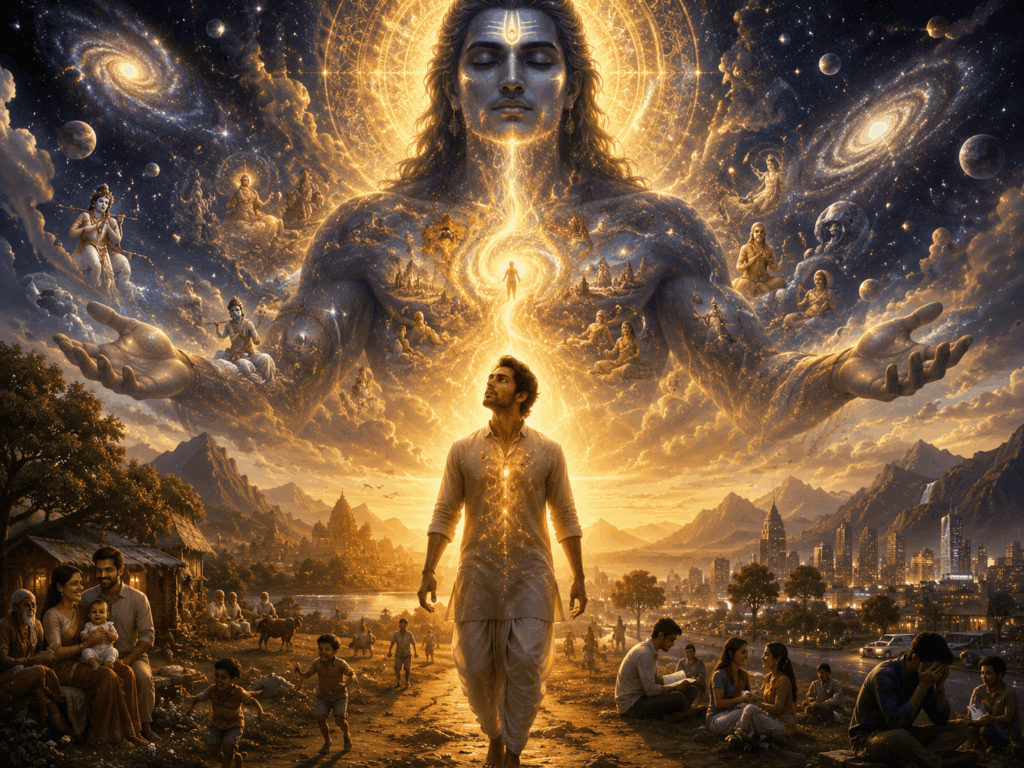
Once you understand what is jiva in Hinduism — the individual soul experiencing existence — the next question immediately arises: why? Why does this individual, limited, mortal Jiva exist at all?
The Jiva exists so that Brahman can know itself.
Not abstractly. Not philosophically. But concretely, specifically, intimately — through the experience of being a particular, limited, individual creature in a particular time and place. You — this specific Jiva in Hinduism — are how Brahman is knowing itself right now, through this angle, in a way it could not know itself any other way.
Why Jiva in Hinduism Is Not a Mistake
Pure, infinite, unlimited consciousness — with nothing to know, no contrast, no texture — has no experience of itself. The moment the first wave rises, the ocean knows something about itself it could not know in stillness. What is Jiva in Hinduism?- It is Brahman’s wave — not a fall from grace, but a conscious act of self-knowing.
The Brahma Sutra gives the most direct answer. Creation — including the creation of individual souls — is Lila. Divine play. Not necessity. Not obligation. The spontaneous, free, joyful expression of creative delight — the way a poet writes not because he must but because the poem is already alive inside him wanting to come out.
analogy – to understand what is jiva in hinduism
Brahman does not create Jivas the way a factory produces products. Brahman becomes Jivas — the way a dreamer becomes the characters in a dream. The dream characters are real within the dream. They have their own inner lives, their own journeys. And they are entirely the dreamer — never separate from it even for a moment. The Jiva exists because existence is Brahman’s own nature overflowing into expression.
Kashmir Shaivism goes even deeper in explaining why jiva in Hinduism exists in its condition of forgetting. It says Brahman — called Shiva — performs five acts continuously. The fourth act is Tirodhana — divine concealment. Brahman deliberately conceals its own nature from itself. Not as a mistake. As the most profound act of creative genius possible.
“Without the experience of not-knowing, the act of knowing has no meaning.”
The Logic of Tirodhana · Kashmir Shaivism
The Jiva exists in its state of apparent separation — feeling small, mortal, lost — precisely so that the moment of recognition, when it comes, is real. Is earned. Means something. The Jiva is Brahman giving itself the gift of its own rediscovery.
But we must be honest about one thing. If the Jiva exists for Brahman’s self-knowledge — why does the process involve so much suffering?
Radhakrishnan’s answer to why jiva in Hinduism involves suffering is the most honest: “God lives, feels and suffers in every one of us.” The suffering is not punishment. It is Brahman experiencing the full spectrum of what it means to be finite — to love and lose, to want more than you have, to feel the gap between what you are and what you sense you could be. That gap — that ache — is Brahman’s most powerful invitation to itself to wake up.
Question Three
What Happens When the Jiva Knows Its True Identity?
This is the final and most important question about what is jiva in Hinduism. And the answer is not what most people imagine.
The Jiva does not become something it was not. It stops believing it is something it never was.
Liberation is not an acquisition. It is the removal of a misunderstanding that was always already false. The Atman was never bound. The Jiva’s sense of being small, separate, and mortal was a case of mistaken identity — real in experience, false in fact.
What happens at recognition is simply this — the mistake is seen through. Five things shift, in sequence:
1
The Outward Search Exhausts Itself
The Jiva spends lifetimes seeking completion outside — in relationships, achievement, pleasure, security. Each thing reached satisfies briefly, then the longing returns. The Aitareya Aranyaka says: whatever he reaches, he desires to go beyond it. This perpetual insufficiency is not a flaw. It is the most important teaching the Jiva will ever receive. The search finally turns inward.
2
Discrimination Awakens
Buddhi — the higher intellect — begins functioning at its true capacity. Not just processing data but discriminating between the permanent and impermanent, the self and the not-self. The Jiva starts asking: is this awareness itself? Or is this something awareness is watching?
3
The Witness Is Noticed
The Jiva stops identifying with the content of experience and begins to recognise the container of experience. The awareness present through every state — waking, dreaming, deep sleep — unchanged, uninvolved, untouched. The second bird. The one that was always watching. The Jiva does not become this witness. It recognises it always already was.
4
The Boundary Dissolves
The sense of being a separate observer inside a body looking out at a world begins to thin. The Mandukya Upanishad calls the ultimate state Turiya — the fourth — the awareness in which all three states arise. This awareness has no location. It is not inside the body. The body is inside it.
5
The Great Equation Is Seen Directly
Aham Brahmasmi — I am Brahman. Not as a belief. Not as a philosophical conclusion. As the most direct, immediate, undeniable perception possible. The Jiva does not merge into Brahman the way a drop falls into the ocean. It recognises it was always the ocean — temporarily experiencing itself as a drop.
The four great schools of Indian philosophy each give a different answer to what ultimately happens when jiva in Hinduism recognises its true nature:
Advaita · Shankara
The Jiva’s individuality was never real — only apparent, caused by avidya. When avidya is removed, only Brahman remains. There was never a separate Jiva to merge or not merge.
Vishishtadvaita · Ramanuja
The Jiva is real and remains distinct — but recognises its inseparable unity with Brahman. Like a cell in a body recognising it is part of the body. Real, distinct, and inseparable simultaneously.
Dvaita · Madhva
The Jiva remains eternally distinct even at liberation — but fully illuminated by Brahman. Like a crystal placed in sunlight. The distinction remains. The bondage is gone.
Kashmir Shaivism
Shiva performs Anugraha — the act of grace — the fifth of his five acts. The concealment lifts. Not through effort alone but through practice, inquiry, and the divine grace that was always waiting.
All four agree on this — the recognition ends the suffering of the separate self. The grief of the first bird passes away the moment it sees the second.
And what changes — and what does not? The Jiva does not disappear. The personality does not evaporate. What changes is identification. The Jiva no longer takes the ego to be its ultimate identity. It wears the ego the way you wear clothes — using it, moving through the world with it, but never again confusing it for the self beneath.
At Last..
The Upanishad’s Final Word on What Is Jiva in Hinduism
“In other living creatures, ignorance of self is nature. In each human body the two principles of immortality and death are simultaneously present.” Only the human Jiva in Hinduism has both — and only the human Jiva can choose which one to identify with.
A Question to Sit With
The wave searched the ocean for water its entire life. Then one day it became still enough to look down — and saw it was made of the very thing it was searching for.
When did you last feel that stillness — and what did you notice in it?
Learn more such simplified wisodm from Upanishads > Vedanta Simplified
References & Sources
This blog draws from Radhakrishnan’s introduction to The Principal Upanishads (Section XIV) and the Chandogya, Katha, Mandukya, and Svetasvatara Upanishads. All philosophical positions on what is jiva in hinduism are grounded in these primary sources.
S. Radhakrishnan · George Allen & Unwin, 1953
Trans. S. Radhakrishnan
Katha Upanishad · I.3.3–4 and II.1.1
Trans. S. Radhakrishnan
Mandukya Upanishad · Karikas 1–12
Trans. S. Radhakrishnan
Trans. S. Radhakrishnan
Brahma Sutra (Vedanta Sutra)Badarayana ·
Commentary by Shankaracharya · Referenced in Radhakrishnan · p.86
NOTE : – All philosophical interpretations are the author’s own synthesis informed by these sources. For deeper reading on what jiva means in Hinduism, Radhakrishnan’s The Principal Upanishads (Section XIV) and the Chandogya Upanishad VIII.7–12 are the most direct primary sources. For the Kashmir Shaivism perspective, Jaideva Singh’s translation of the Pratyabhijnahridayam is the most accessible entry point.

Hina is the founder of BrowsingIndia, a platform dedicated to making Indian philosophy, epics, and consciousness-related ideas accessible to curious readers. A computer engineer by profession, her lifelong passion for Indian scriptures led her to pursue a Master’s in Hindu Studies, and she is currently a PhD research student in the same field. Her writing is grounded in close reading of primary texts and respected scholarly sources.