
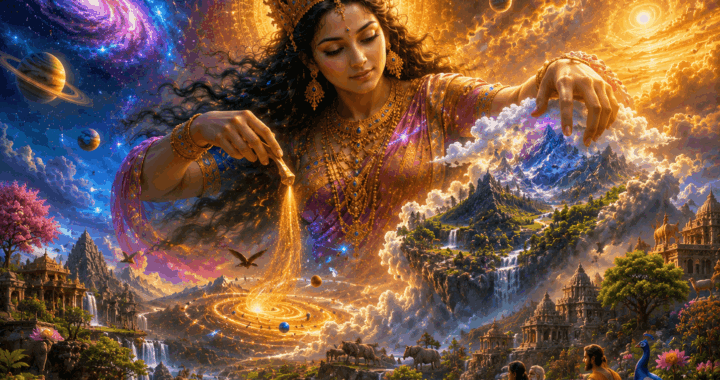
What Is Maya in Hinduism? Everyone says maya means illusion. The Upanishads say something far more interesting — and far more relevant to your life right now.
Maya measures out, moulds forms in the formless. It is the divine art by which God makes a likeness of the eternal prototypes inherent in his own nature.
Radhakrishnan · The Principal Upanishads
Table of Contents
The Common Answer — And Why It Falls Short
Ask most people what maya means in Hinduism and you get one word back: illusion. The world is maya. Life is maya. All unreal. All false.
This is not entirely wrong. But it is so incomplete that it becomes misleading. Because the part it leaves out is the most important part.
The Upanishads do not ask you to deny the world. They ask you to see it rightly. And that is a completely different instruction.
❌ The Common Answer
Maya means the world is an illusion. Nothing is real. The goal is to see through the illusion and escape it.
✓ What Maya in Hinduism Actually Means
Maya is the divine creative power by which Brahman projects the universe from within itself. The world is real — but not self-sufficient. The goal is to see it rightly.
What Is Maya in Hinduism — The Original Meaning
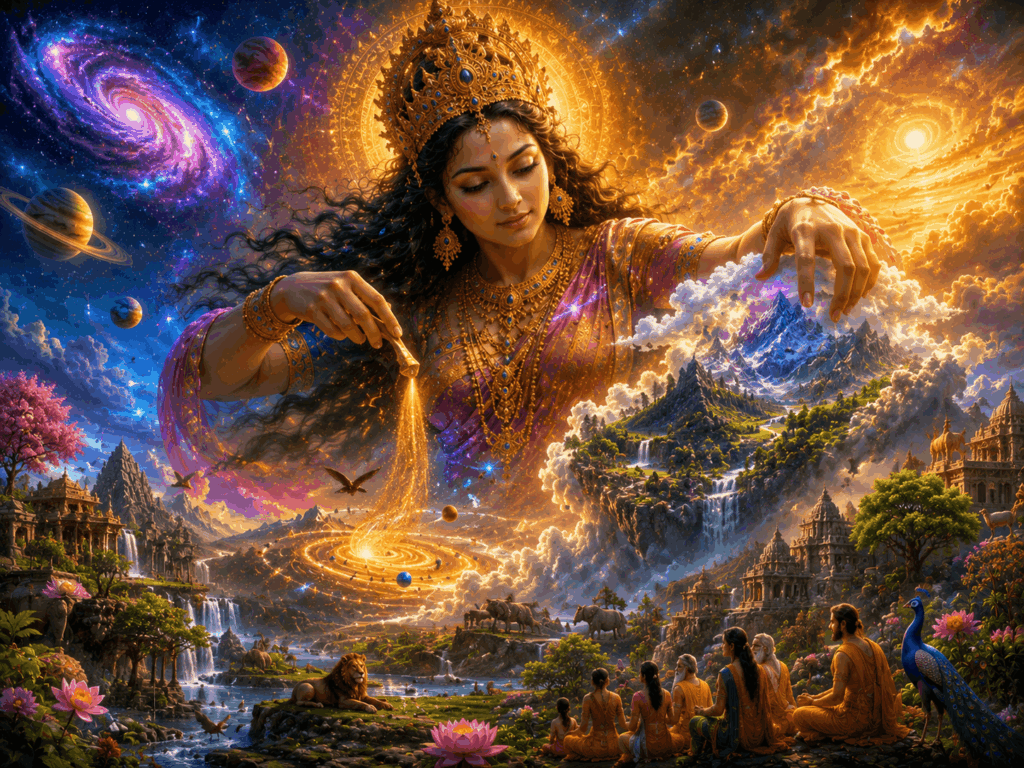
To understand what maya means in Hinduism properly, we have to go back to the beginning — to the Rig Veda, India’s oldest scripture. In its original sense, maya means the divine art or power by which God makes forms from formlessness. Indra is praised for assuming many shapes through his maya. His maya is his creative power — his ability to project from his infinite nature specific, limited, particular expressions.
This is the first and most important truth about maya in Hinduism. It is not trickery. It is the creative power of God.
Root Meaning of Maya in Hinduism
Maya comes from the Sanskrit root ma — to measure, to form. What is maya in Hinduism at its deepest? The measuring-out of the infinite into the finite. Not a mistake. A creative act. God projecting the universe from within himself, the way a dreamer projects an entire world from within their own consciousness.
The Svetasvatara Upanishad describes God as mayin — the wonder-working Being who creates the world through his maya. And then it says something crucial:
“God has control of maya. He is not subject to it.”
Radhakrishnan · The Principal Upanishads · p.84
God wields maya the way an artist wields a brush. He is not trapped in the painting. We, however, are a different story. We will come back to that.
God Does Not Create the World — God Becomes It
This is where understanding what is maya in Hinduism gets truly extraordinary — because the Upanishadic answer challenges everything Western religion taught about creation.
Radhakrishnan, reading the Upanishads closely, writes: “God does not create the world but becomes it. Creation is not a making of something out of nothing. It is the self-projection of the Supreme.”
God does not stand outside raw material and fashion a universe. There is no raw material outside God. The universe arises from within God — the way a dream arises from within the dreamer. The dream is real inside the dream. But it has no existence apart from the dreamer.
The Brahma Sutra calls this act of maya in Hinduism a Lila — divine play. Not necessity. Not obligation. Not mistake. Joy overflowing into expression.
The Key Concept
Līlā
Divine Play · The Joy of Creation
The world is not God’s burden. It is his play — the free, joyful expression of creative delight. The Supreme is called a kavi — a poet, an artist — and the world is his poem.
This means the physical world — including every difficult, painful, ordinary part of it — is not something God regrets. It is Brahman in the act of self-expression. No less sacred for being material.
What Is Maya in Hinduism vs Avidya — The Distinction That Matters
Now we get to the personal part. And the most important distinction in the entire question of what is maya in Hinduism.
There are two different things the word maya describes. Radhakrishnan insists they must be kept separate.
Maya at the cosmic level is God’s creative power — the divine art that projects the universe. This is not a problem. It is the universe working exactly as intended.
Avidya at the individual level is our ignorance — the personal mistake of looking at the world as if it were self-sufficient and ultimate. As if the world contained its own meaning within itself. As if you were a separate, self-sufficient ego in a world of other separate egos.
This is the real problem maya points to in Hinduism. Not that the world exists. But that we misread what the world is.
“Maya is concerned not with the existence of the world but with the meaning of the world — not with the factuality of the world but with the way in which we look upon it.”
Radhakrishnan · The Principal Upanishads
When the Upanishads say overcome maya — they are not saying deny the world exists. They are saying stop treating the world as if it were self-explanatory and final. Understanding what is maya in Hinduism correctly means this: the world exists, but it does not carry its own meaning. Its meaning comes from Brahman.
Avidya breeds selfishness and fear because if you believe you are a separate ego in a threatening world, then grasping and defending yourself become rational. But the moment you recognise that the ground of your being is the same ground as everything else — that changes everything.
The Two Birds

To understand what maya means in Hinduism at the experiential level — not just the philosophical — the Svetasvatara Upanishad offers the single most vivid image ever given.
Svetasvatara Upanishad · IV. 6–7
Two birds, inseparable friends,
cling to the same tree.
One eats the sweet fruit.
The other looks on without eating.
Man sits grieving, bewildered —
but when he sees the other lord,
contented and knows his glory,
his grief passes away.
The First Bird
The Individual Self · The Jiva
Caught in experience. Eating the fruit — tasting joy, suffering, consequence. Immersed. Bewildered. This is you, as you ordinarily experience yourself.
The Second Bird
The Witnessing Self · The Atman
Simply watching. Never eating. Never affected. Always whole. Present through every experience — unchanged, unborn, undying. Inseparable. Same tree.
Liberation is not the first bird escaping from the tree. It is the first bird looking up and seeing the second bird. Recognising that what it truly is has never been entangled at all.
This is what avidya does. It makes the first bird forget the second bird is there. Not destroyed. Not absent. Simply overlooked — because the eating felt so urgent and total.
At Last… What Is Maya in Hinduism Saying About Reality?
This is the final question maya always raises — and it deserves a precise answer rather than a vague one.
Radhakrishnan states it simply:
“The world is real as based on Brahman. It is unreal by itself.”
-Radhakrishnan · The Principal Upanishads
The world is not a hallucination. Waking objects exist independently of your imagining them — the Upanishads are careful on this point. But the world is not self-sufficient. It does not contain its own meaning. It depends on Brahman the way an echo depends on the original sound. Remove the sound — the echo never was. The echo is real. But it is not ultimate.
And — most importantly — Brahman accepts world existence. The Ultimate Reality does not reject the world. It sustains the world and dwells within it. There is nothing in this world not lit up by God. Even the most ordinary material object is an expression of divine creative energy — to the eye that knows how to look.
The Complete Answer to What Is Maya in Hinduism
Maya in Hinduism is not asking you to reject life. It is asking you to stop mistaking the relative for the ultimate. The world is real — and it is not the final word. Both are true simultaneously. Living with that tension, clearly and without confusion, is what the Upanishads call wisdom.
A Question to Sit With
If the world is real but not self-sufficient — if you are both the bird eating and the bird watching — which bird is reading these words right now?
And has the watching one ever once been troubled by anything?
Learn more concepts like this from Upanishads > Vedanta explained simply
References & Sources
This blog draws primarily from Radhakrishnan’s introduction to The Principal Upanishads (pp. 80–90) and the Svetasvatara, Chandogya, and Katha Upanishads. All positions on what maya means in Hinduism are grounded in these primary sources.
S. Radhakrishnan · George Allen & Unwin, 1953
Svetasvatara Upanishad · IV.6–10
Trans. S. Radhakrishnan
Brahma Sutra (Vedanta Sutra)Badarayana ·
Commentary by Shankaracharya · Referenced in Radhakrishnan · p.86
Pratyabhijnahridayam · Sutras 1–5
Kshemaraja · Kashmir Shaivism · Trans. Jaideva Singh
Note: – All philosophical interpretations are the author’s own synthesis informed by these sources. For deeper reading on what maya means in Hinduism beyond the common illusion interpretation, Radhakrishnan’s The Principal Upanishads (Introduction, Section XII–XIII) is the most accessible scholarly treatment in English.

Hina is the founder of BrowsingIndia, a platform dedicated to making Indian philosophy, epics, and consciousness-related ideas accessible to curious readers. A computer engineer by profession, her lifelong passion for Indian scriptures led her to pursue a Master’s in Hindu Studies, and she is currently a PhD research student in the same field. Her writing is grounded in close reading of primary texts and respected scholarly sources.