
From a silent, formless void to a human being reading these words — the most extraordinary journey ever taken, and the traveller was always the same.
The world is not the result of meaningless chance. There is a purpose working itself out through the ages — and that purpose is consciousness coming to know itself, through everything that has ever existed.
– Radhakrishnan · The Principal Upanishads
Begin With What You Know
Right now, you are reading. You are aware of these words. You know you are reading. That simple, undeniable fact — awareness knowing itself — is the entire story of how Brahman experiences itself. Except in the version we are about to tell, it took roughly fourteen billion years to arrive at this moment.
In the last blog, we established what Brahman is — the ground of all existence, pure consciousness, the one reality beneath everything. We also asked: if Brahman is already infinite and complete, why does a universe exist at all?
The answer: Brahman is not a distant God observing creation. Brahman is consciousness itself — and consciousness, by its nature, must know. How does Brahman experience itself? Through the universe. The cosmos is how the infinite gets to know itself — from the inside.
But knowing that answer intellectually is one thing. Feeling it — seeing it — in the actual unfolding from void to matter to life to you — that is something else entirely. That is what this blog is for.
The Central Idea – How does Brahman Experience Itself?
The entire history of the universe — from the first particle to the last thought you had — is one continuous act of Brahman progressively waking up to its own nature. You are not a spectator of this process. You are its current frontier.
The Five Sheaths — A Map of How does Brahman Experience Itself
The Upanishads gave us a precise map of Brahman’s self-experience — the progressive journey inward from matter to pure awareness. They called it the doctrine of the Pancha Kosha — the Five Sheaths. Imagine an infinitely bright light wrapped in layer after layer of progressively thicker veils. Each veil dims the light — but also gives it a new way to know itself.
01
Annamaya
The sheath of food — the physical body, matter itself
02
Pranamaya
The sheath of life — the vital force, biological energy
03
Manomaya
The sheath of mind — emotion, instinct, perception
04
Vijnanamaya
The sheath of intellect — reason, self-reflection, inquiry
05
Anandamaya
The sheath of bliss — the nearest veil to Brahman itself
These are not arbitrary categories. They describe a living sequence — a real journey that Brahman takes, from pure formless awareness all the way to the physical universe, and then back again through progressive self-recognition. Let us walk through each stage.
The Six Stages of Brahman’s Self-Experience
How does Brahman experience itself across fourteen billion years of cosmic history? Radhakrishnan, drawing from the Upanishads, describes this with a vision that maps almost perfectly onto what modern cosmology and biology have independently discovered. This is not coincidence. This is what happens when you look deeply enough — the same truth appears whether you measure it with instruments or sit in silence long enough to see it directly.
The Evolutionary Arc of Consciousness
Stage One · The Void
Before the Beginning
Brahman as pure, undifferentiated awareness. No object. No experience. No time. Perfect fullness — and yet, in a profound sense, nothing to know itself with. The Nasadiya Sukta of the Rig Veda calls this the state before both being and non-being. Not darkness. Not light. Not even void — because void is still something. Simply — That.
Tad ekam — That One
Stage Two · Matter
Brahman as the Physical Universe
Through its own intrinsic creative power — what the Upanishads call Tapas, and Kashmir Shaivism calls Shakti — Brahman crystallises into the physical universe. Stars. Galaxies. Atoms. Elements. This is Brahman at its most contracted, most seemingly unconscious, most hidden from itself. The Annamaya kosha — the sheath of matter. And yet — every atom of this universe is still Brahman. Just Brahman asleep.
Annamaya Kosha — the body of matter
Stage Three · Life
Brahman Stirs in Matter
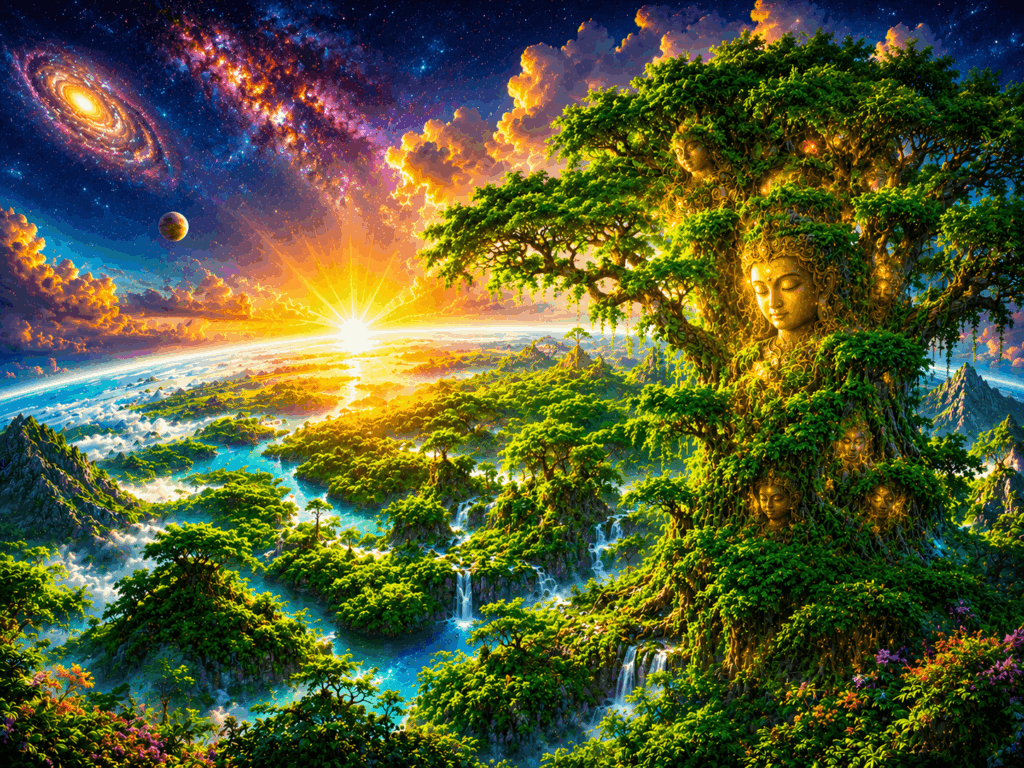
When matter arranges into the right conditions, something extraordinary happens. Life appears. But — and this is critical — life is not produced by matter. Radhakrishnan is explicit on this point: the principle of life is already in Brahman. Matter creates the conditions; life expresses through it. This is Brahman beginning to wake up. The first flicker of interiority in the universe. A living cell that responds, that moves toward light, that sustains itself — this is consciousness beginning to look outward.
Pranamaya Kosha — the body of life-force
Stage Four · Mind
Brahman Begins to Feel
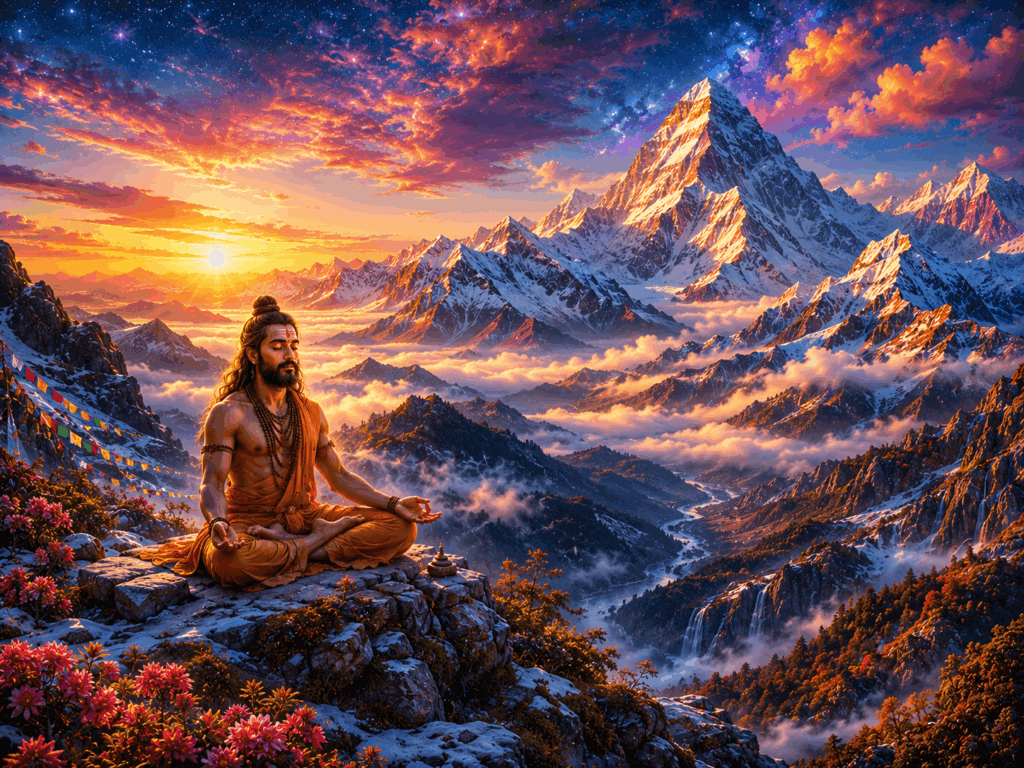
As life complexifies into animal existence, a new sheath emerges — Manomaya — the sheath of mind. Sensation. Emotion. Desire. Fear. The antelope running from the lion is not just matter in motion — it is Brahman experiencing urgency, alarm, the will to survive. Every creature that has ever felt anything — joy, hunger, warmth, terror — is Brahman experiencing itself through that feeling. The universe is no longer merely existing. It is now feeling its own existence.
Manomaya Kosha — the body of mind and feeling
Stage Five · Intelligence
Brahman Turns to Look at Itself
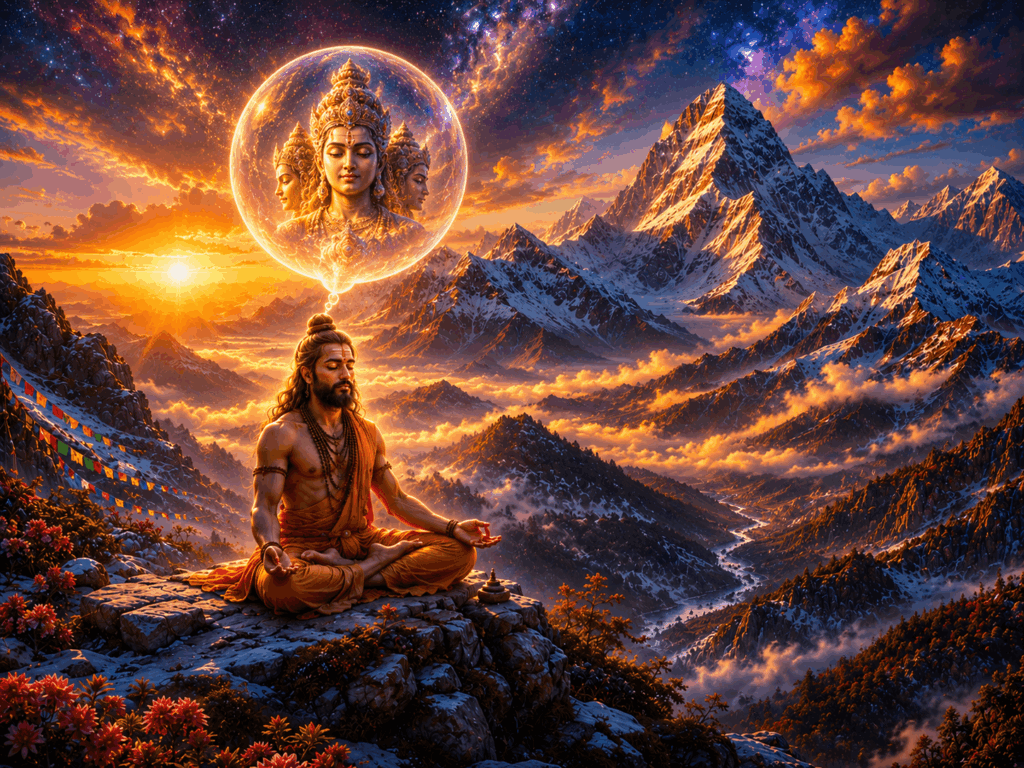
In the human being, something unprecedented appears in the history of the cosmos. Self-conscious reason. The ability not just to experience — but to step back from experience and ask: what is experiencing this? Who am I? Why does anything exist? This is Vijnanamaya — the intellect sheath. The universe has become aware of itself as a universe. Brahman has evolved a nervous system sophisticated enough to begin asking the question it has been moving toward all along.
Vijnanamaya Kosha — the body of intelligence and self-reflection
Stage Six · Recognition
Brahman Remembers What It Is
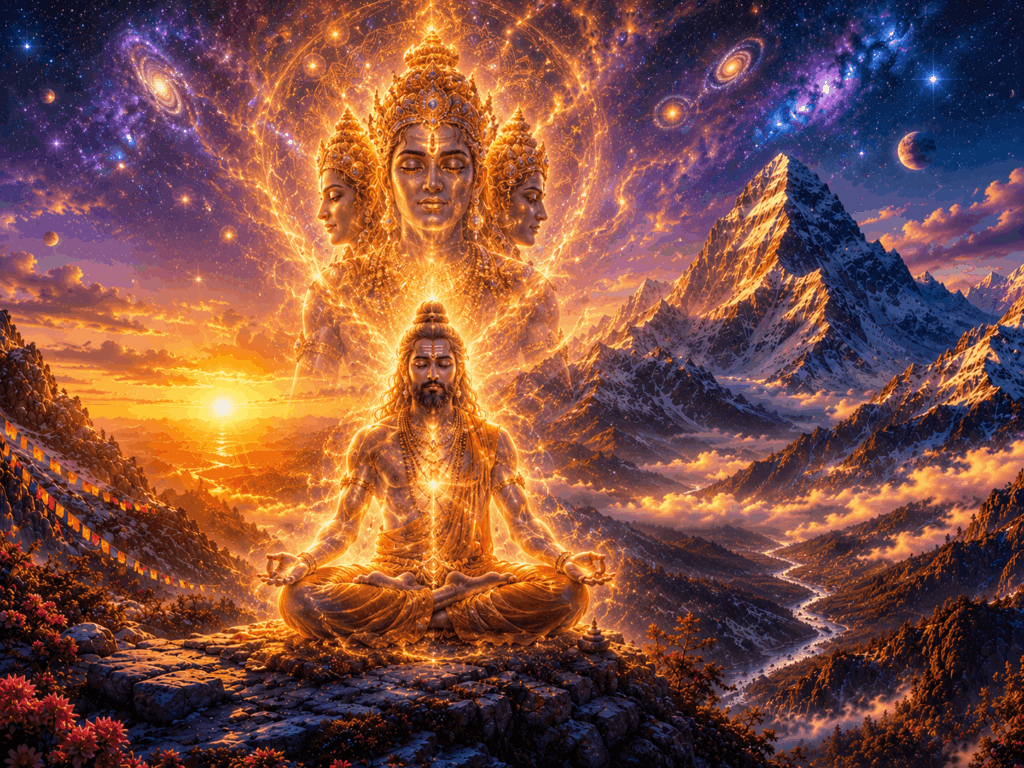
Beyond intellect — in deep meditation, in moments of profound love, in the ecstasy of genuine creative insight — the boundary between the knower and the known dissolves. The seeker and the sought collapse into one. This is Anandamaya — the bliss sheath — and beyond it, Brahman itself, unveiled. The Upanishad says: Absolute Reality is Satyam, Jnanam, Anantam — Truth, Consciousness, Infinity. The journey that began in formless silence ends in formless recognition. And the recogniser and the recognised were always the same.
Anandamaya Kosha — the body of bliss · and beyond — Brahman
Why Did Brahman Need to Forget Itself?
There is a question that naturally arises here. If Brahman’s self-experience through the universe is intentional — if this is how Brahman knows itself — why does the process involve forgetting? Why the fourteen-billion-year detour through matter, life, suffering, confusion, and death? Why not simply remain in pure awareness?
The Upanishads, Kashmir Shaivism, and Advaita Vedanta all converge on the same answer — one of the most profound things ever articulated about the nature of consciousness.
You cannot know what you are unless you experience what you are not.
Analogy
Pure, infinite light filling all of space — with no surfaces to illuminate, no shadows, no objects — is, functionally, the same as darkness. Light only knows itself as light when it meets resistance, contrast, something other than itself. Brahman, to fully experience its own nature as love, had to experience the absence of love. To experience its nature as bliss, it had to experience suffering. To know itself as infinite, it had to experience the feeling of being finite, limited, mortal. The forgetting was not a mistake. The forgetting was the plan.
Kashmir Shaivism calls this divine forgetting Tirodhana — the act of concealment, the fifth of Shiva’s five acts. It is not something that happened to Brahman from outside. It is something Brahman does to itself, willingly, continuously, out of the same creative impulse that produced the universe in the first place.
And here is the twist that changes everything about your own story. The confusion you feel. The sense of being a small, separate person in a large, indifferent universe. The anxiety, the longing, the searching for something you cannot quite name — this is not evidence that something has gone wrong. This is Tirodhana working exactly as intended. You are Brahman in the act of forgetting itself perfectly enough that the remembering — when it comes — will mean something real.
The Paradox at the Heart of Existence
Brahman does not need the universe to be complete. Brahman creates the universe to experience completeness — which is only possible from within the experience of incompleteness. Every human longing is Brahman’s longing for itself, wearing the costume of a specific person with a specific hunger.
Rumi Saw This Too
Radhakrishnan, in his introduction to the Principal Upanishads, quotes a poem that stopped me cold the first time I read it. It is from Jalal ud-Din Rumi — the 13th century Sufi mystic who had never read the Upanishads and who lived in a completely different culture, language, and tradition. And yet he describes the exact same journey — Brahman’s descent into matter and its return through progressive stages of existence — with such precision that it feels less like poetry and more like a map.
Jalal ud-Din Rumi · 13th Century
I died a mineral and became a plant,
I died a plant and rose an animal,
I died an animal and I was man.
Why should I fear?
When was I less by dying?
Yet once more I shall die as man, to soar
With the blessed angels — but even from angelhood
I must pass on. All except God perishes.
When I have sacrificed my angel soul, I shall become that which no mind ever conceived.”
To him we shall return.”
Mineral. Plant. Animal. Man. Angel. And beyond — something no mind has conceived. This is the Pancha Kosha described by a poet who reached the same insight through a completely different door. The Upanishads say this convergence is not coincidence — it is what always happens when consciousness looks at itself honestly for long enough. It finds the same truth.
At Last… What This Means About You, Specifically
Let us be very concrete now, because philosophy without application is just beautiful furniture that nobody sits on.
If we ask how does Brahman experience itself most fully — the answer, according to the Upanishads, is: through a human being who is consciously inquiring into its own nature. The atom cannot ask “who am I?” The bacterium cannot wonder about consciousness. The antelope cannot read an Upanishad and feel something shift. Only you can do this. Only a being at the Vijnanamaya level — with self-conscious intelligence — can turn awareness back on itself and begin the journey of recognition.
This means your spiritual seeking — every meditation, every genuine question, every moment of wonder that stopped you in your tracks — is not a personal hobby. It is Brahman’s self-experience, happening through you, at the frontier of its own self-recognition.
analogy
The universe spent billions of years producing the right conditions for stars, then for planets, then for single-celled life, then for multicellular life, then for nervous systems, then for self-conscious intelligence, then for the specific conditions that produced you. Not so that you could ignore the whole thing and watch television. So that in you, right now, the universe could look back at itself with enough clarity to finally ask — and answer — the question it has been moving toward since the first stirring in the void.
Radhakrishnan writes that the great spiritual men of history — the Buddhas, the Ramanujas, the Shankaracharyas, the Rumis — are not exceptions to human nature. They are the direction human nature is already moving. They arrived early at the destination the rest of us are still walking toward. And the path they walked — inquiry, practice, devotion, surrender — is simply the conscious acceleration of the process that Brahman has been driving forward unconsciously through evolution for billions of years.
Prajnanam Brahma
Consciousness Is Brahman
— Aitareya Upanishad · One of the Four Great Sayings
Not — consciousness is produced by Brahman. Not — consciousness will merge with Brahman when you achieve liberation. But: consciousness is Brahman. Right now. The awareness reading these words is not separate from the ground of all existence, trying to get back to it. It is the ground of all existence, temporarily wearing the costume of a reader.
A Question to Sit With
From the void before the Big Bang to the atom to the bacterium to the animal to the human to the sage who dissolves into pure awareness — if that is one continuous journey of Brahman knowing itself — where, exactly, in that journey are you right now?And what does it feel like to be this close to the destination?
References & Sources
This blog draws from Radhakrishnan’s introduction to The Principal Upanishads and the Upanishadic texts themselves. All philosophical positions on how Brahman experiences itself are grounded in these primary sources.
The poem “I died a mineral and became a plant” — used to demonstrate the convergence of Sufi mysticism and Upanishadic philosophy on the same vision of how consciousness progressively experiences and knows itself through successive levels of existence.The Principal Upanishads
S. Radhakrishnan · George Allen & Unwin, 1953
Taittiriya Upanishad · II.1–5
Trans. S. Radhakrishnan
The foundational source for the Pancha Kosha (five sheaths) doctrine — Annamaya, Pranamaya, Manomaya, Vijnanamaya, Anandamaya — and how consciousness progressively knows itself through each layer.
Aitareya Upanishad · II.1.3
Trans. S. Radhakrishnan
Source for the Prajnanam Brahma Mahavakya — “Consciousness is Brahman” — and the teaching that Brahman’s self-knowledge is expressed through progressive levels of being from plant to animal to human.
Shiva Sutras & Pratyabhijnahridayam
Kashmir Shaivism · Trans. Jaideva Singh
Source for the doctrine of Tirodhana — divine self-concealment as the mechanism by which Brahman forgets itself in order to experience the full arc of recognition. Also source for the five acts of Shiva: Srishti, Sthiti, Samhara, Tirodhana, Anugraha.
Masnavi · Jalal ud-Din Rumi · 13th Century
Referenced in Radhakrishnan · Principal Upanishads · p.57
The poem “I died a mineral and became a plant” — used to demonstrate the convergence of Sufi mysticism and Upanishadic philosophy on the same vision of how consciousness progressively experiences and knows itself through successive levels of existence.

Hina is the founder of BrowsingIndia, a platform dedicated to making Indian philosophy, epics, and consciousness-related ideas accessible to curious readers. A computer engineer by profession, her lifelong passion for Indian scriptures led her to pursue a Master’s in Hindu Studies, and she is currently a PhD research student in the same field. Her writing is grounded in close reading of primary texts and respected scholarly sources.