
What is Brahman is the question that has no easy answer. And the answer that changes everything.
In the beginning this world was Brahman alone. It knew only itself — I am Brahman. And so it became everything.
-Brihadaranyaka Upanishad · 1.4.10
Table of Contents
The Question Nobody Can Escape
At some point in your life — maybe late at night, maybe staring at the sky — a question has probably crept up on you that you couldn’t shake off.
Why is there something rather than nothing?
Why does the universe exist? Why does anything exist? Why are you here, reading this, thinking this, experiencing anything at all?
Modern science can tell you how the universe works — particles, forces, fields, the Big Bang. But it cannot tell you why there is a universe in the first place. That question sits beyond the reach of physics. It always has.
Indian philosophy — specifically the Upanishads — decided to begin right there. Not with atoms. Not with gods. With the most fundamental question possible: What is the ground of all existence? What is that one thing, knowing which, everything else is known?
Their answer was Brahman.
Key Insight
What is Brahman? he is not a god you worship. It is not a being who created the universe and watches it from outside. Brahman is the ground of existence itself — the one reality behind everything you have ever seen, thought, felt, or known.
What Does the Word Actually Mean?
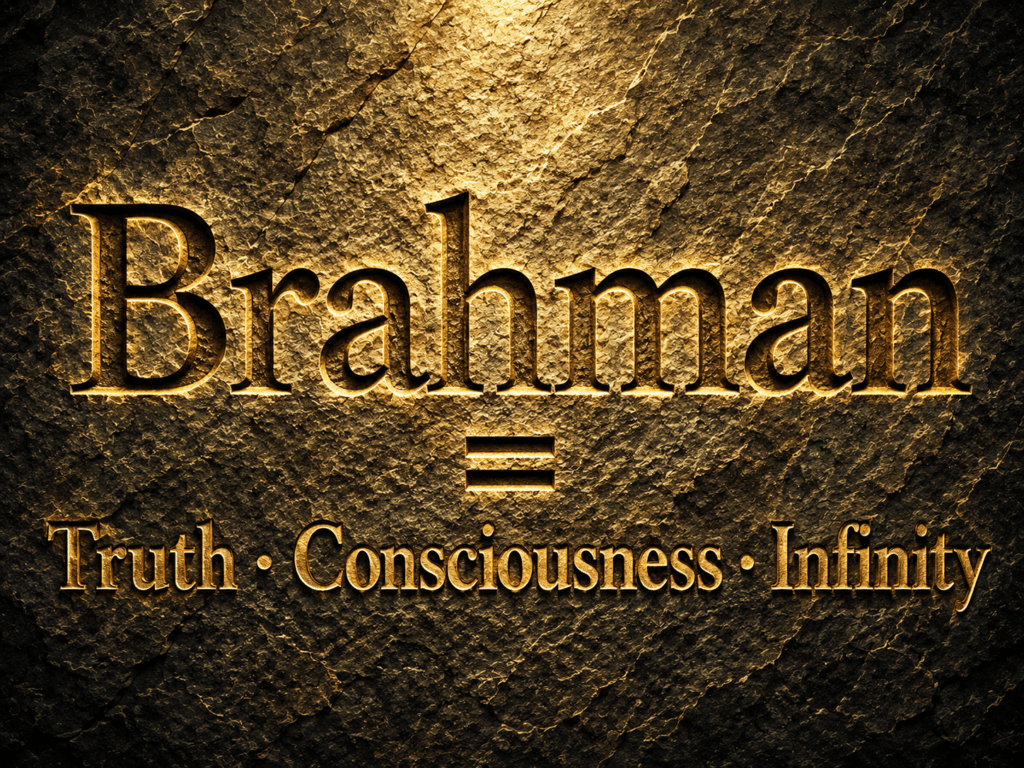
The word Brahman comes from the Sanskrit root brh — which means to grow, to expand, to burst forth. Radhakrishnan, one of India’s greatest philosophers, notes that it originally referred to the power in sacred speech — the sacred utterance that felt like it was reaching toward something beyond the speaker.
Gradually, through centuries of inquiry, the meaning deepened. The word that began as sacred chant became the name for the sacred reality behind all chanting. Behind all speaking. Behind all knowing.
The Upanishads describe Brahman with a phrase so stark it stops you cold:
What is Brahman literally mean in sanskrit
Satyam · Jñānam · Anantam
Truth · Consciousness · Infinity
— Taittiriya Upanishad
Not a person. Not a place. Not even a thing. Truth itself. Consciousness itself. Infinity itself.
And then — in one of the most extraordinary philosophical moves ever made — the Upanishads add: whatever you say about Brahman, Brahman is beyond that too. It is neti, neti — not this, not this. Every description falls short. Every name is just a finger pointing at the moon.
But Where Did Brahman Come From?
Here is where the Upanishads say something that the human mind finds almost impossible to digest.
Brahman did not come from anywhere. Brahman was never created. Brahman has no beginning.
Your mind immediately wants to push back — but everything has a beginning, doesn’t it? Something must have caused Brahman. What came before Brahman?
But that question itself assumes that Brahman is inside time. The Upanishads say time itself is inside Brahman. Time, space, causality — these are not the containers within which Brahman exists. They are the furniture within the room of Brahman’s consciousness. You cannot ask what came before Brahman for the same reason you cannot ask what is north of the North Pole. The question doesn’t work there.
Analogy – Let’s understand what is brahaman with example
Think of a dream. Inside the dream, events have causes. One thing leads to another. Time moves forward. But where does the entire dream exist? In your consciousness — before the dream began, during it, and after it ends. The dream didn’t cause your consciousness. Your consciousness contains the dream. Brahman is to the universe what your consciousness is to your dream — except infinitely more so.
The Rig Veda’s creation hymn — the Nasadiya Sukta — sits with this mystery instead of fleeing it. Before the universe, there was neither being nor non-being. Neither darkness nor light. Not even nothing — because nothing is still something. And then, the hymn says, That One breathed — breathless — by its own power.
Breathed — but without lungs. Stirred — but without anything outside to stir it. This is the Upanishads’ way of saying: Brahman’s nature itself contains the impulse toward self-expression. Not caused by anything. Not triggered by anything. But intrinsic — like how wetness is intrinsic to water. You don’t need a reason for water to be wet.
Why Does Anything Exist At All?
Now we arrive at the deepest question of all. Even if Brahman is eternal and uncaused — why did it produce a universe? Why not remain in pure, silent, undisturbed infinity forever?
The Upanishads offer an answer so simple and so profound that you may need to sit with it for a while.
Brahman is not just existence. Brahman is consciousness. And consciousness, by its very nature, knows.
But here is the problem. Pure, infinite, unlimited consciousness — with nothing to know, no object to perceive, no contrast, no texture — has no experience of itself at all. Think of pure light filling an infinite space with no surfaces, no objects, no shadows. That light illuminates nothing. It cannot even know it is light.
The Core Paradox – What is brahman
Brahman is infinite and complete — lacking nothing. And yet, infinite consciousness without any object of experience is, in a sense, consciousness that cannot know its own nature. The universe is Brahman’s solution to this paradox. It is how the infinite gets to know itself.
Kashmir Shaivism — one of the most sophisticated philosophical traditions in the world — describes this with crystalline precision. Shiva (their name for Brahman) performs five acts, not once at the beginning of time, but continuously, in every moment:
I) Srishti — Creation
The projection of experience. Brahman reaches out into apparent multiplicity — the way a dreamer projects an entire world from within.
II) Sthiti — Sustaining
The maintenance of that experience. The dream holds its coherence long enough to be experienced fully.
III) Samhara — Dissolution
The withdrawal back into the source. Every moment of experience dissolves back into the ground of awareness.
IV) Tirodhana — Concealment
The act of forgetting. Brahman, to truly experience something other than itself, must genuinely forget what it is. This is the veil of Maya.
V) Anugraha — Grace
The act of remembering. The slow, inevitable return to recognition — I am That. This is liberation. This is the whole point.
These five acts are not ancient history. They are happening right now. Every thought that arises in your mind is Srishti — a tiny act of creation. Every moment of rest is Sthiti. Every thought that dissolves is Samhara. Your forgetting that you are Brahman — your sense that you are a small, separate person in a large, indifferent universe — that is Tirodhana, the act of divine concealment. And every genuine moment of wonder, every flash of recognition, every meditation that dissolves the boundary between you and everything — that is Anugraha, grace, the remembering beginning.
The Universe Is Not a Mistake
This changes everything about how you understand your existence.
You are not an accident. You are not a random arrangement of particles that briefly gained the illusion of awareness before dissolving back into meaningless matter. You are Brahman having an experience of being you — fully, genuinely, with all the weight and texture and confusion and love that brings.
Radhakrishnan, reading the Upanishads, describes this in evolutionary terms that feel startlingly modern. Matter comes first — Brahman at its most contracted, most concealed. Then life emerges through matter — not because matter produces life mechanically, but because life is already in Brahman, and matter simply creates the conditions for it to express. Then mind. Then self-conscious intelligence. Then — the Upanishads insist — something beyond even that. The great men of history — the Buddhas, the Christs, the Ramanujas — are not exceptions to human nature. They are the direction human nature is moving.
Analogy
Imagine Brahman as an infinite ocean. The universe is not a bucket of water taken out of the ocean. It is the ocean itself, learning to know its own depths — by forming waves. Each wave is separate, temporary, unique. Each wave rises and falls. But no wave was ever anything other than the ocean. The rising was the ocean. The falling is the ocean. And the moment a wave recognises this — that is liberation.
The Upanishads summarise the whole of this in four words — four Mahavakyas, great sayings, one from each of the four Vedas. The most famous is from the Brihadaranyaka Upanishad:
Aham Brahmāsmi
I Am Brahman
Not as a belief. Not as a philosophical position. As a direct, living recognition.
Not “I will become Brahman when I reach enlightenment.” Not “I am trying to merge with Brahman.” But: I am Brahman — right now, already, always — underneath the temporary costume of this name, this body, this personality, this story I call my life.
At Last … Why This Matters for You, Right Now
You may be reading this “What is Brahman” and thinking — this is beautiful philosophy, but what does it actually do for me on a Tuesday morning when I’m stuck in traffic and anxious about my bills?
Here is what it does. It reframes the entire context of your existence.
If you are a random creature in an indifferent universe, then your suffering is just suffering — meaningless, going nowhere, signifying nothing. But if you are Brahman temporarily wearing the costume of limitation — then even your confusion is part of the pattern. Even your seeking is part of the return. Even your most difficult moments are Brahman experiencing itself through the texture of difficulty, learning something through you that infinite peace and silence could never learn.
The Upanishads do not promise you that realising this will make life comfortable. They promise something far more radical: that realising this will make you free. Not free from life — free within it. Because you will know, at the deepest level, that you are not merely in the game. You are the one who made the game, forgot you made it, and is slowly waking up to remember.
The Practical Truth
Every spiritual practice — meditation, yoga, prayer, self-inquiry — is not a technique for acquiring something you lack. It is a technique for removing what obscures what you already are. You are not becoming Brahman. You are remembering you always were.
A Question to Sit With
After understanding “What is Brahman” the question arise that If Brahman is the ground of all existence — if consciousness is not something the universe produced, but something the universe is made of — then what does that make the awareness reading these words right now? Not a question to answer. A question to inhabit.
Understand more of such concepts from Upanishads > Vedanta Explained Simply
References and Sources
Brihadaranyaka Upanishad · 1.4.10
Trans. S. Radhakrishnan Source for the Mahavakya Aham Brahmasmi — “In the beginning this world was Brahman alone. It knew only itself — I am Brahman. And so it became everything.”
Source for Satyam Jnanam Anantam Brahma — Brahman as Truth, Consciousness, and Infinity. The foundational definition of Brahman’s essential nature.
Rig Veda · Nasadiya Sukta · 10.129
The Creation Hymn — “That One breathed, breathless, by its own power.” Source for the description of the state before creation and Brahman’s intrinsic creative impulse.
Svetasvatara Upanishad · 4.6–7
Source for the Pancha Kosha doctrine (five sheaths) and the framework of Brahman’s progressive self-experience through matter, life, mind, intelligence, and bliss.

Hina is the founder of BrowsingIndia, a platform dedicated to making Indian philosophy, epics, and consciousness-related ideas accessible to curious readers. A computer engineer by profession, her lifelong passion for Indian scriptures led her to pursue a Master’s in Hindu Studies, and she is currently a PhD research student in the same field. Her writing is grounded in close reading of primary texts and respected scholarly sources.