
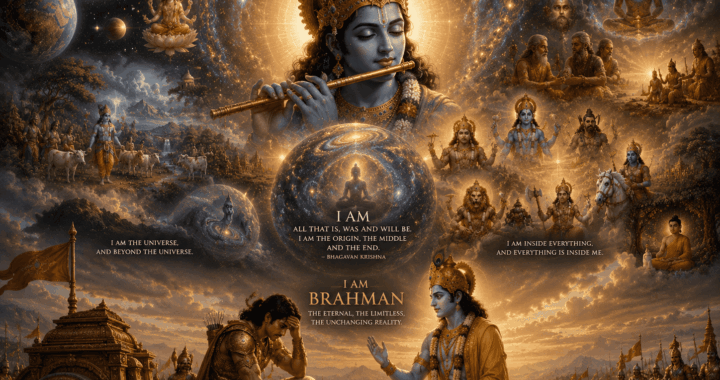
यदा यदा हि धर्मस्य ग्लानिर्भवति भारत।
अभ्युत्थानमधर्मस्य तदात्मानं सृजाम्यहम्॥ (4.7)
परित्राणाय साधूनां विनाशाय च दुष्कृताम्।
धर्मसंस्थापनार्थाय सम्भवामि युगे युगे॥ (4.8)
Whenever there is a decline of righteousness and a rise of evil, I manifest Myself. For the protection of the good, for the destruction of the wicked, and for establishing Dharma, I take birth in every age.
— Krishna · Bhagavad Gita 4.7–4.8
Yada yada hi dharmasya meaning most people know this verse read it as a simple promise. When things get bad enough, God will come. And yes, at one level that is exactly what it means. But these two verses — Gita 4.7 and 4.8 — carry something much bigger inside them. Read them at four different depths and they stop being a promise. They become a description of how life itself actually works.
Layer One · The Literal Meaning · Adhibhautika
God Actually Comes — The Dashavatara
The simplest reading of yada yada hi dharmasya meaning— and it is already extraordinary.
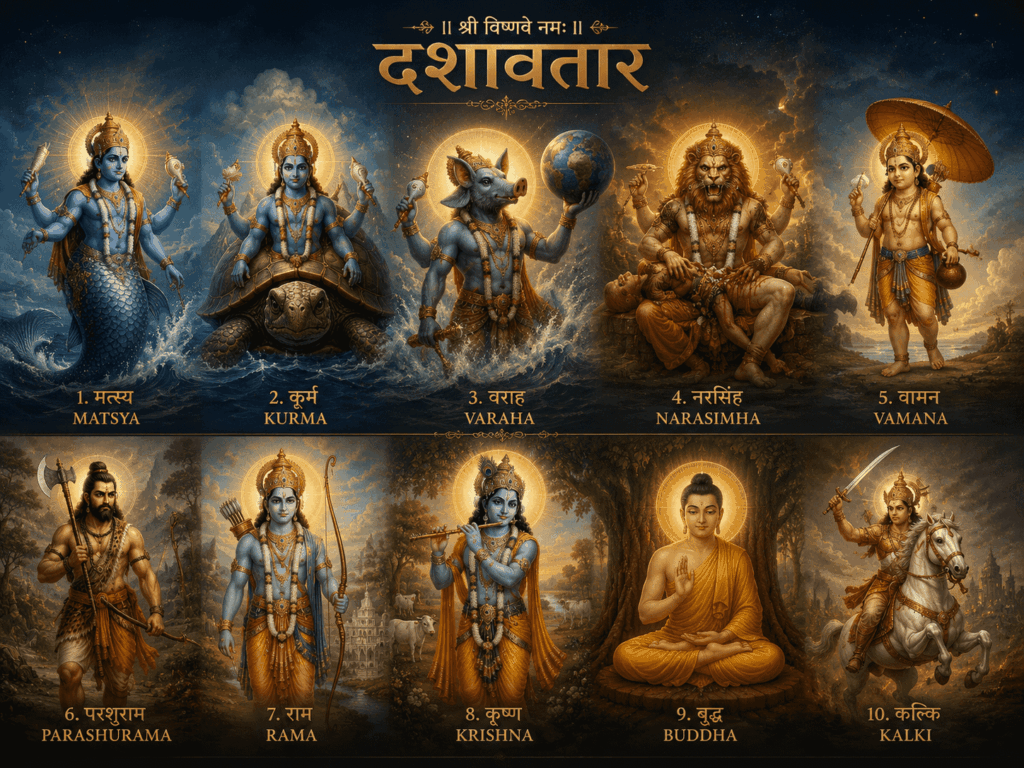
At this level these verses mean exactly what they say. When goodness — Dharma — collapses in the world. When cruelty and injustice rise so high that human beings alone cannot fix it — God does not sit back and watch. God enters. Takes a physical form. Shows up in history in a way that people can actually see and follow.
This is the tradition of the Dashavatara — the ten great forms Vishnu took across time. Each one came at exactly the moment when things had gone so wrong that something beyond human effort was needed.
Matsya
The Fish
Kurma
The Tortoise
Varaha
The Boar
Narasimha
Man-Lion
Vamana
The Dwarf
Parashu-
rama
Rama
Krishna
Buddha
Kalki
Yet to come
What this gives you: The deep comfort that the universe is not indifferent. That darkness never has the final word. That at the worst moments of history — something has always shown up. And according to these verses — always will.
Layer Two · The Psychological Meaning · Adhidaivika
The Avatar Rises Inside You
Yada yada hi dharmasya meaning is not only about the world outside. It is about what happens inside every human being..

Think about your own life. There are times when you feel clear — when you know what matters, when your actions feel right, when you are living from your best self. And then something shifts. Old habits come back. Fear creeps in. Resentment builds. You drift away from who you want to be. That is your inner Dharma declining.
And then — at exactly that low point — something happens. A conversation with a friend. A book that lands at the right time. A quiet moment where you suddenly see yourself clearly. Something stirs in you. You begin to pull yourself back. That stirring — that turning back toward your own better nature — that is the inner Avatar arising.
So when Krishna says he will destroy the wicked to protect the good — at this level he is not talking about people outside you. He is talking about what happens inside:
Kama · desire
Krodha · anger
Lobha · greed
Moha · delusion
Mada · pride
Matsarya · envy
What this gives you: the realization that yada yada hi dharmasya is personal — not just cosmic. Every single time you have pulled yourself back from your own darkness — you have already lived this verse.
Layer Three · The Consciousness Meaning · Adhyatmika
Awareness Always Finds Its Way Back
Consciousness never truly loses itself. It only seems to — so that the joy of returning becomes possible.
Here is where the yada yada hi dharmasya meaning becomes truly extraordinary. At this level we are not talking about the world or even your personal psychology. We are talking about the nature of consciousness itself.
Think of it this way. When awareness gets trapped — when it becomes so identified with fear, with ego, with limitation — something inside it naturally pushes back. Not from outside. From within its own nature. Awareness has a kind of built-in immune system. It cannot stay contracted forever. At some point it begins to move back toward what it actually is — open, free, unafraid.
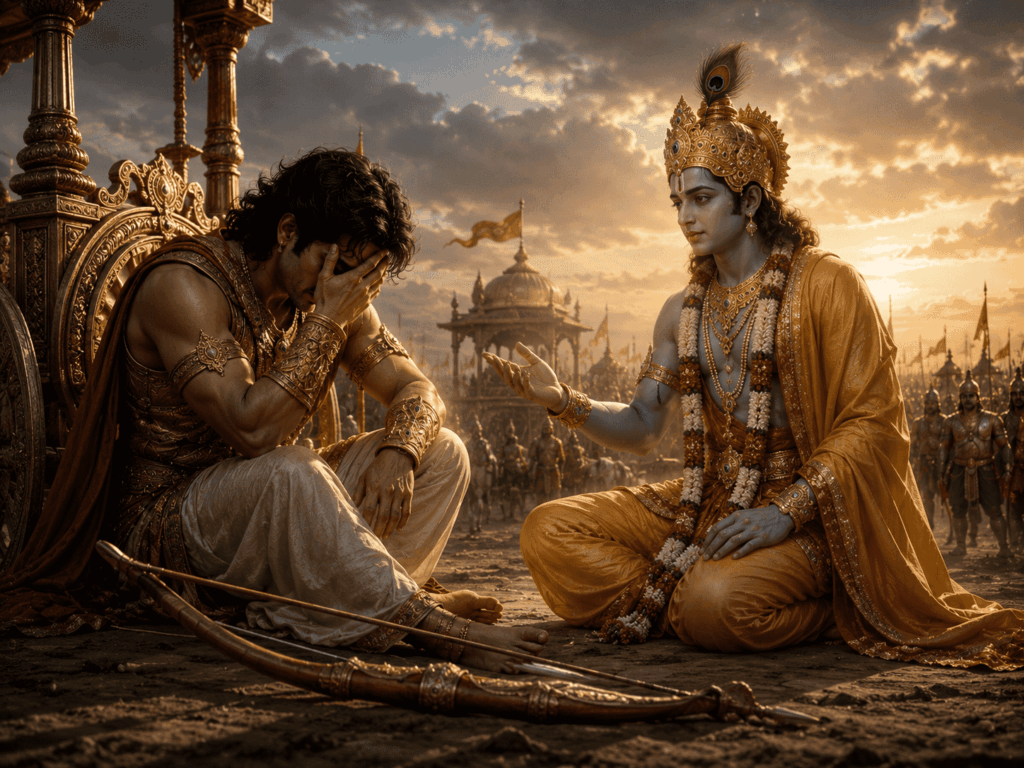
This is why the Gita begins with Arjuna completely broken. At his lowest. Unable to move. Because that is the moment of maximum contraction — and therefore the moment when the return becomes inevitable. Krishna does not appear despite Arjuna’s breakdown. He appears because of it.
The darkness is not just the problem. The darkness is the very pressure that makes the return certain. Adharma — when it reaches its peak — creates the conditions for its own reversal. This is not philosophy. This is how awareness works.
Layer Four · The Cosmic Meaning · The Brahmic Layer
There Is Only One — Playing Every Role
At the deepest level of yada yada hi dharmasya meaning — there is no broken world and no saviour. There is only one consciousness dreaming both sides.
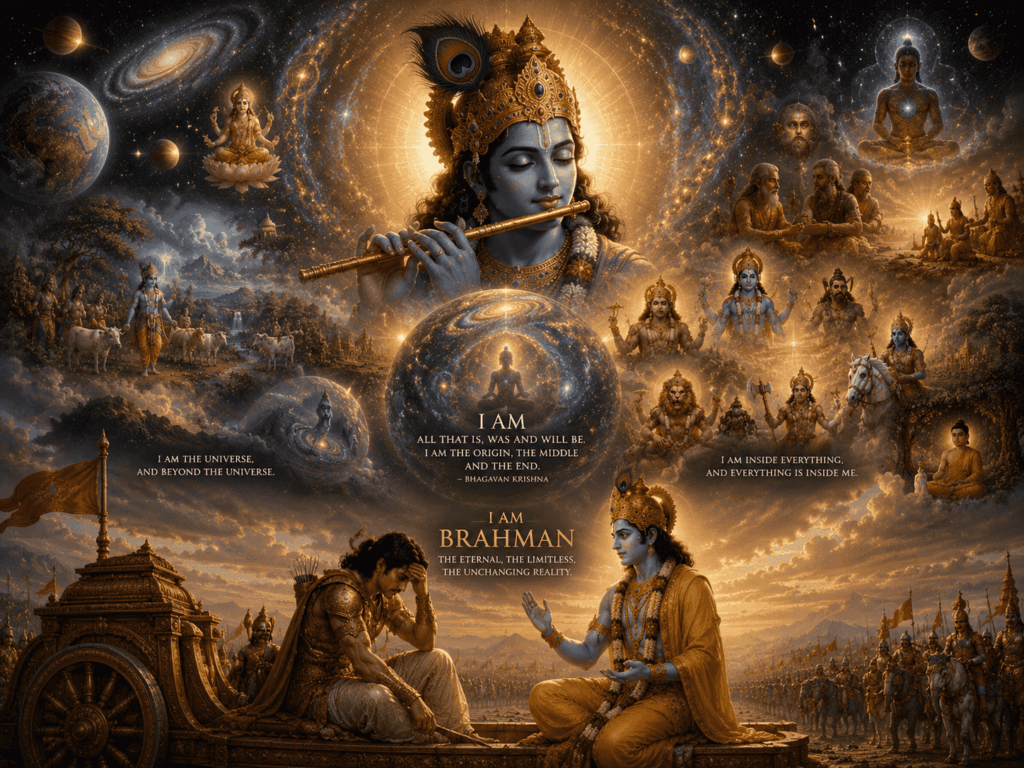
This is the hardest layer to explain — and the most freeing one to understand. At this depth, there is no separate world that has gone wrong and no God who enters to fix it. There is only one infinite consciousness — call it Brahman, call it the Absolute — and it is playing every single role at the same time. The darkness. The Avatar. The destruction of evil. The restoration of Dharma. The joy of return. All of it is the same one consciousness moving within itself.
The Avatar is not God solving a problem. The Avatar is consciousness waking up to its own nature — using the drama of a particular moment as the occasion. The forgetting and the remembering are both part of the same single movement.
Sambhavami yuge yuge — I am born in every age — at this level means something breathtaking. Not once every few thousand years. But in every moment where awareness begins to recognize itself. Perpetually. Everywhere. Right now.
The Avatar is not an interruption of ordinary reality. The Avatar is what ordinary reality always is — when you finally see it clearly enough.
Here is the most personal thing about the yada yada hi dharmasya meaning — and it is the thing that most explanations never reach.
Right now, as you are reading this — if something in you is recognizing these words as true. Not just understanding them in your head but feeling them somewhere deeper — that recognition itself is the Avatar. That is Krishna manifesting. That is Dharma being established. Not in ancient history. Not in some future age.
Right now. In you.
The darkness is not a mistake.
It is the setup.
The return was always
part of the plan.
A question to sit with
Think of the hardest moment in your own life — when you had completely lost your way. What came back to life in you at that lowest point? And now that you know the yada yada hi dharmasya meaning — can you see what was actually happening?
Read more insights from Bhagavat Gita from our Bhagavad Gita explained simply >
References & Further Reading
The verses cited, the books worth reading, and the teachers worth listening to — organized so you know exactly where to go next.
Verses Cited in This Blog
Gita 4.7
“Whenever there is a decline of righteousness and a rise of evil, I manifest Myself.”
The first verse — the promise of divine manifestation. The foundation of this entire blog.
Gita 4.8
“For the protection of the good, for the destruction of the wicked, and for establishing Dharma, I take birth in every age.”
The second verse — the four purposes of divine descent. Sambhavami yuge yuge.
Gita 6.5
“The Self alone is the friend of the self — and the Self alone is the enemy of the self.”
Referenced in Layer Two — the inner Avatar rising against inner Adharma.
Gita 1.28–47
Arjuna’s complete breakdown on the battlefield — the full description of his collapse.
Referenced in Layer Three as the example of maximum contraction — the moment that makes the Avatar’s arising inevitable.
Bhagavata Purana 1.3
The complete listing and description of the ten avatars — the Dashavatara tradition.
The primary Puranic source for Layer One of this blog.
Books
Radhakrishnan, S. (1948)
The Bhagavadgita: With an Introductory Essay, Sanskrit Text, English Translation and Notes
Ramanuja. Bhagavad Gita Bhashya (12th century CE)
Available through Ramakrishna Math, Chennai
Prabhupada, A.C. Bhaktivedanta Swami (1968)
Aurobindo, Sri (1922)
Essays on the Gita — Chapter Eight: The Divine Birth and Divine Works
Vivekananda, Swami (1896)

Hina is the founder of BrowsingIndia, a platform dedicated to making Indian philosophy, epics, and consciousness-related ideas accessible to curious readers. A computer engineer by profession, her lifelong passion for Indian scriptures led her to pursue a Master’s in Hindu Studies, and she is currently a PhD research student in the same field. Her writing is grounded in close reading of primary texts and respected scholarly sources.