
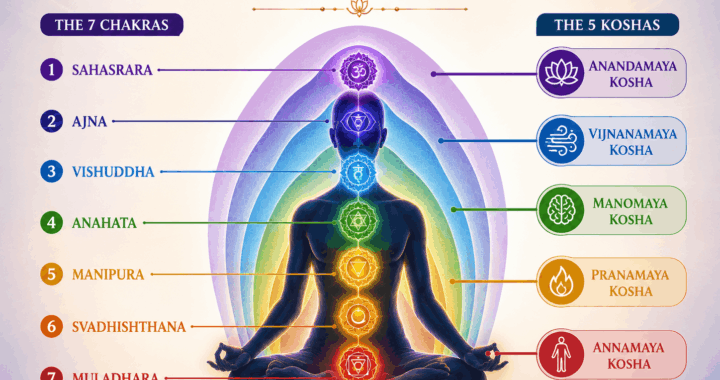
Table of Contents
The chakras and koshas connection is one of the most practically useful and most underexplained ideas in Indian philosophy. Most people encounter these two systems separately — chakras in a yoga class, koshas in a philosophy text. But here is what rarely gets said: they are not separate ideas. They are two different maps of the same interior journey.
Understanding the chakras and koshas connection changes how you work with both systems. Alone, each is interesting. Together, they become a complete practical roadmap — from the surface of ordinary experience all the way to pure consciousness.
One gives you the territory. The other gives you the doors.
The Chakras and Koshas Connection — A Reframe That Changes Everything
Important reframe
Chakras are not “closed” the way a door is closed. They are more like rivers — either flowing freely or partially blocked by sediment. The work is not to open them so much as to remove what is obstructing them. And what blocks them? Mostly unprocessed emotions, habitual thought patterns, physical tension, and unresolved experiences that get stored in the body.
With that in mind, let us look at the two systems — and then the precise way they connect.
The Panchkosha — Five Koshas of Being
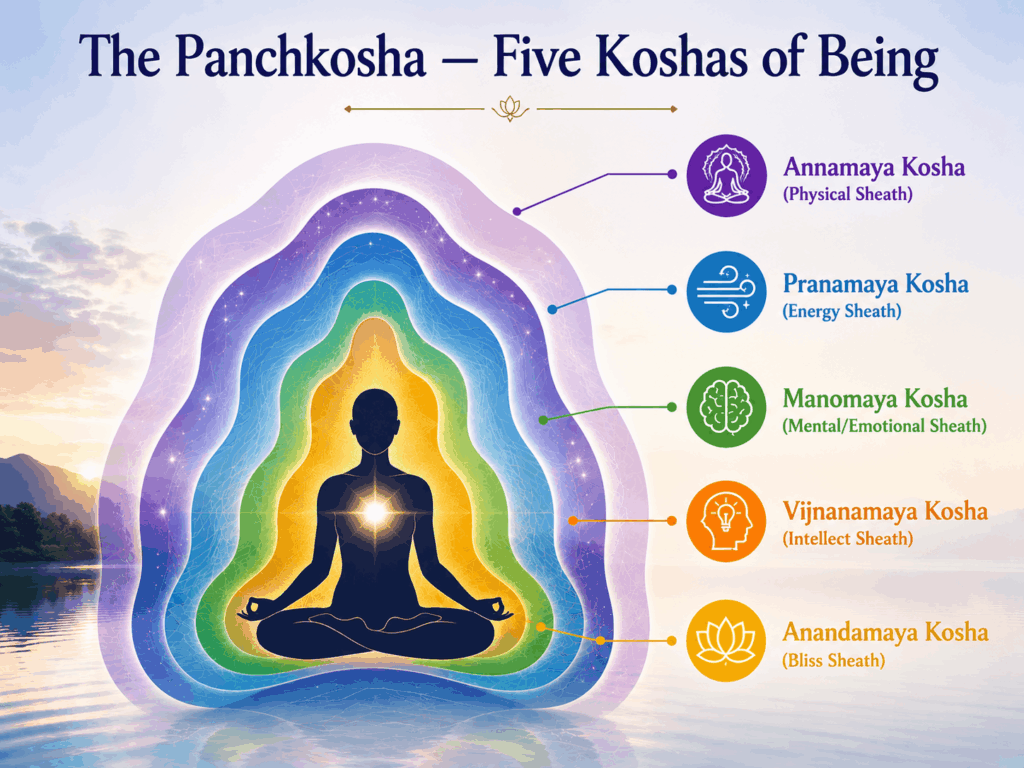
The Taittiriya Upanishad describes the human being not as a single thing but as five nested layers — like Russian dolls, each one subtler than the last — surrounding the Atman, the pure Self at the centre. These five koshas are the territory that the chakras and koshas connection is mapping.
From gross to subtle, they are: the physical body sustained by food, the body of life energy and breath, the mental and emotional body, the layer of higher intellect and wisdom, and finally the bliss body — the subtlest covering closest to pure consciousness. Beyond all five lies the Atman itself — awareness in its original, uncovered nature.
The 7 Chakras — The Doors in the Koshas
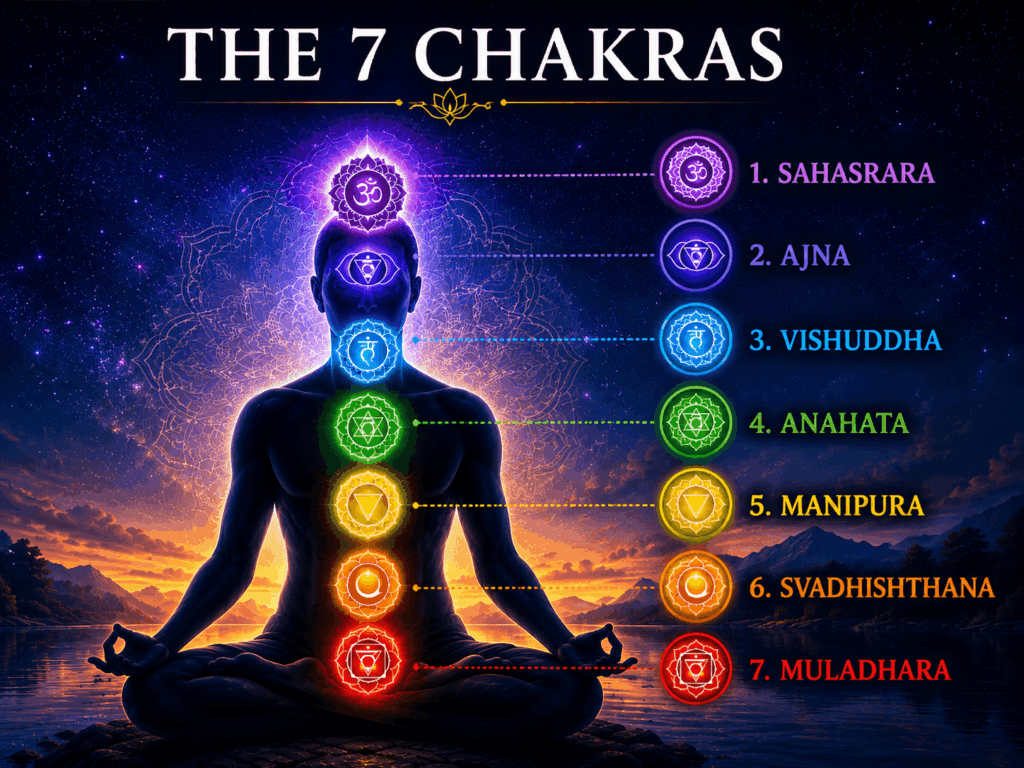
The chakra system from Tantra and Yoga maps seven energy vortices from the base of the spine to the crown of the head. Each one corresponds to a different dimension of human experience — survival, creativity, will, love, expression, insight, and the transcendent.
This is the chakras and koshas connection in its simplest form — the koshas are the floors of the building, and the chakras are the doors between them.
How the Chakras and Koshas Connect — Layer by Layer
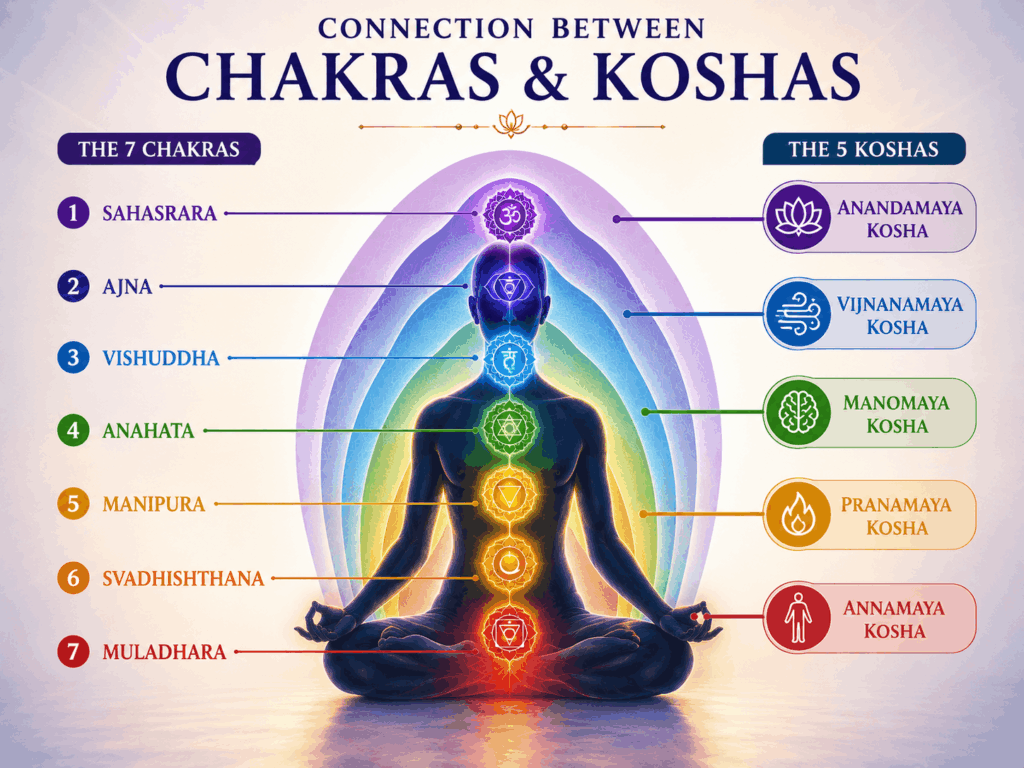
Chakras and Koshas Connection — The Complete Correspondence
Annamaya Kosha — The Physical Body
anna = food · maya = made of
When the root chakra is blocked, the body is the loudest thing in the room. Anxiety, restlessness, physical discomfort — it demands all of consciousness’s attention. When it opens, the physical layer settles and grows quiet. Meditation becomes possible for the first time.
Pranamaya Kosha — The Energy Body
prana = life force · maya = made of
When the root chakra is blocked, the body is the loudest thing in the room. Anxiety, restlessness, physical discomfort — it demands all of consciousness’s attention. When it opens, the physical layer settles and grows quiet. Meditation becomes possible for the first time.
Manomaya Kosha — The Mental Body
manas = mind · maya = made of
This is where most of us live our entire lives — completely identified with the mental-emotional weather. When heart and throat open, unprocessed emotions are finally felt and released. Thoughts still arise in meditation — but they no longer have the same grip. The space between thoughts becomes visible for the first time.
Vijnanamaya Kosha — The Wisdom Body
vijnana = higher knowing · maya = made of
When Ajna opens, something remarkable shifts. You stop just thinking and start genuinely seeing. Thinking is the mind talking to itself. Seeing is awareness observing directly. The Upanishads call this Viveka — the capacity to discriminate between what is real and what is appearing. The witness begins to stand apart.
Anandamaya Kosha — The Bliss Body
ananda = bliss · maya = made of
In deep meditation, you touch this layer as a profound peace — a joy that needs no cause. But here is the paradox the Upanishads point to very carefully: even bliss is still a covering. The Sahasrara opening is not the destination. It is the final dissolution of the separate experiencer — and what remains cannot be named.
Practices for Each Doorway
Understanding the map is one thing. Walking the territory is another. Here are simple, classical practices — one for each layer of the journey.
Root · Muladhara
Ground the Body
- Walk barefoot on earth
- Feel your feet fully
- Physical exercise, especially legs
- Grounding foods
Sacral · Svadhisthana
Allow Flow
- Hip-opening yoga postures
- Creative expression
- Feel emotions rather than suppress
Solar Plexus · Manipura
Build Will
- Kapalabhati breathwork
- Core strengthening
- One small brave action daily
Heart · Anahata
Open to Love
- Loving-kindness meditation
- Bhakti — devotional practices
- Hand on heart, breathe
Throat · Vishuddha
Speak Truth
- Say what is actually true
- Chanting and humming
- Journaling what you cannot say
Third Eye · Ajna
Witness Clearly
- Sit as the witnessing awareness
- Less screen, more silence
- Trataka — gentle candle gazing
Crown · Sahasrara
Simply Be
- Deep meditation and self-inquiry
- Study with genuine curiosity
- No doing, no achieving — just being
The Chakras and Koshas Connection — In Three Lines
The Chakras and Koshas Journey Inward
The Paradox the Upanishads Want You to Know

The deepest teaching
The koshas do not disappear when you see through them. The body still exists. Emotions still arise. Thoughts still come. But they become like clean glass rather than frosted glass.
Consciousness shines through all of them — clearly, without distortion. And then you realize what Indian philosophy has been pointing at all along: you were never inside the koshas. The koshas were always inside you.
This is why the chakras and koshas connection matters beyond theory. The chakras are not decorative energy art. They are the practical mechanism by which the layers of the self become transparent — one by one — until what was always at the centre simply stands revealed.
No effort created it. No practice produced it. Awareness was always there. The work was only ever the removal of what was in the way.
At Last…
You were never inside the koshas.
The koshas were always inside you.
A question to sit with
When you notice yourself feeling emotionally stuck or mentally scattered — which layer of yourself do you think is asking for attention? And what would it mean to actually listen to it?
Explore more wisdom from Vedanta > Vedanta explained simply
Reference and further reading
Taittiriya Upanishad · 2.1–2.5
The Anandavalli section — the primary source for the Panchkosha model. Five sheaths described in sequence from Annamaya to Anandamaya with the Atman at the centre.
Sat-Chakra-Nirupana · 16th century
The most important classical text on the chakra system — sixty verses describing each chakra’s location, qualities, presiding deities and relationship to consciousness.
Yoga Sutras of Patanjali · 1.2
“Yoga is the cessation of the modifications of the mind.” The framework behind the kosha-transparency model — as the mind stills, the layers become progressively clearer.
Mundaka Upanishad · 2.1.4
The image of the Atman as the innermost flame — surrounded by sheaths of progressively grosser matter. The poetic source for the Russian-dolls metaphor used in this blog.

Hina is the founder of BrowsingIndia, a platform dedicated to making Indian philosophy, epics, and consciousness-related ideas accessible to curious readers. A computer engineer by profession, her lifelong passion for Indian scriptures led her to pursue a Master’s in Hindu Studies, and she is currently a PhD research student in the same field. Her writing is grounded in close reading of primary texts and respected scholarly sources.