

If you’ve ever wondered why you feel like a “witness” to your own thoughts — Indian philosophy has a 5,000-year-old answer for you.
Have you ever sat quietly and noticed that there is a part of you that is simply watching — watching your thoughts, watching your emotions, watching your life unfold without getting disturbed?
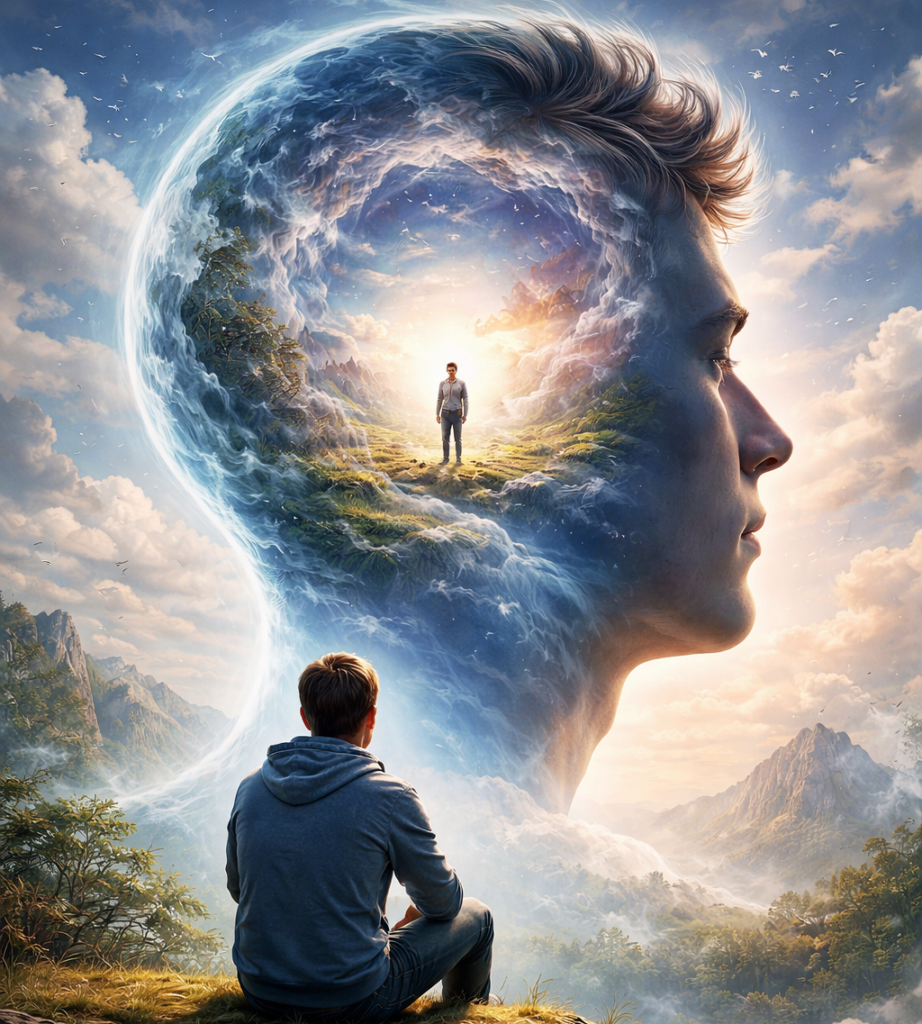
That quiet watcher is exactly what Indian philosophy has been talking about for thousands of years.
In our previous blog, we explored consciousness vs awareness through everyday moments — like zoning out while staring at a wall and then suddenly “coming back.” We saw that awareness keeps the lights on, while consciousness is the one who walks back into the room.
But Indian philosophy takes this understanding to a completely different level.
It doesn’t just explain the difference between consciousness vs awareness — it tells you that understanding this difference is the key to freedom, peace, and knowing who you truly are.
Let’s explore this together — simply, clearly, and without any complicated jargon.
First, A Completely Different Starting Point
Before we go further, here is the most important thing to understand.
Western science asks: “How does the brain produce consciousness?”
Indian philosophy asks something completely opposite: “What if consciousness was never produced at all? What if it is the very source of everything — including the brain?”
This one shift in thinking changes absolutely everything.
In Indian philosophy, consciousness is not something you have. It is something you are. And awareness is the light through which consciousness knows itself.
Let that sink in for a moment.
A Few Simple Sanskrit Words Worth Knowing
Don’t worry — we are not going into a Sanskrit lecture. But knowing just a few words will make everything much clearer as you read ahead.
| Sanskrit Word | Simple Meaning |
| Chit | Pure Consciousness — the knowing quality |
| Chetan | Awareness — being alive and sentient |
| Sakshi | The silent witness inside you |
| Turiya | A state beyond sleep, dream and waking — pure awareness |
| Brahman | The ultimate reality — infinite consciousness |
| Atman | Your individual self or soul |
| Moksha | Liberation — realizing your true nature |
These are not just old religious words. They are precise psychological and philosophical terms that describe real experiences — experiences you may have already had without knowing what to call them.
What the Upanishads Say About Consciousness vs Awareness
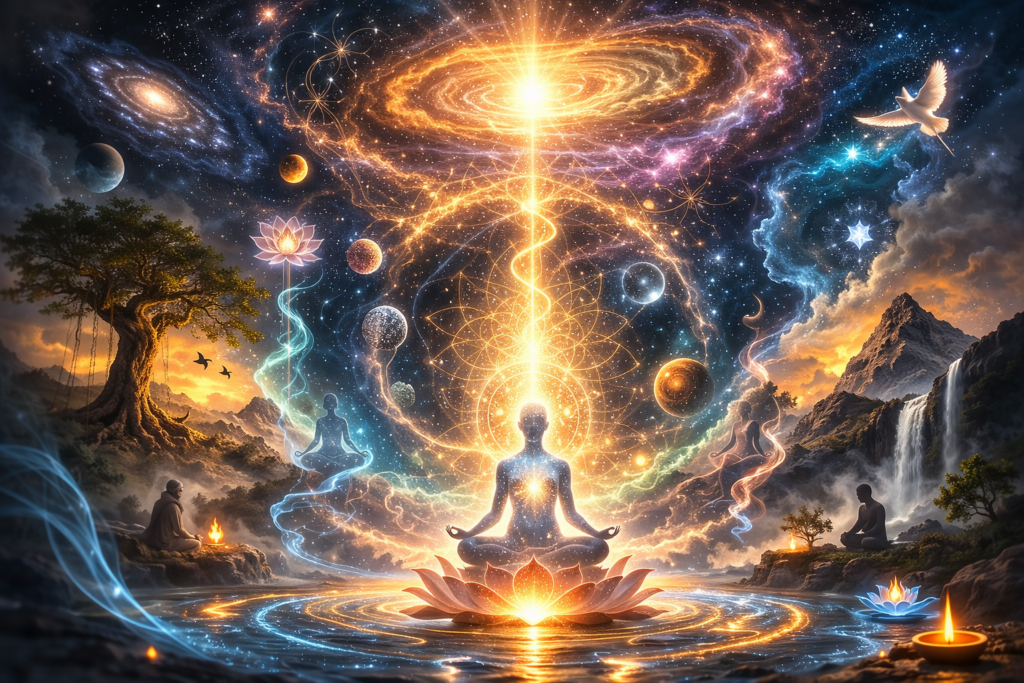
The Upanishads are ancient Indian texts — some over 3,000 years old — and they contain some of the most direct and powerful statements about consciousness ever written.
Here are two of the most famous:
“Prajnanam Brahma” — Consciousness is the ultimate reality. (Aitareya Upanishad)
“Aham Brahmasmi” — I am that infinite consciousness. (Brihadaranyaka Upanishad)
What are they saying in simple language?
They are saying that the consciousness you experience right now — the feeling of “I exist, I am here, I am aware” — is not a small, personal thing locked inside your head.
It is the same consciousness that runs through everything — every living being, every star, every moment of existence.
And your awareness — your ability to notice, to witness, to simply know — is that very consciousness shining through you.
Advaita Vedanta — The Philosophy of Oneness
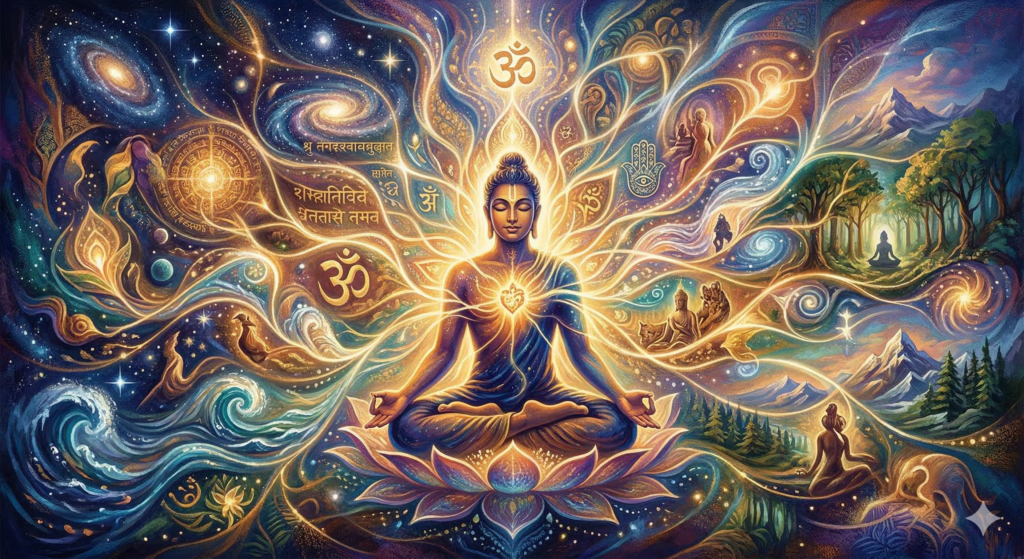
One of the greatest philosophers India ever produced was Adi Shankaracharya, who lived in the 8th century. He taught a philosophy called Advaita Vedanta — which simply means “non-duality” or “no separation.”
His message was beautifully simple:
- Brahman = The infinite, universal consciousness — the only true reality
- Atman = Your individual awareness and sense of self
- The ultimate truth = Atman and Brahman are the same thing
In other words — your awareness and the universal consciousness are not two different things. They just appear different, the same way waves appear different from the ocean — but they are made of the same water.
A Simple Example
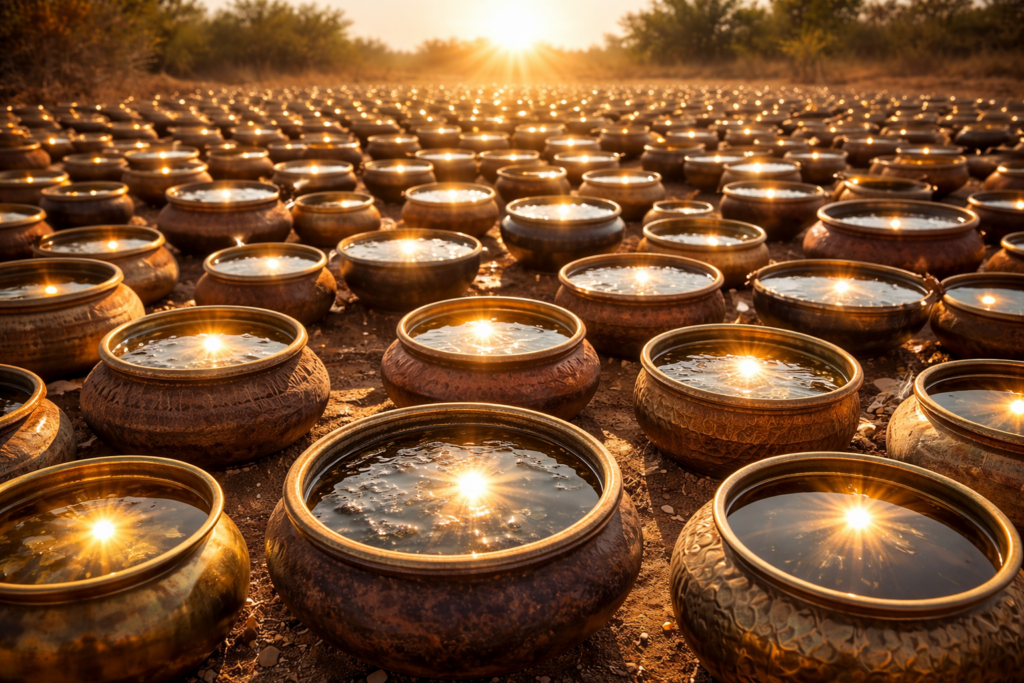
Imagine the sun is shining.
Now imagine thousands of different pots filled with water sitting outside.
Each pot reflects the sun. Each reflection looks like a “different” sun — some big, some small, some clear, some rippled.
But there is only one sun.
In this analogy:
- The sun = Universal consciousness (Brahman)
- Each reflection in a pot = Individual awareness (Atman)
- The water = The individual mind
When the water is still and clear — your awareness is sharp, calm, and clear. When the water is disturbed — your awareness feels confused and scattered.
But the sun — the consciousness — never changed. Not even for a moment.
This is what Advaita Vedanta teaches about consciousness vs awareness.
The Four States of Consciousness — India’s Unique Map
This is where Indian philosophy truly becomes extraordinary. While modern psychology recognizes a few states of mind, the ancient Mandukya Upanishad gave us a precise and detailed map of consciousness — thousands of years ago.
There are four states:
State 1 — Jagrat (The Waking State)
This is where you are right now — reading this blog.
- Your senses are active
- You are aware of the world around you
- Your sense of “I” — your ego and identity — is fully running
- Consciousness and awareness are both engaged with the outside world
This is the most familiar state — but according to Indian philosophy, it is also the most “surface level” state of consciousness.
State 2 — Swapna (The Dream State)
Every night when you dream, you enter this state.
- The outer world disappears completely
- But experience continues — you see, feel, and react to things
- Your mind creates an entire world from within
- Awareness is turned inward rather than outward
Here is something fascinating — in the dream state, you don’t usually know you are dreaming. The dream feels completely real. This is because consciousness is still active — just pointed in a different direction.
State 3 — Sushupti (Deep Dreamless Sleep)
This is the state of deep, dreamless sleep.
- No thoughts, no dreams, no sense of self
- No awareness of the outer or inner world
- Complete stillness and peace
But here is the question Indian philosophy asks: If you were completely unconscious in deep sleep — who noticed the peace? Who woke up and said “I slept so well”?
There must have been something — some quiet, background awareness — that was present even then.
That something is what Indian philosophy calls the Sakshi — the silent witness. And it never sleeps.
State 4 — Turiya (The Fourth State)
This is the most extraordinary state — and the hardest to describe in words.
Turiya literally means “the fourth.” It is not a state you go into and come out of — it is the background of all the other three states. It is always there — like the screen in a cinema that is present whether the movie is playing or not.
In Turiya:
- There is pure, open awareness — with no object
- No thoughts, no sense of “I”, no separation
- Just being — fully, completely, peacefully
This is what great yogis and meditators touch in deep meditation. And according to Indian philosophy, this is your true nature — not the thoughts, not the emotions, not the personality.
Just pure consciousness, aware of itself.
Samkhya Philosophy — Two Principles Behind Everything
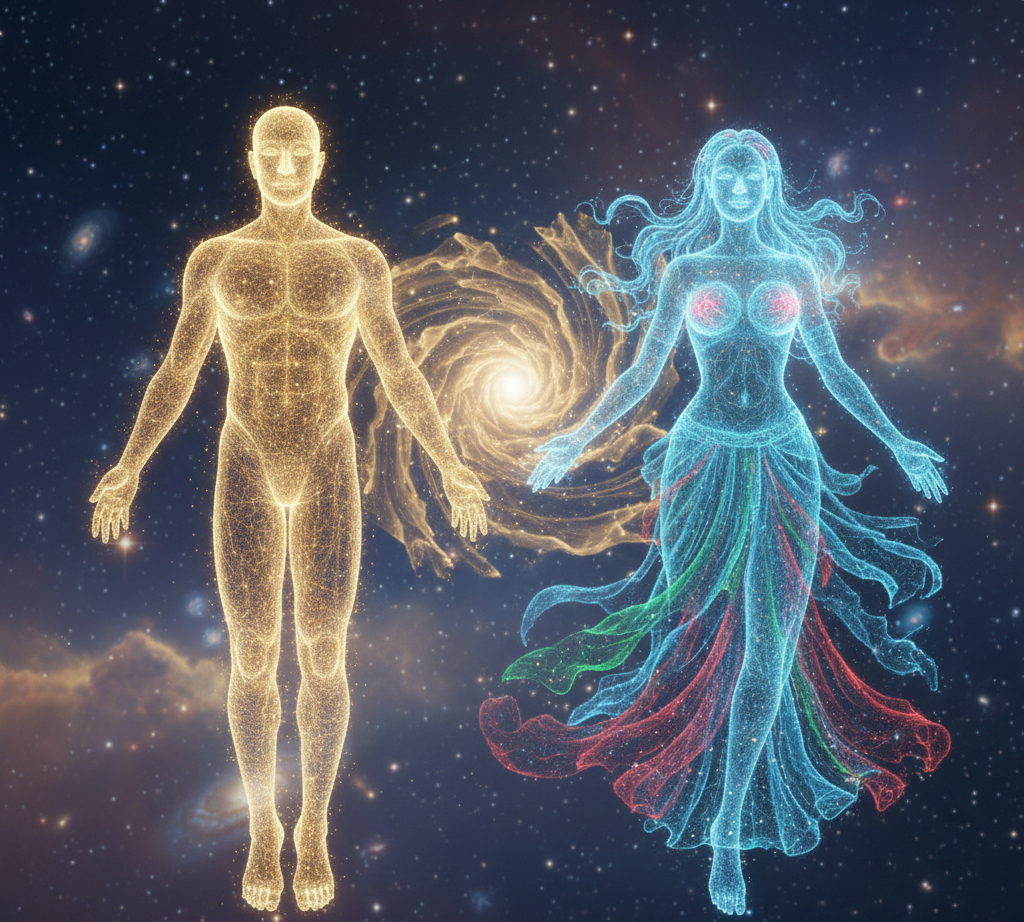
Another ancient Indian school called Samkhya explains consciousness vs awareness in a very interesting way — by dividing all of existence into just two principles:
Purusha — Pure Consciousness
- Silent, still, unchanging
- Just a witness — never acts, never moves
- Like a king sitting on a throne — simply present and aware
Prakriti — Nature and Matter
- Everything that moves, changes, and acts
- Includes your body, your mind, your thoughts, and even your emotions
- Awareness, in this system, belongs to the mind — which is part of Prakriti
The problem — and the cause of all human suffering according to Samkhya — is this:
We confuse Purusha with Prakriti. We mistake the witness for the actor. We think “I am my thoughts, I am my emotions, I am my story” — when in reality, we are the pure consciousness quietly watching all of it.
Liberation, in Samkhya, means clearly seeing the difference — realizing you are Purusha, not the noise of Prakriti.
Sound familiar? This is exactly the consciousness vs awareness distinction — played out on a cosmic scale.
What Buddhism Adds to This Conversation
Buddhism, which also grew from Indian soil, brings a beautiful and slightly different perspective.
The Buddha’s core teaching on consciousness vs awareness can be said simply:
- Most people are aware of their thoughts
- But they are trapped by their thoughts — pulled along, identified, lost in them
- The practice of meditation is learning to be conscious of thoughts without becoming them
In Tibetan Buddhism, this open, clear, knowing quality of mind is called Rigpa — pure awareness. It is described as:
“The sky — vast, open, and unchanged — no matter what clouds pass through it.”
Your thoughts, emotions, fears, and memories are the clouds. You — the awareness — are the sky.
The clouds don’t damage the sky. They just pass through it.
This is the Buddhist contribution to understanding consciousness vs awareness — and it is a teaching that millions of meditators around the world practice every single day.
Kashmir Shaivism — Consciousness Is Playful
There is one more school of Indian philosophy worth mentioning — Kashmir Shaivism, developed by the brilliant philosopher Abhinavagupta around 1,000 years ago.
His teaching is perhaps the most joyful of all:
- Shiva = Pure, infinite consciousness — the ground of all existence
- Shakti = The living, dynamic awareness and energy within consciousness
- The entire universe = Consciousness playing with itself — creating, experiencing, and dissolving — just for the joy of experience
In Kashmir Shaivism, consciousness and awareness are like fire and heat — you cannot separate them. Where there is fire, there is heat. Where there is consciousness, there is awareness.
And you — the person reading this right now — are that fire. You are not a tiny flame in a small body. You are the entire fire, temporarily appearing as a small flame.
So What Does All This Mean For Your Daily Life?
Indian philosophy is never just theory sitting on a library shelf. Every single teaching has a deeply practical side.
Here is what this means for how you actually live:
When you are anxious — Indian philosophy says: you are Prakriti (the mind) believing it is Purusha (the consciousness). Step back. Be the witness. Watch the anxiety without becoming it.
When you feel lost — remember the Advaita teaching: you are the ocean, not the wave. The wave rises and falls. The ocean remains.
When you meditate — you are not trying to achieve a special state. You are simply resting in what you already are — pure awareness, the Sakshi, the witness that has always been there.
When you zone out and “come back” — that little moment of return we talked about in our last blog? Indian philosophy says that is a tiny, spontaneous glimpse of Turiya — your true nature briefly recognizing itself.
The Most Beautiful Summary — Through a Single Story
Imagine a wave in the ocean.
The wave rises up, looks around, and starts to feel very important. It has a shape, a size, a direction. It crashes against other waves. It thinks “I am this wave. This is who I am.”
But one day, the wave looks down — and realizes.
“I am not just a wave. I am made of ocean. I have always been the ocean. The shape was temporary. The water is eternal.”
In this story:
- The wave’s belief that it is separate = ordinary consciousness — the ego-driven “I”
- The wave realizing it is the ocean = pure awareness — Turiya, Brahman, Atman
- The ocean itself = the infinite consciousness that Indian philosophy points to
This moment of the wave realizing it is the ocean — this is what every school of Indian philosophy, in its own language, is pointing toward.
It is called Moksha. Liberation. Awakening.
And according to Indian philosophy — it is not something you achieve. It is something you remember.
In the End…
We started this blog with a simple everyday moment — zoning out and coming back.
Western thinking says: “Oh, your mind wandered. That’s normal.”
Indian philosophy says something far more extraordinary: “That moment of coming back — that snap of awareness returning to itself — that is consciousness recognizing its own nature. That is the universe waking up inside you.”
The difference between consciousness vs awareness, in Indian philosophy, is not just an intellectual idea. It is a lived experience waiting to be discovered — in meditation, in stillness, in those quiet moments when the mind goes silent and something vast and peaceful remains.
That vast, peaceful something?
That is you. The real you. The one that was always there.
“Tat Tvam Asi.” That Thou Art.
You are not searching for consciousness. You are consciousness — searching for itself.

Hina is the founder of BrowsingIndia, a platform dedicated to making Indian philosophy, epics, and consciousness-related ideas accessible to curious readers. A computer engineer by profession, her lifelong passion for Indian scriptures led her to pursue a Master’s in Hindu Studies, and she is currently a PhD research student in the same field. Her writing is grounded in close reading of primary texts and respected scholarly sources.